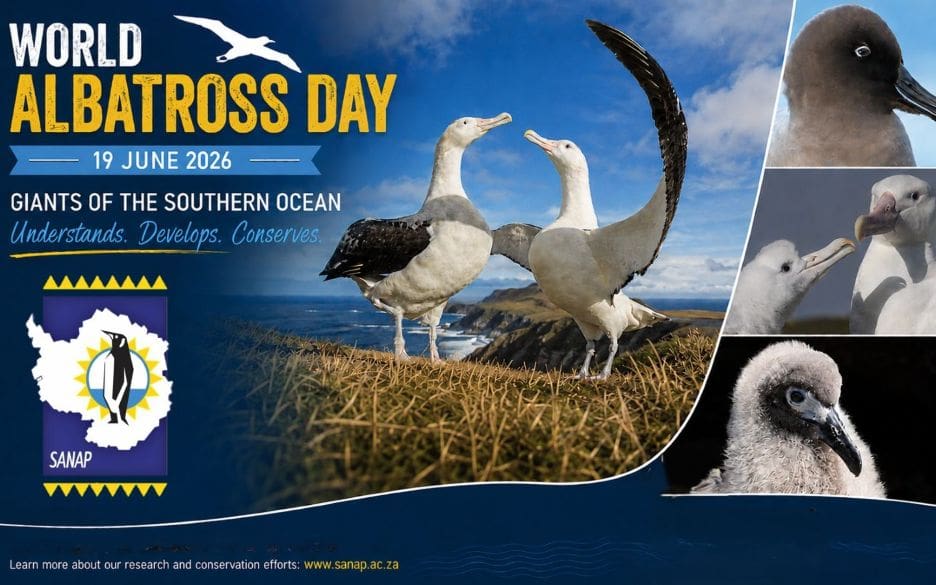
 Every year on 19 June, World Albatross Day raises awareness of one of the world’s most remarkable seabird groups and the challenges they face in an increasingly changing environment. With their extraordinary wingspans, ocean-crossing migrations and critical role in Southern Ocean ecosystems, albatrosses are among the most iconic ambassadors of the Antarctic and sub-Antarctic regions.
 For South Africa, Marion Island in the Prince Edward Islands archipelago is one of the world’s most important breeding sites for albatrosses. The island supports breeding populations of Wandering, Grey-headed, Indian Yellow-nosed, Sooty and Light-mantled Albatrosses, making it a globally significant refuge for these majestic seabirds. Protecting these species is central to the South African National Antarctic Programme’s (SANAP) vision to understand, develop and conserve the Antarctic and Southern Ocean environment for present and future generations.
 Through SANAP-supported research, South African scientists are advancing our understanding of how environmental change is affecting seabirds and the ecosystems on which they depend. Professor Susan Cunningham of the University of Cape Town leads research investigating the on-island impacts of climate change on the Southern Ocean’s iconic seabirds. Her work examines how changing temperatures, rainfall patterns and ecosystem dynamics influence breeding success, behaviour and long-term population trends of seabirds, including albatrosses.
 Complementing this work, Azwianewi Benedict Makhado of the Department of Forestry, Fisheries and the Environment (DFFE) is investigating the interactive effects of multiple stressors and environmental change on seabird breeding performance. This research seeks to understand how climate variability, food availability and other environmental pressures combine to affect breeding success and population resilience in seabird species that depend on the Southern Ocean.
 A major conservation milestone for albatrosses and other seabirds has been the implementation of the Mouse-Free Marion Project. Introduced house mice have caused severe impacts on Marion Island’s bird populations, attacking chicks and threatening the survival of several seabird species, including albatrosses. The ambitious eradication initiative aims to remove invasive mice from the island and restore the ecological balance of this globally important seabird sanctuary. A successful mouse eradication programme will significantly improve breeding success and long-term survival prospects for albatrosses and many other native species.
The conservation of albatrosses extends far beyond Marion Island. These birds spend most of their lives traversing vast oceanic distances, linking continents and ecosystems across the Southern Ocean. Their health and survival provide valuable insights into the condition of marine ecosystems and the impacts of environmental change. On this World Albatross Day, SANAP celebrates the dedication of researchers, conservation practitioners and support teams working to safeguard these magnificent birds. Through science, collaboration and conservation action, SANAP continues to contribute to a future where albatrosses can thrive in healthy Southern Ocean ecosystems.
As we commemorate World Albatross Day 2026, we are reminded that protecting albatrosses means protecting the Southern Ocean itself—an ocean that sustains biodiversity, regulates the global climate and connects us all.