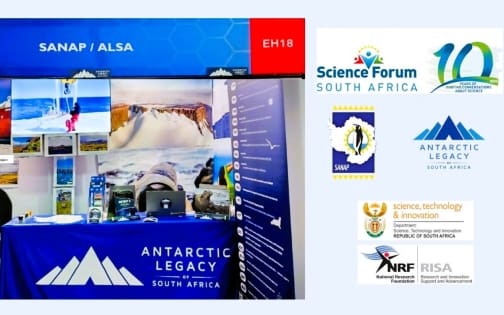
 The Science Forum South Africa (SFSA) 2025 brought together researchers, policy leaders, students, and science enthusiasts from across the globe—and once again, SANAP- ALSA proudly showcased South Africa’s vital role in Antarctic and climate-change research. This year, the Antarctic Legacy of South Africa (ALSA) exhibit drew significant attention from delegates and exhibitors eager to learn more about the scientific, cultural, and environmental contributions South Africa makes in the Antarctic region. ALSA highlighted its mission to preserve, promote, and communicate South Africa’s polar heritage, while also reflecting the essential research being conducted by institutions across the country under SANAP.
 Ministerial Engagement and Public Interaction: We were honoured to welcome the Honorable Minister of Higher Education, Science and Innovation, Dr Blade Nzimande, to the ALSA exhibition. During his visit, he participated in an interview with SABC at the ALSA stall and added his fingerprint to a large map of Antarctica—a symbolic gesture celebrating South Africa’s commitment to protecting the region. The full fingerprint map, once completed by visitors during SFSA, will be delivered to the Minister.
 Many attendees followed suit, placing their fingerprints on Antarctica maps to show solidarity in protecting the polar environment. This interactive activity reminded visitors of the fragility of polar ecosystems and the importance of ongoing conservation and research.
 Delegates also enjoyed creating their own Antarctic animal-themed badges—an engaging way to spark conversation about biodiversity in the Southern Ocean and sub-Antarctic islands.
 Showcasing SANAP Research: Among the highlights of the SANAP presence was the showcase by Prof Michelle Greve and Nicola Marnewick representing the Marion Island mouSe Ecology (MISE) Project. Their exhibit included research photographs, a project banner, and lively discussions with attendees about the ecological impacts of invasive house mice on Marion Island and ongoing efforts to understand and mitigate these effects.
Highlighting South Africa’s Contributions to Polar Science: SANAP supports a wide array of multidisciplinary research projects aimed at understanding the Antarctic, the sub-Antarctic, and the Southern Ocean. During SFSA 2025, we highlighted several active research programmes across South Africa’s leading institutions, these projects collectively demonstrate South Africa’s leadership in understanding climate change, marine ecosystems, glaciology, atmospheric science, biodiversity, and Earth systems—research essential to global climate policy and scientific preparedness.:
- SEAmester – South Africa’s Floating University
- SA Agulhas II – Flagship for Vessel (4.0) – Part II
- On-island impacts of climate change on the Southern Ocean’s iconic seabirds
- The biological carbon pump in a changing Southern Ocean
- Micronutrient and pollutant trace elements at the air-sea interface of the Southern Ocean
- Crustal evolution of Dronning Maud Land
- Marion Island mouSe Ecology (MISE)
- Ecogenomics
- SANAE HF radar
- South African Antarctic Artists and Writers Programme (AWP) Pilot
- Polar Space Weather Studies
- Interactive effects of multiple stressors and environmental change on seabird breeding performance
- Decoding the mercury cycle in the Southern Ocean: in situ observations and advanced modeling
- Landscape and Climate Interactions in the sub-Antarctic
- Marion Island Top Predator Long-Term Observations
- Southern Ocean Carbon-Heat Nexus: mixed-layer processes & feedbacks for improved climate projections
- Growth dynamics of sea ice and how they affect sea-ice mechanics
- ECOSOPHY – Emergent constraints on Southern Ocean phytoplankton physiology
- Structural Glaciological Analysis of North-Western Antarctic Ice Shelf (SANAS)
- Provenance and paleomagnetics of the rocks of the Grunehogna Craton in Western Dronning Maud Land
- Antarctic MIZ Observations: interdisciplinary approaches to resolve seasonal sea-ice variability
Acknowledgements: We extend our sincere thanks to all visitors, partners, collaborators, and supporters who stopped by the ALSA exhibit. Your interest and engagement help strengthen South Africa’s ongoing commitment to polar science. Thank you to DSTI and NRF making the exhibit possible.