by Ria Olivier | Jan 30, 2026 | Announcement, Jobs, Marion Island, News, Overwintering Team, Research, SANAP, Science, Southern Ocean, Stations, sub-Antarctic, Team member
 Applications are still open for the following positions on the sub-Antarctic, Marion Island for the overwintering period (April 2026 to May 2027)
Communications Engineer Diesel Mechanic Electrical Engineer Medical Orderly
Closing Date: 09 February 2026
The incumbent will execute duties at a Sub/Antarctic Base and adhere to the health, safety and environmental requirements. The successful applicant will spend a full year (April 2026 to May 2027) at Marion Island. There is no option to return to South Africa before May 2027. The ability to work and live with small groups of people is thus essential. Although the base is well-equipped with e-mail, fax and satellite telephone facilities, the applicant must be self-sufficient and self-motivated.
by Ria Olivier | Dec 19, 2025 | Uncategorised
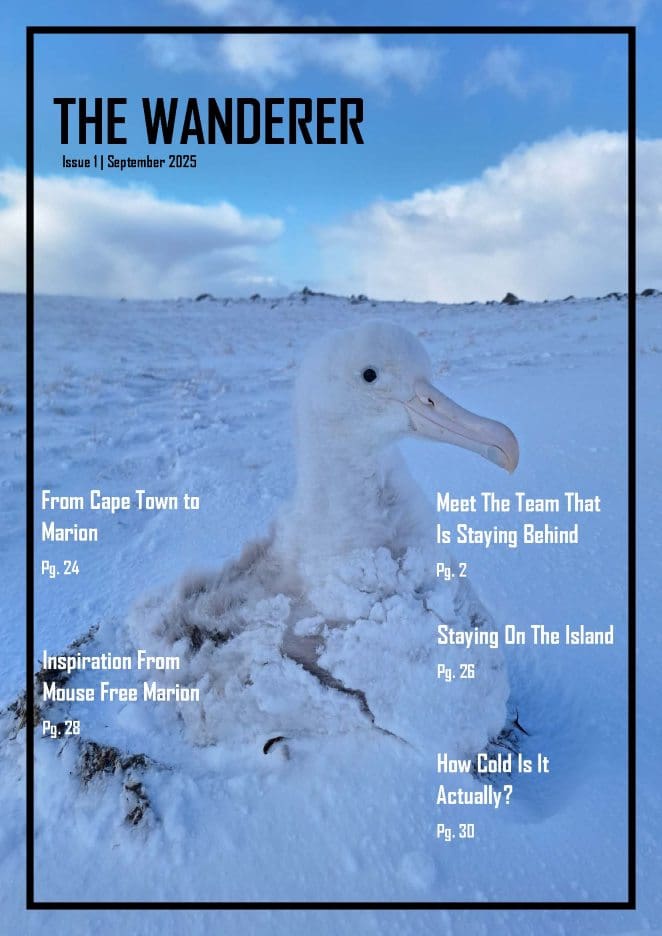
The Marion 82 Overwintering Team newsletter is now available. Based on Marion Island as part of the South African National Antarctic Programme (SANAP), the Marion 82 team shares a vivid snapshot of life and work on the island.
This edition features a warm welcome and introduction from Mndeni Hlatshwayo (Team Leader & Medical Orderly) and Andile Kuzwayo (Editor-in-Chief), followed by a “Meet the Team” section introducing the overwintering members. Richly illustrated with striking photographs, the newsletter also highlights the team’s daily activities, captures the unique island environment, and presents insightful weather statistics that reflect the challenging conditions of Marion Island. Together, these stories offer an engaging look at the people, science, and experiences shaping the Marion 82 overwintering year.
Download Newsletter here
by Ria Olivier | Dec 15, 2025 | Uncategorised
The South African National Antarctic Programme (SANAP) is proud to announce a striking new science–art installation on Cape Town’s iconic Sea Point Promenade: “Pole to Promenade”, a public photo exhibition, alongside “Drifters: The Invisible Forest”, a vibrant mural celebrating the unseen world of phytoplankton. Together, these installations transform one of South Africa’s most visited public spaces into an open-air gateway to the Southern Ocean and Antarctic region.
This Science–Art project was initiated by Dr Sandy Thomalla, Research Group Leader of the Southern Ocean Carbon–Climate Observatory (SOCCO) at the CSIR, and realised in collaboration with Ria Olivier of the Antarctic Legacy of South Africa (Stellenbosch University). It reflects SANAP’s commitment not only to world-class polar research, but also to sharing that knowledge widely — beyond academic journals and into everyday life.
Art as a Bridge to Science: Art has a unique power: it invites people to pause, to look closely, and to feel curious. In that moment of engagement, complex scientific ideas can become accessible, memorable, and meaningful. Much of SANAP’s work takes place in remote, extreme environments that most people will never experience first-hand. Through creative expression, art becomes a bridge between science and society — translating data, models, and observations into stories that resonate emotionally. Globally, arts and culture are increasingly recognised as essential partners in science communication, particularly in areas such as climate change and ocean literacy. By combining visual art, imagery, and storytelling, Pole to Promenade aims to deepen public understanding of why polar research matters, why national investment in this work is vital, and how the Antarctic region and Southern Ocean are tightly connected to everyday life in South Africa.
Drifters: The Invisible Forest: At the heart of the installation is Drifters: The Invisible Forest, a large-scale mural painted by Cape Town artist Joh Del on one of the Sea Point promenade’s ablution blocks. The mural celebrates phytoplankton — microscopic, single-celled organisms that drift through the sunlit surface of the ocean. Though invisible to the naked eye, phytoplankton are foundational to life on Earth. Like plants on land, they photosynthesise, forming the base of marine food webs. They are responsible for producing roughly half of the oxygen we breathe and play a critical role in regulating Earth’s climate by absorbing vast amounts of carbon dioxide through the biological carbon pump. Their seasonal blooms drive ocean productivity, influence global carbon cycles, and ultimately support marine ecosystems and human food security. Structurally diverse and visually striking, phytoplankton are also unexpectedly beautiful. The mural brings this hidden world to life through flowing forms and vivid colour, inviting passers-by to appreciate both the aesthetic wonder and ecological importance of these tiny ocean drifters.
Pole to Promenade: An Outdoor Image Exhibition – Alongside the mural, the Pole to Promenade image exhibition features more than 20 powerful photographs and data visualisations captured by South African polar researchers. These images offer a rare glimpse into the remote and fragile environments of the Southern Ocean and Antarctic region — places central to global climate regulation, yet far removed from daily experience. The exhibition blends field photography, satellite imagery, microscopic views, and creative data visualisations to showcase the breadth of SANAP-supported research. Together, the images highlight South Africa’s long-standing leadership in polar science and underscore the importance of sustained research in understanding climate change, ocean processes, and Earth system dynamics. A huge thank you to all the contributors of these images
As Dr Sandy Thomalla writes: “The Sea Point Promenade in Cape Town has become a portal to the Southern Ocean, thanks to a new science–art installation celebrating South Africa’s leadership in polar research.”
A Living, Learning Space for All – Both installations will remain on the Sea Point Promenade for at least two years, creating a free, open-access encounter with polar science for locals and visitors alike. With more than a million people visiting the promenade each year, the site offers a rare opportunity to reach audiences from all walks of life — outside the walls of museums, galleries, or universities. An official launch is planned for early 2026, which will include a dedicated workshop with learners from schools across the Western Cape, reinforcing SANAP’s commitment to education, inspiration, and the next generation of scientists. In the meantime, SANAP warmly invites the public to explore the installations, engage with the stories they tell, and learn more about South Africa’s vital role in Antarctic and Southern Ocean research.
Why It Matters – The Southern Ocean absorbs around 50% of the ocean’s carbon dioxide uptake and 75% of the excess heat generated by human activities, acting as a crucial buffer against climate change. Understanding how this system works — and how it is changing — is central to SANAP’s mission. By bringing this science into public spaces through art, Pole to Promenade helps foster awareness, appreciation, and care for our shared environment.
CLICK HERE for more information on the project
We invite everyone walking the promenade to pause, look closer, and let this journey from the Pole to the Promenade spark curiosity about our planet — and South Africa’s role in protecting its future.
by Ria Olivier | Dec 5, 2025 | Legacy, Research, SANAP, SANAP Student, Science
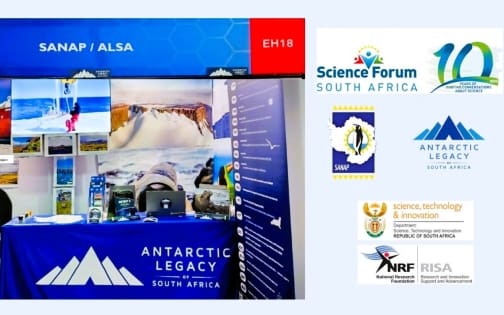
The Science Forum South Africa (SFSA) 2025 brought together researchers, policy leaders, students, and science enthusiasts from across the globe—and once again, SANAP- ALSA proudly showcased South Africa’s vital role in Antarctic and climate-change research. This year, the Antarctic Legacy of South Africa (ALSA) exhibit drew significant attention from delegates and exhibitors eager to learn more about the scientific, cultural, and environmental contributions South Africa makes in the Antarctic region. ALSA highlighted its mission to preserve, promote, and communicate South Africa’s polar heritage, while also reflecting the essential research being conducted by institutions across the country under SANAP.
Ministerial Engagement and Public Interaction: We were honoured to welcome the Honorable Minister of Higher Education, Science and Innovation, Dr Blade Nzimande, to the ALSA exhibition. During his visit, he participated in an interview with SABC at the ALSA stall and added his fingerprint to a large map of Antarctica—a symbolic gesture celebrating South Africa’s commitment to protecting the region. The full fingerprint map, once completed by visitors during SFSA, will be delivered to the Minister.
Many attendees followed suit, placing their fingerprints on Antarctica maps to show solidarity in protecting the polar environment. This interactive activity reminded visitors of the fragility of polar ecosystems and the importance of ongoing conservation and research.
Delegates also enjoyed creating their own Antarctic animal-themed badges—an engaging way to spark conversation about biodiversity in the Southern Ocean and sub-Antarctic islands.
Showcasing SANAP Research: Among the highlights of the SANAP presence was the showcase by Prof Michelle Greve and Nicola Marnewick representing the Marion Island mouSe Ecology (MISE) Project. Their exhibit included research photographs, a project banner, and lively discussions with attendees about the ecological impacts of invasive house mice on Marion Island and ongoing efforts to understand and mitigate these effects.
Highlighting South Africa’s Contributions to Polar Science: SANAP supports a wide array of multidisciplinary research projects aimed at understanding the Antarctic, the sub-Antarctic, and the Southern Ocean. During SFSA 2025, we highlighted several active research programmes across South Africa’s leading institutions, these projects collectively demonstrate South Africa’s leadership in understanding climate change, marine ecosystems, glaciology, atmospheric science, biodiversity, and Earth systems—research essential to global climate policy and scientific preparedness.:
- SEAmester – South Africa’s Floating University
- SA Agulhas II – Flagship for Vessel (4.0) – Part II
- On-island impacts of climate change on the Southern Ocean’s iconic seabirds
- The biological carbon pump in a changing Southern Ocean
- Micronutrient and pollutant trace elements at the air-sea interface of the Southern Ocean
- Crustal evolution of Dronning Maud Land
- Marion Island mouSe Ecology (MISE)
- Ecogenomics
- SANAE HF radar
- South African Antarctic Artists and Writers Programme (AWP) Pilot
- Polar Space Weather Studies
- Interactive effects of multiple stressors and environmental change on seabird breeding performance
- Decoding the mercury cycle in the Southern Ocean: in situ observations and advanced modeling
- Landscape and Climate Interactions in the sub-Antarctic
- Marion Island Top Predator Long-Term Observations
- Southern Ocean Carbon-Heat Nexus: mixed-layer processes & feedbacks for improved climate projections
- Growth dynamics of sea ice and how they affect sea-ice mechanics
- ECOSOPHY – Emergent constraints on Southern Ocean phytoplankton physiology
- Structural Glaciological Analysis of North-Western Antarctic Ice Shelf (SANAS)
- Provenance and paleomagnetics of the rocks of the Grunehogna Craton in Western Dronning Maud Land
- Antarctic MIZ Observations: interdisciplinary approaches to resolve seasonal sea-ice variability
Acknowledgements: We extend our sincere thanks to all visitors, partners, collaborators, and supporters who stopped by the ALSA exhibit. Your interest and engagement help strengthen South Africa’s ongoing commitment to polar science. Thank you to DSTI and NRF making the exhibit possible.
SANAP remains dedicated to advancing research, supporting our scientists, and preserving our legacy in the Antarctic region.
by Ria Olivier | Dec 5, 2025 | Announcement, Marion Island, Prince Edward Island, Prince Edward Islands
CLOSING DATE: Monday 26 January 2026
Consultation on the intention to adopt a generic environmental management programme and exclude identified activities associated with conservation or conservation research at THE PRINCE EDWARD ISLANDS, for public comment.
The Minister of Forestry, Fisheries and the Environment is hereby consulting on the intention to adopt a Generic Environmental Management Programme for Conservation or Conservation Research at the Prince Edward Islands (revision 0 of 2025) (GEMPr) as an environmental management instrument in terms of the Regulations Laying Down the Procedure for the Adoption of Environmental Management Instruments, 2019, read with section 24(5)(bA) of the National Environmental Management Act, 1998, (Act No. 107 of 1998) (NEMA) and based on compliance with this environmental management instrument to, in terms of section 24(2)(e) of the NEMA, exclude activities identified in terms of section 24(2)(a) and (b) from the requirement to obtain an environmental authorisation.
Only conservation or conservation research currently takes place at the Prince Edward Islands, some of which may require environmental authorisation for activities identified in terms of sections 24(2)(a) and (b) of the NEMA prior to commencement thereof. The GEMPr stipulates appropriate measures to avoid, manage and/or mitigate potential environmental impacts and risks associated with the implementation of identified activities. The exclusion of identfied activities will be applicable to conservation or conservation research only, subject to compliance with the Government Notice and Schedule and the relevant requirements of the GEMPr, which includes the requirement to register any such exclusions.
Members of the public are invited to submit written comments or input within 30 days from the date of the publication of the Notice in the Government Gazette or the publication of the newspaper notice, whichever occurs last. Should the 30-day comment period overlap with the period from 15 December 2025 to 5 January 2026, this period will be excluded from the reckoning of days.
Comments may be submitted by post to the Director-General of the Department of Forestry, Fisheries and the Environment for the attention of A Gabriel, at Private Bag X447, Pretoria, 0001; or by e-mail at agabriel@dffe.gov.za. Comments or inputs received after the public comment period may not be considered.
The Government Notice is accessible on the website of the Department – CLICK HERE
GEMPr is accessible at DFFE – CLICK HERE
Any inquiries in connection with the Notice can be directed to Alvan Gabriel at agabriel@dffe.gov.za (Cell: 066 081 9554).
For communications or media enquiries, kindly contact Mr Zolile Nqayi: Acting Chief Director Communications and Advocacy on Cell: 083 898 6483 I Tel: 021 4937144 Email: znqayi@dffe.gov.za
The Department of Forestry, Fisheries and the Environment complies with the Protection of Personal Information Act, 2013 (Act No. 4 of 2013). Comments received and responses thereto are collated into a comments and response report which will be made available to the public as part of the consultation process. If a commenting party has any objection to his or her name, or the name of the represented company/organisation, being made publicly available in the comments and responses report, such objection should be highlighted in bold as part of the comments submitted.
TEXT from PUBLIC NOTICE: ISSUED BY THE DEPARTMENT OF FORESTRY, FISHERIES AND THE ENVIRONMENT.


 This edition features a warm welcome and introduction from Mndeni Hlatshwayo (Team Leader & Medical Orderly) and Andile Kuzwayo (Editor-in-Chief), followed by a “Meet the Team” section introducing the overwintering members. Richly illustrated with striking photographs, the newsletter also highlights the team’s daily activities, captures the unique island environment, and presents insightful weather statistics that reflect the challenging conditions of Marion Island. Together, these stories offer an engaging look at the people, science, and experiences shaping the Marion 82 overwintering year.

 Drifters: The Invisible Forest: At the heart of the installation is Drifters: The Invisible Forest, a large-scale mural painted by Cape Town artist Joh Del on one of the Sea Point promenade’s ablution blocks. The mural celebrates phytoplankton — microscopic, single-celled organisms that drift through the sunlit surface of the ocean. Though invisible to the naked eye, phytoplankton are foundational to life on Earth. Like plants on land, they photosynthesise, forming the base of marine food webs. They are responsible for producing roughly half of the oxygen we breathe and play a critical role in regulating Earth’s climate by absorbing vast amounts of carbon dioxide through the biological carbon pump. Their seasonal blooms drive ocean productivity, influence global carbon cycles, and ultimately support marine ecosystems and human food security. Structurally diverse and visually striking, phytoplankton are also unexpectedly beautiful. The mural brings this hidden world to life through flowing forms and vivid colour, inviting passers-by to appreciate both the aesthetic wonder and ecological importance of these tiny ocean drifters.
 Pole to Promenade: An Outdoor Image Exhibition – Alongside the mural, the Pole to Promenade image exhibition features more than 20 powerful photographs and data visualisations captured by South African polar researchers. These images offer a rare glimpse into the remote and fragile environments of the Southern Ocean and Antarctic region — places central to global climate regulation, yet far removed from daily experience. The exhibition blends field photography, satellite imagery, microscopic views, and creative data visualisations to showcase the breadth of SANAP-supported research. Together, the images highlight South Africa’s long-standing leadership in polar science and underscore the importance of sustained research in understanding climate change, ocean processes, and Earth system dynamics. A huge thank you to all the contributors of these images
 The Science Forum South Africa (SFSA) 2025 brought together researchers, policy leaders, students, and science enthusiasts from across the globe—and once again, SANAP- ALSA proudly showcased South Africa’s vital role in Antarctic and climate-change research. This year, the Antarctic Legacy of South Africa (ALSA) exhibit drew significant attention from delegates and exhibitors eager to learn more about the scientific, cultural, and environmental contributions South Africa makes in the Antarctic region. ALSA highlighted its mission to preserve, promote, and communicate South Africa’s polar heritage, while also reflecting the essential research being conducted by institutions across the country under SANAP.
 Ministerial Engagement and Public Interaction: We were honoured to welcome the Honorable Minister of Higher Education, Science and Innovation, Dr Blade Nzimande, to the ALSA exhibition. During his visit, he participated in an interview with SABC at the ALSA stall and added his fingerprint to a large map of Antarctica—a symbolic gesture celebrating South Africa’s commitment to protecting the region. The full fingerprint map, once completed by visitors during SFSA, will be delivered to the Minister.
 Many attendees followed suit, placing their fingerprints on Antarctica maps to show solidarity in protecting the polar environment. This interactive activity reminded visitors of the fragility of polar ecosystems and the importance of ongoing conservation and research.
 Delegates also enjoyed creating their own Antarctic animal-themed badges—an engaging way to spark conversation about biodiversity in the Southern Ocean and sub-Antarctic islands.
 Showcasing SANAP Research: Among the highlights of the SANAP presence was the showcase by Prof Michelle Greve and Nicola Marnewick representing the Marion Island mouSe Ecology (MISE) Project. Their exhibit included research photographs, a project banner, and lively discussions with attendees about the ecological impacts of invasive house mice on Marion Island and ongoing efforts to understand and mitigate these effects.
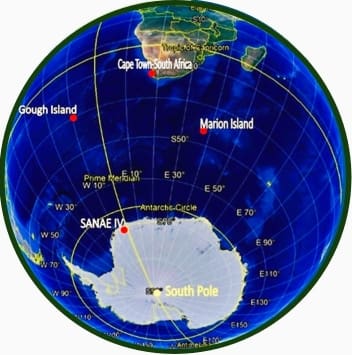 Consultation on the intention to adopt a generic environmental management programme and exclude identified activities associated with conservation or conservation research at THE PRINCE EDWARD ISLANDS, for public comment.
  Only conservation or conservation research currently takes place at the Prince Edward Islands, some of which may require environmental authorisation for activities identified in terms of sections 24(2)(a) and (b) of the NEMA prior to commencement thereof. The GEMPr stipulates appropriate measures to avoid, manage and/or mitigate potential environmental impacts and risks associated with the implementation of identified activities. The exclusion of identfied activities will be applicable to conservation or conservation research only, subject to compliance with the Government Notice and Schedule and the relevant requirements of the GEMPr, which includes the requirement to register any such exclusions.
 Members of the public are invited to submit written comments or input within 30 days from the date of the publication of the Notice in the Government Gazette or the publication of the newspaper notice, whichever occurs last. Should the 30-day comment period overlap with the period from 15 December 2025 to 5 January 2026, this period will be excluded from the reckoning of days.
 TEXT from PUBLIC NOTICE: ISSUED BY THE DEPARTMENT OF FORESTRY, FISHERIES AND THE ENVIRONMENT.