by Ria Olivier | Feb 5, 2020 | Announcement, Current Event, Fellowship, SA Agulhas II, SEAmester, Southern Ocean, Uncategorised
CLOSING DATE extended to 13 MARCH 2020
DOWNLOAD APPLICATION FORMS
SEAmester – South Africa’s Class Afloat aims to introduce marine science as an applied and cross-disciplinary field to students who have shown an affinity for core science disciplines. It will combine traditional class-room lectures with hands-on ship-based deck activities for a maximum of 46 students; while providing them with an opportunity to support specialist scientists in recognised marine research activities. Our research group comprises of over 30 oceanographic, fisheries, biogeochemical and biological experts, who jointly have trained over 600 Southern African students on-board a wide variety of international and local research vessels. read more at SEAmester website
How do I qualify?
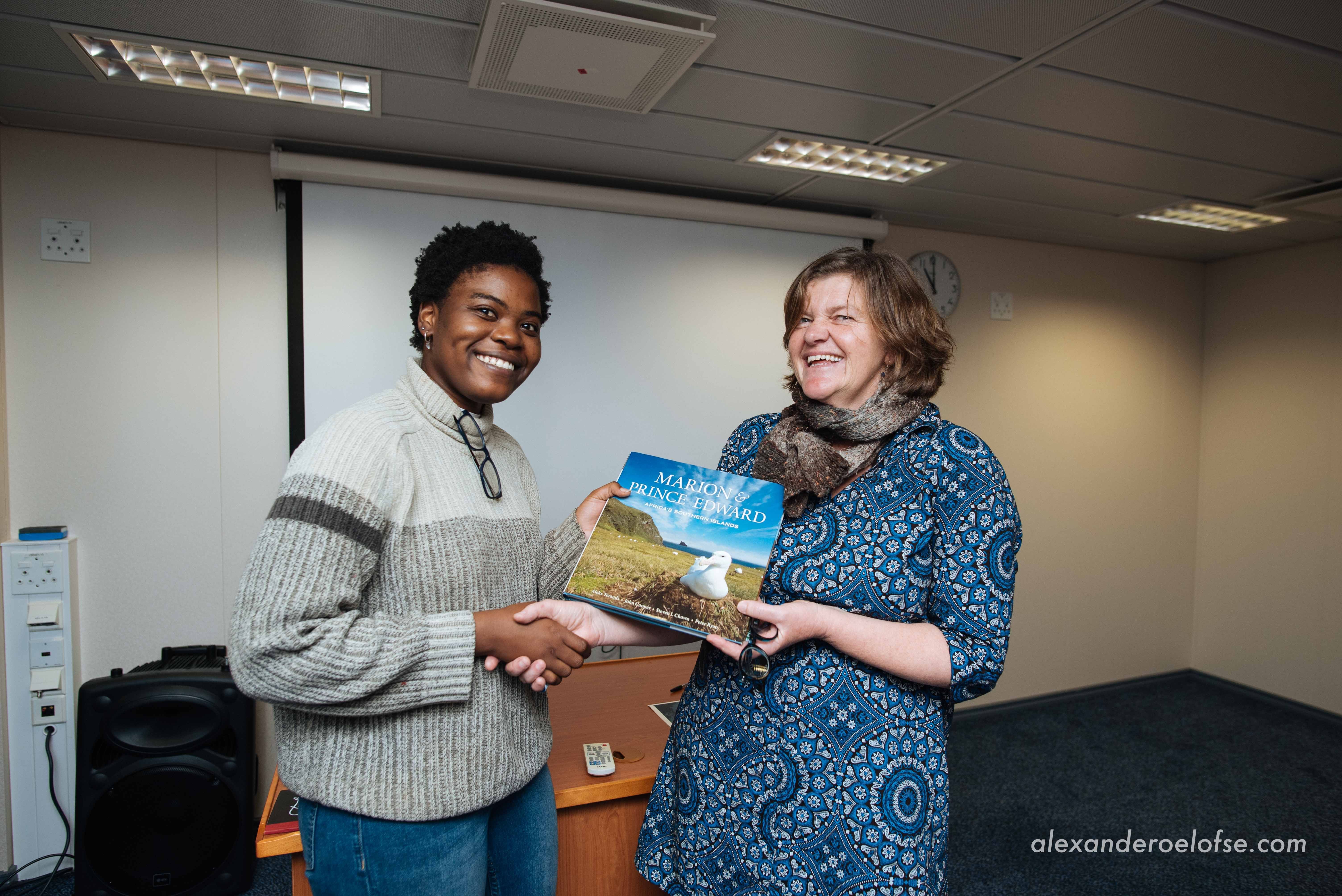
A maximum of 46 post-graduate (Honours/BTech, MSc/MTech, PhD and Interns) University and Technikon students will be selected nationwide. Applications will be accepted from currently registered post-graduate students with a background in marine or similar sciences. Past sea-going experience is not compulsory. Left: Rudzanie Silima best Student SEAmester 2019 with Prof Isabelle Ansorge of UCT
What ship will SEAmester take place on?
The new South African polar research vessel SA Agulhas II will be used for SEAmester V. The SA Agulhas II is a state-of-the-art icebreaker and is fully equipped for all marine research activities. To find out more go to https://www.sanap.ac.za/
What will it cost me?
Nothing. SEAmester is fully funded through the Departments of Science and Technology (DST) and Environmental Affairs (DEA). All board and lodging onboard the SA Agulhas II will be provided free of charge through SEAmester.
What research will SEAmester be involved in??
SEAmester will run in parallel to the scientific objectives of the Agulhas System Climate Array (ASCA) spearheaded by DSTs SAEON Egagasini node. ASCA is a multi-institutional, international collaboration and designed to provide the first long-term observations of Agulhas Current volume, heat and salt transport and its variability from seasonal to interannual timescales. ASCA’s objectives are to determine how the Agulhas Current and its role in the global conveyor belt varies over time. To find out more go to http://asca.dirisa.org
Listening for mammal sounds.
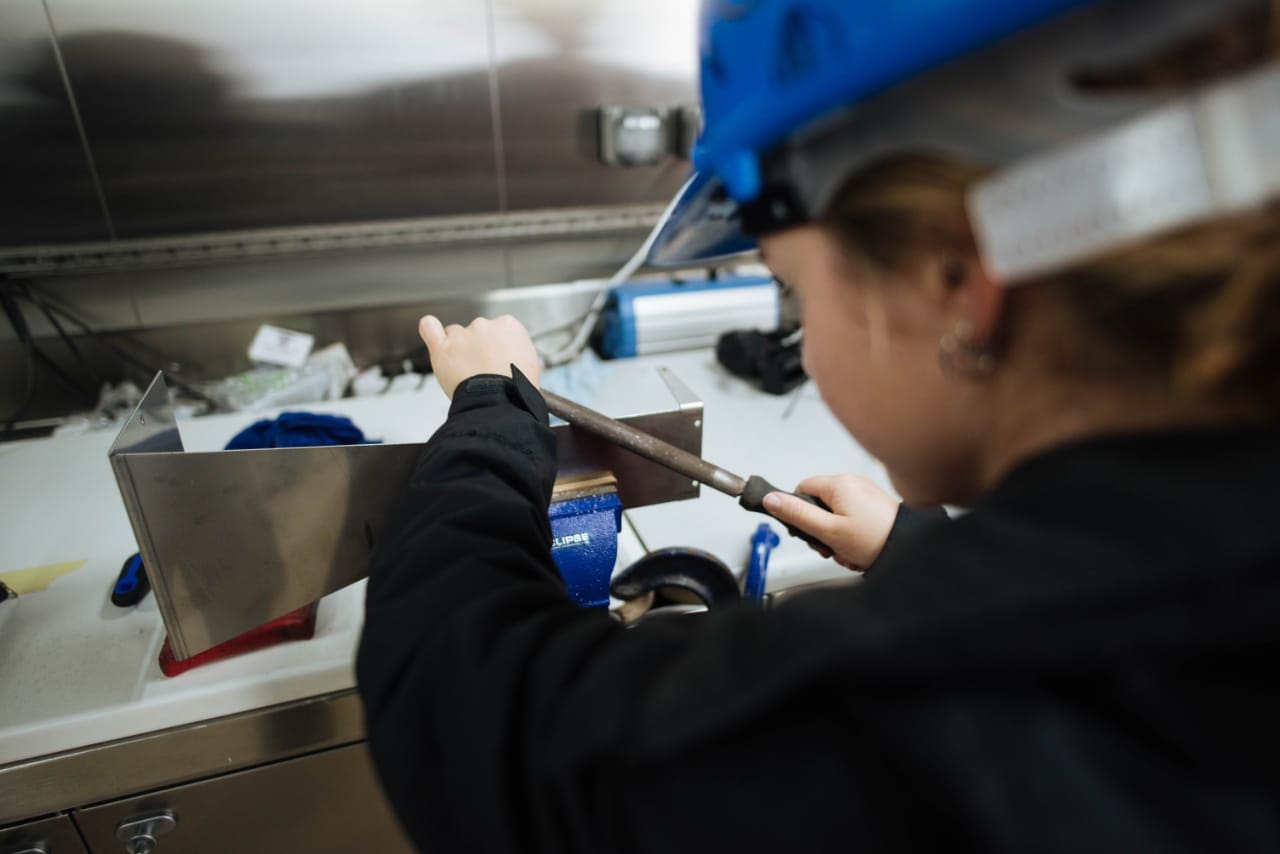
Working on their Aghulus bottle opener in the practical session.
What will be expected from me?
You will be expected to choose one of two module steams – either Tools of the Trade or Oceans in a Changing World (see overleaf). Learning will comprise of daily class-room lectures, daily assignments and deck work – running in parallel to the ASCA programme. Students from both streams will also provide research support to specialist scientists and obtain daily hands-on deck training, data collection, sampling and data analysis. Each student will gain experience working with the full suite of oceanographic, atmospheric and biological ship-based instrumentation such as CTD, underway measurements and autonomous devices such as Argo, SVP drifters as well as gain experience on all biological net tows. Training on data analysis following each deployment will be given, as well as technical and electronic experience in calibrating, assembling and modifying each instrument. In addition, each student will work on a specific scientific mini-project related to their area of interest and the scientific research underway.
What are the tentative dates for SEAmester?
SEAmester will depart on the 13th July returning to Cape Town on the 24th July 2020. Travel arrangements and costs will be made through the SEAmester programme for all students residing outside of the Western Cape. PLEASE NOTE: Applicants to be aware that the cruise dates may be subject to change by a few days.
What travel documentation must I have?
SEAmester will be working outside of South African waters and therefore all participants are requested to have a valid passport. SAMSA approved medicals will be required and costs incurred will be covered by the SEAmester programme. Students with study visas need to ensure that their visas have not expired.
Is there reading material – See the attached files (SANCOR site) for any additional reading material, or contact Isabelle.Ansorge@uct.ac.za
See SEAmester 2019 videos on SEAmester website as well as the previous years
by Fishgate Developer | Aug 21, 2018 | Announcement, Antarctica, Gough Island, Legacy, Marion Island, Research, SANAP, Science, SEAmester, Southern Ocean, sub-Antarctic
FIFTH SANAP SYMPOSIUM : OPENING REMARKS (13 August 2018)
Gansen Pillay PhD
DCEO: Research and Innovation Support and Advancement (RISA)
Distinguished Participants
It is a pleasure and privilege to provide some Opening Remarks on behalf of the National Research Foundation (NRF) of SA on the occasion of the 5th SANAP Symposium jointly hosted by CPUT and SANSA. This afternoon, I would like to focus on four dimensions.
Firstly, I would like to focus on this Symposium and its importance. Secondly, I would like to explore the strategic positioning of SANAP and its related research areas in the context of a global research agenda. Thirdly, we will share with you the latest information relating to the funding of SANAP by the NRF. And finally, I would like to focus on training the next generation of researchers, viz., our postgraduate students.
Our sincere congratulations to the Conference Organisers for conceptualising the content and themes for this Symposium. Hermanus as a venue could not have been more ideal venue given the themes of this meeting. This Symposium signifies a meeting of the oceans and space, each looking at the other through different lenses, yet focusing on the common good of responsiveness, relevance and sustainability.
We take the opportunity of congratulating Prof Isabelle Ansorge and her joint authors for the timely article in the South African Journal of Science (SAJS) titled “SEAmester – SA’s first class afloat”. It intersects the Global Change Grand Challenge and draws on Operation Phakisa. As you may be aware, one of NRF’s National Research Facilities (NFs), viz., the SA institute for Aquatic Biodiversity (SAIAB) is a partner in this initiative. This goes a long way towards accelerating NRF’s objective of not just providing NFs but National Research Infrastructure Platforms (NRIPs).
We would also like to commend SANAP on its new SANAP portal and website (www.sanap.ac.za), the Antarctic Legacy Platform (http://blogs.sun.ac.za/antarcticlegacy/). It is current and informative and its presence on Facebook and other social media platforms is very encouraging.
The public lecture on ‘South Africa’s legacy within the Antarctic region’ being presented this evening is timely and critical to the public understanding of science.
This symposium provides delegates the opportunity to present their research within the Southern Ocean, Antarctic and sub-Antarctic regions.
Interwoven into the fabric of the Symposium is a rich tapestry of complementary themes on (i) A window into geospace; (ii) Southern Oceans in the coupled ocean; (iii) Carbon-climate links and geotraces; (iv) Ecosystem functioning and the response to global change; (v) Biodiscovery and biotechnology; (vi) Earth and living systems; (vii) Paleosciences and human history; and (viii) Innovation, technology and engineering. A research canvas of this nature offers enormous possibilities.
Given the aforementioned, I would like to move to the second dimension of my Opening Remarks, viz., the strategic positioning of SANAP research in the global research agenda. One of the hallmarks of any successful organization or company like Apple is the ability to respond to change. Those who adapt to change, survive. Those who do not, perish. A systems thinking approach is essential.
When one looks at the various themes of this Symposium its main focus is on interactions and the ability to respond to change. So what exactly happens in the Southern Oceans and Space? Is there a constant quest for dynamic equilibrium and sustainability? Is there a symphony at play that is being orchestrated and conducted by global climate change? What are SA’s geographic and competitive advantages? In responding to how we position SANAP, we have to accept that we cannot be everything to everyone. So what is it that we do that is unique or what is it that we do exceptionally well? More importantly, what should we stop doing?
In positioning our research there are some aspects that we must factor. These include, inter alia, how do we plan for impact? How do we manage impact? What is the potential for translational research? What are the alignments to national priorities, the draft White Paper on Science, Technology and Innovation (STI), the NDP, Agenda 2063, the Sustainable Development Goals (SDGs), the World in 2050, the Belmont Forum, Future Earth, etc. Would Artificial Intelligence (AI) and Robotics come into play? What about quantum computing? Machine learning? How would you be dealing with Big Data? Do you have the capacity to deal with Big Data? I leave you with these questions as you contemplate the future of your research during this Symposium.
Thirdly, over the next three years, the NRF has made the following investments in SANAP:
- 29 grant holders:
- 23 rated: 3A-rated, 6 B-rated, 2 P-rated, importantly 4 Y-rated
- 16 female; 13 male
- Currently, only 4 grant holders are Black which is an are that requires attention and intervention
- There is growing evidence of young talent, especially black and female, moving up through the ranks. Many of SANAP’s early career researchers were students supported though this programme. But it is not enough. Much more needs to be done to bring in smart young students from previously disadvantaged backgrounds and institutions.
Finally, I would like to focus on the numerous postgraduate students who are here today. One of the most important aspects at the beginning of your research is its conceptualisation. Read widely, and know the entire backdrop/canvas of your research. Identify the gaps in knowledge and develop smart research questions/hypotheses. Use the latest methodologies in your field to explore these research questions. The information/data that you produce must be engaged with against the backdrop of existing knowledge. What is the new knowledge that you have produced? Production of new knowledge is the hallmark of a PhD degree and is immortalised through your scholarly publications or translational research. Remember, it is often easier to choose a wife, husband or life partner than to choose a supervisor. So choose smartly and wisely. Good luck with your studies!
Despite the constrained fiscal environment, the NRF would continue to fund excellent, transformative research that enables SA to meaningfully contribute to the SDGs.
In conclusion, I would like to wish you every success in your research and thank you in advance for your contributions to society.
May you have a whale of a time in Hermanus!!
END
Posted by: Ria Olivier (Antarctic Legacy of South Africa), 21 August 2018
 What ship will SEAmester take place on?