by Fishgate Developer | Aug 5, 2019 | Antarctica, News, Research, SA Agulhas II, SANAP, Science, Southern Ocean, sub-Antarctic
It is the last week of the SCALExperiment Winter Cruise of 2019. Here’s what the engineers of Stellenbosch University are currently doing onboard the S.A. Agulhas II.
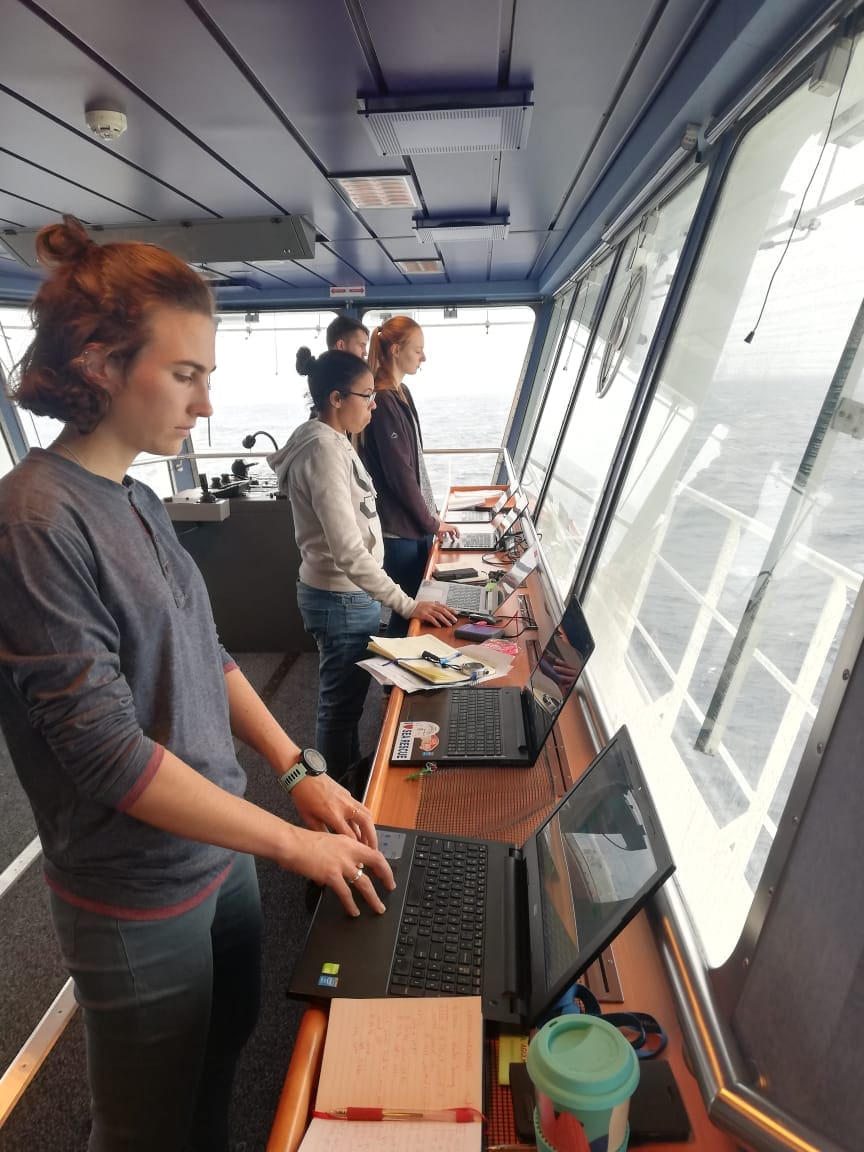
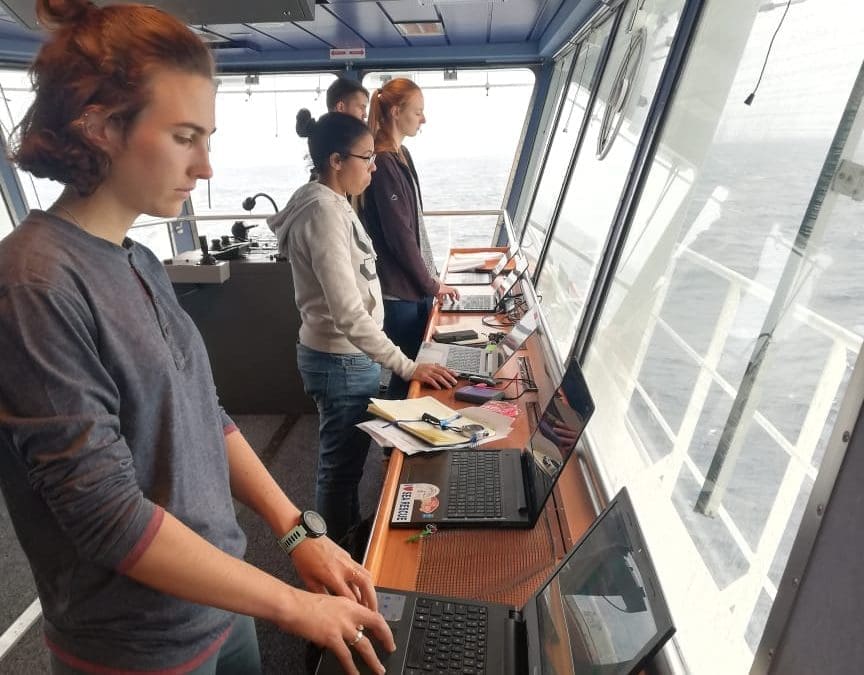
Observations of stern and bow slamming done from the SAAII bridge
During the SCALE Voyyage to Antarctica, the Sound and Vibration Group has been conducting full scale measurements using accelerometers placed on the S.A. Agulhas II. Wave observations have been conducted to estimate the height and frequency of the waves encountered by the vessel. With this, slamming observations have been conducted. When the vessel is experiencing slamming the team is tasked to rate the slam according to the comfort experienced.
The team has conducted ship manoeuvers in open water while stationary and moving at various speeds. This was done to investigate under which wave states the vessel experiences slamming.
The team is also investigating human comfort onboard the vessel. Passengers fill in daily motion sickness and slamming surveys. In addition to this a head acoustic dummy, Mike, has been measuring the sound experienced in a passenger cabin.
Information received from: Prof Annie Bekker, Associate Professor, Department of Mechanical and Mechatronic Engineering, Stellenbosch University, 05 August 2019
Photos: supplied by Sound and Vibration Group
by Fishgate Developer | May 3, 2019 | Announcement, Important Dates, SANAP, Southern Ocean, sub-Antarctic
Date: 29 – 30 July 2020
“Come and discuss the challenges facing the sub-Antarctic in a changing world and share ideas for the future”.
Sessions include:
- climate
- conservation
- biosecurity
- geoscience
- tourism
- fishing
- heritage
- connectivity
- management challenges.
Website: Click here.
Follow subant2020 on Twitter!
by Fishgate Developer | Apr 16, 2019 | Research, Science, Southern Ocean, sub-Antarctic
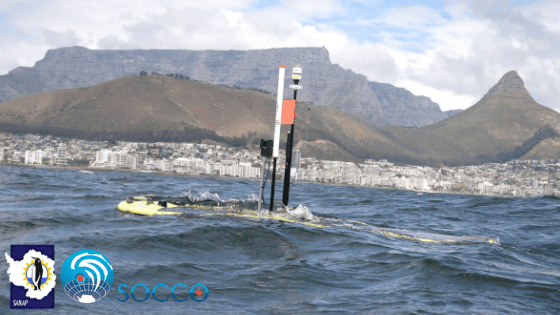
Our Wave Gliders have arrived back from the Southern Ocean. Last Friday 5th April we picked up our second carbon Waveglider WG027 a few tens of metres from the breakwater in Granger Bay at the end of an exciting but problem free transit of 1500km from the Sub-Antarctic Zone (43oS 8oE)(Video). Its twin WG052 had completed its even longer transit of 2800km from the Polar Upwelling Zone (54oS OoE) 9 days earlier. Both units arrived in excellent shape in what was a first for us, bringing our gliders home with a ship pick-up. Both gliders completed 4-month long missions of which 10 weeks were sampling at their respective locations and 6 weeks transiting back to Cape Town.
VIDEO: WG052 waiting to be picked up off Granger Bay in a cold misty morning in Cape Town a couple of weeks ago after its 2800km epic from 54oS.
https://www.facebook.com/AntarcticLegacySA/videos/322703648445517/
Bringing the gliders home under their own means opens the door towards the direction of reducing the dependency on ships and reduces the long-term costs of long-term observations. It is a significant technical challenge for the robots and the engineers. The biggest problems we encountered, apart from the vicious storms, were the very strong mesoscale jets west of the Agulhas retroflection area. Jets with flow speeds of over 2kn posed navigation challenges for the pilots but we also learned much from the experience and despite a few necessary deviations (Figure 1a,b) that probably added a week to the transit we got them home in really good shape (Figure 2).
The decision to bring them home was shaped by two main considerations: firstly, we wanted to avoid the expensive physical damage to the gliders that often happens with ship recovery, especially under the typically rough conditions in the Southern Ocean. As it turned out we made the right call especially for WG052 which would have been all but impossible to retrieve such were the conditions. Secondly, we wanted to evaluate if wave gliders can be combined to address mesoscale differences in the response of the ocean to synoptic scale atmospheric forcing.
As mentioned in earlier posts each of these gliders was paired with a buoyancy glider over the entire period of deployment at their respective long-term observational sites in the SAZ and the PUZ as part of two NRF-funded SOCCO SOSCEX-Storm projects. This pairing enabled us to simultaneously observe the air-sea fluxes of CO and the ocean physics dynamics that influence them in the upper 1000m of the ocean. This is necessary because it is not clear how important these ocean dynamics are in predicting the climate sensitivity of the carbon cycle in the Southern Ocean. This learning will be used to improve the Earth System Models used to predict regional and global climate change, particularly the South African CSIR-VrESM model being developed as a collaboration between SOCCO, Global Change Institute-Wits University and the MaRe Institute at UCT.
All the instruments were fully operational over the entire time and the initial look at the data suggests that we have excellent accuracy and precision. This was the first operational test for our newly developed VeGAS pCO2 units on both gliders and we will do a deep dive into the data later this week.
This science work would not have been possible without the expertise and dedication of our engineering partners at Sea Technology Services who run SA-RobOTIC and their student engineers.
– Dr. Pedro M. Scheel Monteiro & SOCCO & SA-RobOTIC team, 08 April 2019 (posted 16 April 2019)
by Fishgate Developer | Mar 25, 2019 | Antarctica, Important Dates, SANAE, SANAP, Science, Southern Ocean, sub-Antarctic
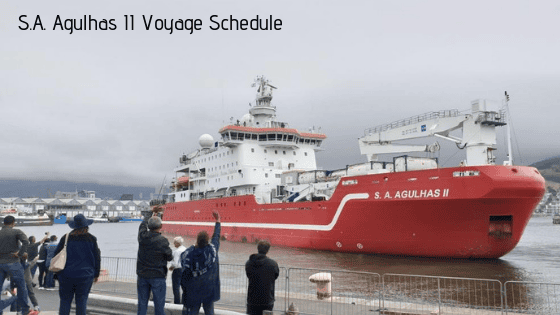
Interested in the South African Research and Supply Vessel, the S.A. Agulhas II 2019 Voyage Schedule?
Click here.
by Fishgate Developer | Mar 7, 2019 | Antarctica, News, Research, SA Agulhas II, SANAP, Science, Southern Ocean, sub-Antarctic
The S.A. Agulhas II is now on its homeward journey having finished all logistical and scientific work at SANAE and in the Weddell Sea (track the ship here). The work is not yet over for all aboard, however. Scientists from the University of Cape Town (UCT), the Council of Scientific and Industrial Research (CSIR) and the South African Weather Service (SAWS) continue to collect oceanographic and meteorological data. UCT and CSIR are both sampling seawater as the ship sails, measuring chlorophyll, nutrients, ammonium and phytoplankton community composition, to name a few.
Over and above this, CSIR—more particularly, CSIR SOCCO—and Martin Mohrmann of the University of Gothenburg and ROAM-MIZ deployed oceanographic instruments on the voyage south to Antarctica (see photos below). CSIR SOCCO, or the Southern Ocean Carbon & Climate Observatory, is a South African research programme focused on the Southern Ocean. ROAM-MIZ, according to their website, “is a multi-institutional initiative to observe the full seasonal cycle of the upper ocean in the marginal ice zone near the Greenwich Meridian”. CSIR SOCCO deployed two wave gliders, a Seaglider and a Slocum glider. ROAM-MIZ deployed two Seagliders and a Sailbuoy, christened SB Kringla. These instruments continuously record oceanographic data while they move through the water. The wave gliders and the Sailbuoy remain at the surface, harnessing wave and wind power, respectively, to propel them through the water. The Seagliders and Slocum glider alter their buoyancy to dive and sample sea water during their journeys to the deeps (deep parts of the ocean) and back to the surface. All these vehicles transmit their data to satellites at regular intervals or when they surface after a dive.
Deployment of Gliders
With the S.A. Agulhas II now making for home, the time has come to recover these instruments in order that they can be serviced and used again in future deployments. The wave gliders, in a true feat of engineering, are being piloted home to Cape Town. This is due to reducing sunlight available for the solar panels of the southernmost glider as the receding summer light wanes at these high latitudes. This will entail a journey of 1200 km and 2500 km for the respective wave gliders (click here for the update on the position of the gliders). Two Seagliders, the Slocum glider and the Sailbuoy will be recovered on the voyage home. The third Seaglider is to be recovered by another vessel, the Norwegian RV Kronprins Haakon, sailing from Punta Arenas in Chile.
On the 1st of March, the Sailbuoy and a ROAM-MIZ Seaglider were both safely recovered in fair weather at 60°S 0°E. The speed and success of the recovery were entirely down to the skill of the S.A. Agulhas II’s crew and the prevailing calm weather. Next, the Slocum glider will be recovered at 54°S 0°E and then CSIR SOCCO’s remaining buoyancy glider at 43°S 8°E. The S.A. Agulhas II is now making for 54°S 0°E after having sailed to South Thule and South Georgia for SAWS deployments and commitments.
Retrieval of Gliders
For more information on CSIR’s SOCCO programme, click here and for further information on ROAM-MIZ, click here.
Cover Photo: ROAM-MIZ’s two buoyancy gliders making satellite contact in preparation for deployment.
Written by: Hermann Luyt, Oceanography, University of Cape Town
Edited by: Anché Louw, Antarctic Legacy of South Africa, 07 March 2019
Photo Credit (all): Hermann Luyt
by Fishgate Developer | Feb 27, 2019 | Announcement, Legacy, Marion75, News, Newsletters, Southern Ocean, sub-Antarctic
Greetings to the friends, families and followers of the M75 team!
Greetings from our sub-antarctic paradise!
The first month of this new year has come and gone much too quickly. The decorations stayed up long after the festive season ended and the M75 team took as long as possible to wind down after all the fun. We had some pretty memorable parties and amazing feasts!
January was a proper summer month on Marion. We had a record number of pleasantly warm and windstill days which have been great for working in the field. The field assistants have been out and about, making the most of the sunny and not-so-windy days. The island is alive with courting albatross, hundreds of penguin chicks, young birds starting to take off, brand new fur seal pups, etc. Back at base, we have been kept entertained with movie nights, some birthdays and many braai’s.
We hope you enjoy The Wanderer (January 2019) and that all the stories and photos give you a better idea of the fantastic things we’ve been experiencing!
Kind regards,
the Wanderer Editing team
Click here to view all the Marion Island newsletters available on the Antarctic Legacy of South Africa Archive.
Authors: Elsa van Ginkel (Editor) and James Burns (Co-Editor), 75th Marion Island Overwintering Team, 27 February 2019 (received 21 February 2019)