by Ria Olivier | Jan 25, 2024 | Ecology, Invasion Biology, Jobs, Marion Island, Mice Eradication, Overwintering Team, SANAP, sub-Antarctic, Team member
 Vacancy for field researcher on Marion Island (March 2024 – May 2025) –
Mouse impacts on invertebrates and plants
The Department of Plant and Soil Sciences at the University of Pretoria is offering one suitably qualified candidate an opportunity to spend a year on Marion Island to measure various aspects of the impact of the house mouse on the diversity and function of the terrestrial ecosystems of Marion Island. This work will entail collecting baseline data, mostly on invertebrates and plants.
CLOSING DATE 4 FEBRUARY 2024
Read more about Marion Island and Overwintering Teams on the SANAP website
REQUIREMENTS (full list available in advertisement
Minimum BSc (Hons) degree in an ecological field.
Experience of field work in rugged terrain is required.
Excellent organisational skills, attention to detail, meticulous observation, note-taking
and record-keeping abilities.
Experience of invertebrate and/or plant surveys.
Computer literacy with experience in data management, statistical analysis (at least
one undergraduate statistics course) and report writing are required.
Applicants should submit their applications here.
South African applicants will receive priority. Please note that appointments will be contingent on availability of ship berths and funding.
For queries contact Prof Greve (michelle.greve@up.ac.za) via email.
by Ria Olivier | Nov 27, 2023 | Announcement, Jobs, Marion Island, News, Overwintering Team, Prince Edward Islands, Research, SA Polar Research Infrastructure, SANAP, SAPolarRI, SAPRI, Science, Southern Ocean, Stations, sub-Antarctic
Applications open for:
- Overwintering Birder
- Overwintering Killer Whaler
- Overwintering Sealer (2x positions)
The National Research Foundation (NRF) supports and promotes research and human capital development through funding, the provision of National Research Facilities and science outreach platforms and programmes to the broader community in all fields of science and technology, including natural sciences, engineering, social sciences and humanities.
The South African Environmental Observation Network (SAEON) is a research platform funded by the Department of Science and Innovation (DSI) and managed by the National Research Foundation (NRF) since 2002. SAEON is mandated to observe and research ecosystems on land, in coastal regions and the oceans to understand how those systems function and might change over time and space when influenced by socio-economic driving forces including climate change. We deliver our data online and offer tools, services and advice for informed environmental policy-making.
SAEON Egagasini Node, based in Cape Town, Western Cape, requires the services of suitably qualified individuals to be responsible for collecting field data on birds and mammals, to be used for conservation and academic purposes as part of the South African Polar Research Infrastructure (SAPRI). The birder will be contributing to the project ‘On-island impacts of climate change on the Southern Ocean’s iconic seabirds’ run by the FitzPatrick Institute (University of Cape Town).
The Marion Island research station is managed and administered by the Department of Forestry, Fisheries and the Environment (DFFE).
Apply before: 07 December 2023
Click here!
Anche Louw, South African Polar Research Infrastructure, 27 November 2023
by Ria Olivier | Oct 30, 2023 | Environment, geochemistry, Gough Island, News, Oceanography, Research, SA Agulhas II, SA Polar Research Infrastructure, SANAP, SAPolarRI, SAPRI, Science, South Atlantic, Southern Ocean, sub-Antarctic, Tristan da Cunha
Research team on the recent Gough Island takeover expedition.
Phytoplankton are microscopic plants that live in the ocean, and just like plants on land they need to have enough food to grow and be happy. However, some places in the ocean don’t have enough food for them whereas some places do. The Southern Ocean Carbon & Climate Observatory (SOCCO) team based at CSIR, Trace Metals team based at Stellenbosch University (TracEx) and the Department of Forestry, Fisheries and the Environment: Oceans and Coasts team are trying to figure out where those places are (in the Southern Ocean).
During the Gough Island takeover expedition:
The Trace Metal Biogeochemistry research teams sampled upstream and downstream of Gough Island to look at how the Antarctic Circumpolar Current (ACC) interacts with the island to resuspend sediments from the seafloor. This resuspended sediments acts as a source of trace metals to the surface mixed layer in support of phytoplankton blooms. The team used a 12 bottle mini-CTD rosette system (see image below, right) to sample for dissolved trace metals, particulate trace metals and organic trace metal chemistry.
| TEAM | Trace Metal Biogeochemistry |
| Projects Name | Seasonal Iron speciation in the Southern Ocean, from open ocean environments to naturally fertilized sub-Antarctic Islands (Marion and Gough Island) |
| Principal Investigator | Dr Thomas Ryan-Keogh | Senior Researcher at the Southern Ocean Carbon-Climate Observatory (SOCCO), CSIR South Africa |
| Co-Principal Investigator (On board DFFE team leader) | Dr TN Mtshali | Department of Forestry, Fisheries and the Environment (DFFE) |
| Co-Principal Investigator | Prof AN Roychoudhury | Stellenbosch University (TracEx) |
| SOCCO/TracEx on board team leader | Olie Valk | TracEx |
On board team member (PhD Student)
| Thapelo Ramalepe | SOCCO-TracEx |
On board team member (MSc Student)
| Miranda Sitofile | SOCCO-TracEx |
| On board DFFE team member | Mutshutshu Tsanwani | DFFE |
| On board DFFE team member | Kanyisile Vena | DFFE |
| On board DFFE team member | Hassan Ismael | DFFE |
| On board DFFE team member | Mbulelo Makhetha | DFFE |
| On board team members | Including all ship-based scientists sampling for trace metals |
The project in more detail:
The Southern Ocean (SO) is one of the largest high-nutrient low-chlorophyll regions in the World’s Ocean, where primary productivity is limited by iron bioavailability, thereby impacting the strength and efficiency of biological carbon pump. There are, however, exceptions with large phytoplankton blooms persistently observed downstream of the sub-Antarctic Islands. While extensive research has focussed on iron-biogeochemistry around Kerguelen and Crozet islands, no such studies have been conducted at Marion and Gough islands.
Furthermore, whilst our previous studies have made substantial advances toward addressing the gaps in seasonal data coverage through the Southern oCean seAsonaL Experiment (SCALE) 2019 winter and spring expeditions, there is still a paucity of dissolved iron data in the SO, especially from autumn to late spring. This is severely hampering our understanding of the full seasonal biogeochemical iron cycle and its impact on primary production. This project aims to continue its focus on seasonality by expanding seasonal coverage of iron measurements to include autumn (Marion) and late-spring (Gough) expeditions for more comprehensive coverage of the SO seasonal cycle, with a particular focus on quantifying biogeochemical cycling of iron-pool around these understudied islands.
This project is funded by: The National Research Foundation, South African National Antarctic Programme funding (NRF-SANAP).
Current NRF-SANAP funded projects
Visit SOCCO here! Visit TracEx here!
Featured Image: L-R (Back): Kanyisile Vena (DFFE), Ole Valk (TracEx), Hassan Ismael (DFFE), Mbulelo Makhetha (DFFE); (front) Miranda Sitofile (SOCCO-TracEx), Thato Mtshali (DFFE), Thapelo Ramalepe (SOCCO- TracEx), Mutshutshu Tsanwani (DFFE).
Project information supplied by Dr Thomas Ryan-Keogh. Images supplied by Thapelo Ramalepe.
Anche Louw, South African Polar Research Infrastructure, 30 October 2023.
by Ria Olivier | Oct 6, 2023 | Announcement, Antarctica, Jobs, Marion Island, Meteorology, Overwintering Team, SANAP, Southern Ocean, Stations, sub-Antarctic
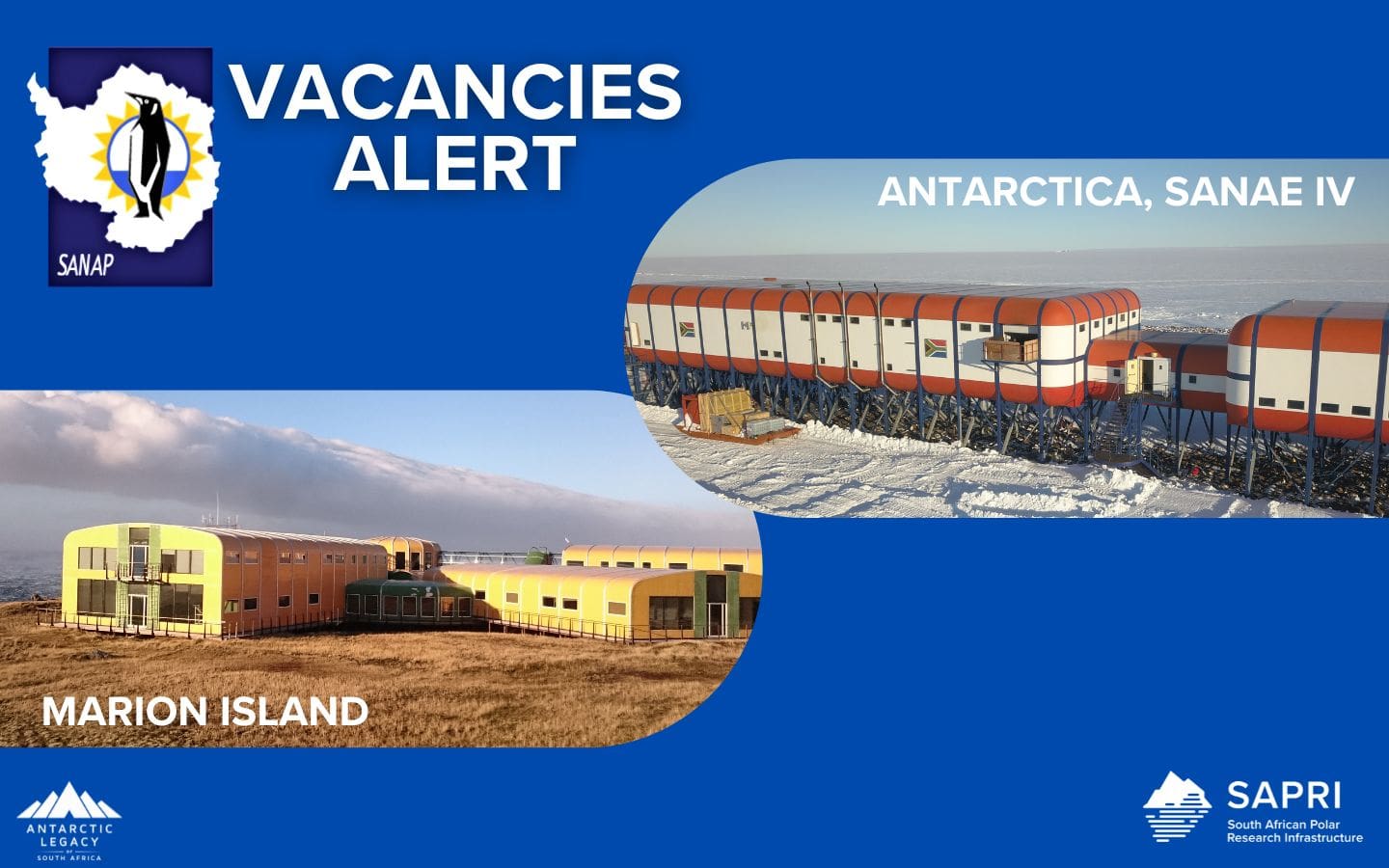
The following vacancies are advertised by The Department of Forestry, Fisheries and the Environment (DFFE) for positions based on Antarctica and Marion Island.
Antarctica, SANAE IV (the 4th South African National Antarctic Expedition Station):
The successful applicant will spend a full year (December 2023 to February 2025) at SANAE base. There is no option to return to South Africa before February 2025.
Marion Island:
The successful applicant will spend a full year (April 2024 to May 2025) at Marion Island. There is no option to return to South Africa before May 2025.
| Job Title | Station | Period | Closing Date | Job Advert |
| Mechanical Engineer | SANAE IV Antarctica | December 2026 to February 2028 | 14 September 2026 | Click here |
| Instrumentation Technician | SANAE IV Antarctica | December 2026 to February 2028 | 14 September 2026 | Click here |
| Medical Doctor | SANAE IV Antarctica | December 2026 to February 2028 | 14 September 2026 | Click here |
| Senior Meteorological Technician | SANAE IV Antarctica | December 2026 to February 2028 | 14 September 2026 | Click here |
| Communications Engineer | SANAE IV Antarctica | December 2026 to February 2028 | 14 September 2026 | Click here |
| Diesel Mechanic | SANAE IV Antarctica | December 2026 to February 2028 | 14 September 2026 | Click here |
| Electro-Mechanical Technician | SANAE IV Antarctica | December 2026 to February 2028 | 14 September 2026 | Click here |
Anche Louw, Co-Principal Investigator of Antarctic Legacy of South Africa and Digital Marketing and Communications Manager of the South African Polar Research Infrastructure, 06 October 2023.
by Ria Olivier | Oct 5, 2023 | Announcement, Marion Island, News, Newsletters>Marion Island Newsletters, Overwintering Team, Prince Edward Islands, SAPolarRI, Science, Southern Ocean, Stations, sub-Antarctic, Team member
The 80th Marion Island overwintering team has published their first newsletter.
Content included in The Wanderer Spring Edition:
- Editor’s Note and Message from the Team Leader
“Hello from the little swampy volcano in the Southern Indian Ocean we call home, or Marion Island. The year has kicked off and the overwinterers have settled into their routines, just in time for it all to change. The Spring Edition of The Wanderer marks the beginning of a massive influx of wildlife onto the island, eager to breed and moult on this isle of paradise. Follow on as the chaos descends for field researchers alike and the hustle continues at the Base at Cabbage Point” ‐ Zafar Monier.
- Meet the team
- Marion’s Magnificent Birds
“Marion Island is home to 40% of the world’s Wandering Albatross population” Zafar Monier.
“M80 has the opportunity to conduct upper air ascends on our expedition twice a day, everyday of the year. Weather balloons are released simultaneously from different locations worldwide! On Marion Island we release the balloon at 12H00Z and 00H00Z (15H00 and 03H00 Marion local time)” – the 2023/2024 South African Weather Service Meteorological team members on Marion Island.
Click on the link below to download the first M80 newsletter.
M80 Newsletter: The Wanderer Spring Edition
The 80th Marion Island overwintering team. This photo was taken before the last helicopter flight to the S.A. Agulhas II, at the end of the 2023 takeover. The ship departed from Marion Island to Cape Town late afternoon of 12 May 2023. Image: Michelle Risi.
Anche Louw, Co-Principal Investigator of Antarctic Legacy of South Africa and Digital Marketing and Communications Manager of the South African Polar Research Infrastructure, 05 October 2023.
by Ria Olivier | Oct 3, 2023 | Current Event, Discover, Gough Island, Mammology, News, Research, SA Agulhas II, SA Polar Research Infrastructure, SANAP, SAPolarRI, SAPRI, Science, sub-Antarctic, Tristan da Cunha
Featuring research teams currently on the Gough Island takeover expedition.
The Tristan da Cunha Conservation Department recruited two Tristan Islanders to assist in the field at Tristan for the duration of the takeover. Image of the two members of a previous team.
During the annual Gough Island takeover (relief) expedition, the S.A. Agulhas II delivers passengers and cargo to Tristan da Cunha Island, which is 350 kilometers from Gough Island. Additionally, several researchers are given the chance to carry out their research at Tristan da Cunha during the relief period for Gough Island.
Prof Marthán Bester, semi-retired, Emeritus Professor and senior Research Fellow of the Mammal Research Institute at the University of Pretoria, is currently on the Tristan da Cunha to conduct field research on Subantarctic fur seals.
Find our more below about this project and prospects for the takeover period.
| TEAM | Tristan Mammal Research |
| Project Name | Subantarctic Fur Seals at the Tristan da Cunha Islands, South Atlantic Ocean |
| Principal Investigator | Prof Marthán Bester | University of Pretoria |
| Co-Principal Investigator | Prof Nico de Bruyn | University of Pretoria |
| Co-Principal Investigator | Dr Mia Wege | University of Pretoria |
| Co-Principal Investigator | Mr. Trevor Glass | Tristan Conservation Department Head |
The history of fur seal research on Tristan da Cunha
Fur seal research at the Tristan da Cunha (TdC) Islands started during the 1970s (1974–1978). In its present form, the research continues through a next phase (2009–2019), and beyond.
Short description of the project
Using Subantarctic fur seals as bioindicators of environmental conditions and as tools for suitable management of natural resources, contributing to observing marine ecosystems in the TdC Islands, since 2019 and beyond, the aim is to: (a) determine the seasonal attendance patterns of primarily lactating adult females, from the smallest (incipient) population of the species in the world at Cave Point Peninsula, TdC, (b) measure and contrast the growth rate and/or weaning mass of pups at the Cave Point breeding colony (10 month nursing period), (c) collect scat (non-invasive) and whiskers (invasive) samples for diet analyses.
During this ‘takeover’ the team aims to service and/or retrieve the Attendance Pattern Automated System (satellite-linked) at Cave Point, collect and process fur seal scat samples to determine diet, and weigh pup/under-yearling fur seals (at around 290 days of age) to compare their weaning weights amongst years and with those of pups from other island populations (including Gough Island).
In everyday language
The fur seals breed and rest on the islands, and they feed at sea. The research team aims to determine (1) what the seals feed on when they are away during feeding trips, (2) how well the pups, which remain on land, grow on a diet of milk which they suck from their mothers when these return to land after each feeding trip, and (3) how far away from the island, and for how long, do the mothers of the fur seal pups have to remain at sea on each feeding trip to be able to sustain their pups until weaning.
For more information visit about Subantarctic fur seals, click on the link below.
Marion Island Marine Mammal Programme
This project is funded by: The National Research Foundation (NRF-SANAP), The Royal Society for the Protection of Birds (RSPB) and Tristan da Cunha Conservation Department (TdC Conservation Department).
Update posted by the Tristan Conservation Department (on Facebook, 09 October 2023):
“The weather has been very nice last week. The conservation team and professor Martian Bester managed to go to the caves to do seal work with the seal pups. It was a great success as they managed to weigh fifty pups. Martian has been working with the conservation department for fourty nine years but sadly this is his last year working with the conservation team as he is retiring”
Project information and feature image supplied by Prof Marthán Bester.
Anche Louw, South African Polar Research Infrastructure, 03 October 2023, updated on 10 October 2023.

 The Department of Plant and Soil Sciences at the University of Pretoria is offering one suitably qualified candidate an opportunity to spend a year on Marion Island to measure various aspects of the impact of the house mouse on the diversity and function of the terrestrial ecosystems of Marion Island. This work will entail collecting baseline data, mostly on invertebrates and plants.