by Ria Olivier | May 25, 2023 | Announcement, Discover, News, Research, SA Agulhas II, SANAP, Science, Southern Ocean
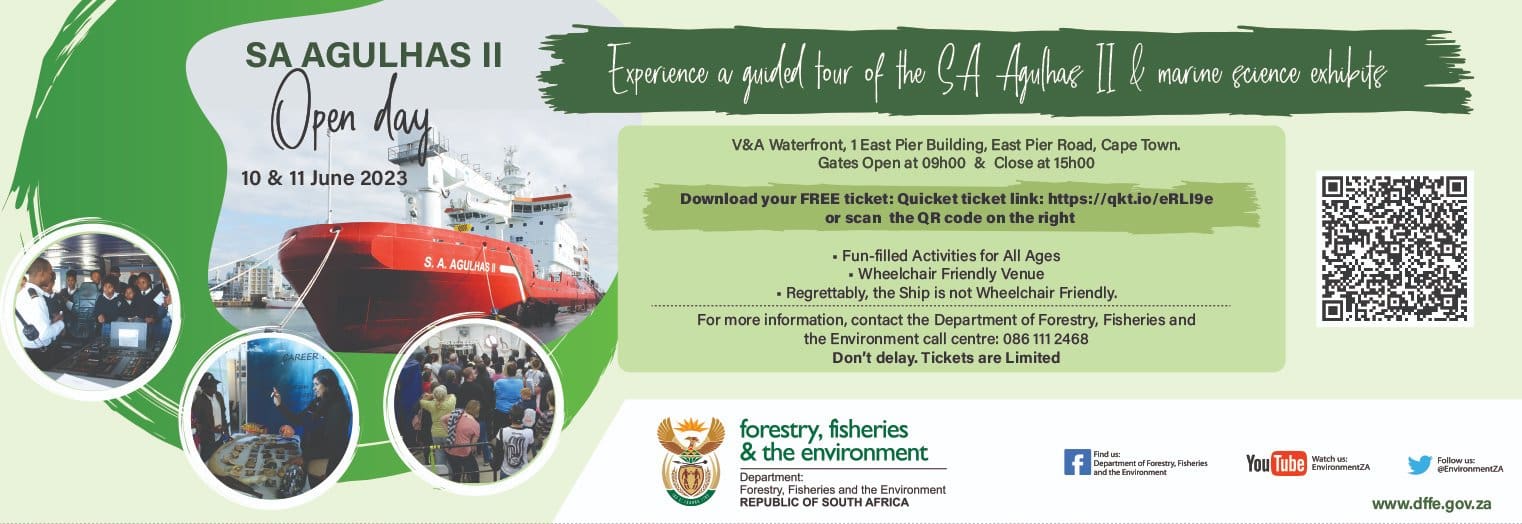
The Department of Forestry, Fisheries and the Environment invites you to attend the S.A. Agulhas II Open Day on the 10 & 11 June 2023 at the V&A Waterfront (Port of Cape Town, East Pier).
What your FREE ticket will include:
- A guided tour of the South African (Polar) research and supply vessel, the S.A. Agulhas II.
- Access to various marine science and environmental conservation exhibitions.
Download your FREE tickets here: https://qkt.io/eRLI9e
Anche Louw, South African Polar Research Infrastructure (SAPRI DPS Node), 25 May 2023
by Ria Olivier | May 18, 2023 | Announcement, Marion Island, News, Newsletters>Marion Island Newsletters, Overwintering Team, Research, SA Agulhas II, SANAP, SAPolarRI, SAPRI, sub-Antarctic, Team member, Team Photo
The 79th Marion Island overwintering team arrived on Marion Island on 21 April 2022.
They are back in Cape Town, after spending 386 days on the island and 6 nights on the S.A. Agulhas II for the journey home.
If you want to know more about the work this team did on the island, check out their newsletters (click on the link below).
Marion79 Newsletters
The featured image is the team’s official team photo and displayed on the wall inside the sub-Antarctic Marion Island research station.
Team Photo:
Top row (L-R): Banele Dosi (MIMMP Sealer), Samuel Peta (O & C Birder – DFFE), Sanele Action Mkhize (Diesel Mechanic), Siphesihle Faltein (Assistant Meteorological Technician – SAWS), Lucy Smyth (MAPRU/NMU Birder), Michael Ross (MIMMP Sealer).
Middle row (L-R): Monica Leitner (MIMMP Killer whaler/Sealer), Mndeni ‘Amani’ Hlatshwayo (Medical Orderly), Thendo Sikhwari (Senior Meteorological Technician – SAWS), Andile Ace Mdluli (O & C Birder – DFFE), Gladys Kemei (Communications Engineer and Deputy Team Leader), Tankiso H. Moso (SANSA Electronics Engineer and Science Team Leader), Ntlangemhlophe Sanele Sukude Nombekela (Chef), Mishumo Masithembi (Environmental Control Officer).
Bottom row (L-R): Gcobani Tshangana (Assistant Environmental Control Officer), Austin Acro Gumba (UKZN Astrophysicist), Tanganedzani Tshitavhe (Assistant Meteorological Technician – SAWS), Tshimangadzo Jufter Munyai (Base Engineer and Team Leader), Elsa van Ginkel (MFM Ecologist).
Inserts (left): Abuyiselwe Nguna (Geomorphologist); (right): Vhuawelo Simba (MFM Ecologist). These team members were evacuated from the island in July 2022, due to injuries obtained.
MAPRU/NMU – Marine Apex Predator Research Unit / Nelson Mandela University; MFM – The Mouse-free Marion Project; MIMMP – Marion Island Marine Mammal Programme; DFFE – Department of Forestry, Fisheries and the Environment; O & C Birder – Oceans and Coasts Birder; SANSA – South African National Space Agency; SAWS – South African Weather Service; UKZN – University of KwaZulu-Natal.
Images taken on arrival – 18 May 2023
Featured image credit: Tshimangadzo Jufter Munyai (Base Engineer and Team Leader).
Arrival images credit: South African Polar Research Infrastructure research coordinators.
Anche Louw, South African Polar Research Infrastructure (SAPRI DPS Node), 18 May 2023
by Ria Olivier | May 10, 2023 | Current Event, Marion Island, News, Overwintering Team, Prince Edward Islands, Research, SANAP, SAPRI, Science, Southern Ocean, Stations, sub-Antarctic, Team member
| TEAM | MAPRU | Affiliation |
| Project Name | Avian scavengers & seabirds |
| Principal Investigator | Dr Maëlle Connan | MAPRU, Nelson Mandela University |
| Co-Investigator | Prof Peter Ryan | Fitzpatrick Institute of African Ornithology, University of Cape Town |
| M79 Field Assistant | Lucy Smyth | MAPRU, Nelson Mandela University |
| M80 Field Assistant | Christopher Jones | MAPRU, Nelson Mandela University |
| M80 Field Assistant | Michelle Risi | MAPRU, Nelson Mandela University and the South African Polar Research Infrastructure (SAPRI) |
This team is studying seabirds at Marion Island and has two projects for the period 2021-2023:
1) Avian scavenger project focusing mostly on Black-faced Sheathbill, Kelp Gull and Brown Skua as well as some of their prey.
2) FitzPatrick long-term monitoring of Wandering Albatross, Grey-headed Albatross and Northern Giant Petrel.
More about the avian scavenger project:
This project started in 2021. It is tightly linked to the Mouse-Free Marion project.
Our aim is two fold: 1) we fill identified scientific gaps at the bird level that are crucial for best planning of the mouse eradication and development of appropriate mitigation measures. We are mostly focusing on three species of avian scavengers: Black-faced Sheathbill, Kelp Gull and Brown Skua and some of their prey. 2) we propose to use the three scavengers as indicators of recovery of the terrestrial ecosystem post-eradication by establishing baselines for the scavenger guild and their prey against which the impact of a successful mouse eradication can be measured in years to come.
More about the FitzPatrick long-term monitoring project:
The FitzPatrick long-term monitoring of Wandering and Grey-headed albatrosses and Northern Giant Petrel started in the early 1980s and has continued ever since. This individual-based monitoring of threatened species allows us to study the threats they face at sea (e.g. fisheries) and on land (e.g. mice) in order to act and decrease these threats and improve the conservation status. The species’ long-term monitoring is crucial as it allows us to decipher abnormal years from long-term trends.
More about the fieldwork:
The two projects above involve for example extensive counts of birds, lots of hiking, observations of bird behavior and record keeping of the activity of known individuals year after year.
What are your plans for this takeover:
During the takeover, we will be debriefing the year of Lucy Smyth who has worked on the island for our projects since April 2022. We will also train Chris and Michelle for the year ahead in all aspects, from field work to data entry and back-ups.
Follow MAPRU:
Follow PFIAO:
Text by Dr Maëlle Connan.
Images supplied by Christopher Jones.
Featured image: The MAPRU takeover 2023 team. L-R: Dr Maëlle Connan (PI), Lucy Smyth (M79 MAPRU Field Assistant), Michelle Risi (M80 MAPRU Field Assistant) and Christopher Jones (M80 MAPRU Field Assistant). Image taken on the Western side of the island.
Anche Louw, South African Polar Research Infrastructure (SAPRI DPS Node), 10 May 2023
by Ria Olivier | May 5, 2023 | Invasion Biology, Marion Island, Mice Eradication, News, Prince Edward Islands, Research, SA Agulhas II, SANAP, Southern Ocean, Stations, sub-Antarctic, Team member
| TEAM | Mouse-Free Marion |
| Project Name | Longitudinal monitoring of terrestrial diversity to assess the effects of the planned mouse eradication on Marion Island, and bait and mouse trials to inform further planning for the Mouse-Free Marion Project |
| Project Manager | Dr Anton Wolfaardt |
| Collaborator | Prof. Michelle Greve |
| M79 Field Assistant | Elsa van Ginkel |
| M80 Field Assistant | Camilla Smyth |
The Mouse-Free Marion Project is a partnership between the Department of Forestry Fisheries and the Environment (DFFE) and BirdLife South Africa, working towards an operation to eradicate invasive mice from Marion Island.
The mice, which were introduced accidentally some 200 years ago, have caused great harm to the ecology of Marion Island. They feed on indigenous invertebrates, damage vegetation, and have more recently started eating seabird chicks. As a result, the mice are considered to be a major pest to the island. If they are not removed, the ecosystem of the island will continue to deteriorate, and they will likely cause most of the seabirds on the island to become locally extinct. These seabirds will be lost to the island forever.
In order to monitor how the island recovers after the mice have been removed, we are collecting data on aspects of the island that we expect to improve once the mice are gone. These include the vegetation and invertebrates. Colleagues working on other projects are collecting similar data on seabirds.
The reason why it is important to collect this data before the eradication operation is so that we can compare and monitor how the island changes (improves) as a result of the eradication operation – comparing the island’s vegetation and invertebrate features before and after the operation.
More about your plans for this takeover?
The project will make use of data that have already been collected over many years, primarily through the various long-term monitoring projects that have been undertaken at Marion Island over many years. The focus of our work currently is to fill some pre-eradication (baseline) data on vegetation and invertebrates. This particular work was initiated during the 2022/23 period, and will continue in 2023/24. The takeover period will be used to provide training and orientation to the new Marion80 overwintering team member (Camilla Smyth) and for the current Marion79 Mouse-Free Marion overwintering team member (Elsa van Ginkel) to hand over the field-work responsibilities to Camilla.
The work includes standard invertebrate and vegetation survey techniques to establish a baseline that can be used to monitor how these ecological parameters change following the eradication of invasive mice. These surveys will repeat and build on historical surveys that have been undertaken on the island previously.
We will also be undertaking further bait trials and weather monitoring to help inform the planning of the baiting operation.
Latest takeover update from the island (on 26 April 2023)
Check out the Mouse-Free Marion Website!
Follow MFM on social media for the latest updates:
Text and images supplied by Dr Anton Wolfaardt.
Featured image: The MFM takeover 2023 team. L-R: Dr Anton Wolfaardt (MFM Project Manager), Camilla Smyth (M80 MFM Field Assistant) and Elsa van Ginkel (M79 MFM Field Assistant). Photo taken on Marion Island, April 2023.
Anche Louw, South African Polar Research Infrastructure (SAPRI DPS Node), 05 May 2023
by Ria Olivier | May 4, 2023 | Announcement, Antarctica, Gough Island, Legacy, Marion Island, News, Prince Edward Islands, SA Agulhas II, SA Polar Research Infrastructure, SANAE IV, SANAP, SAPolarRI, SAPRI, Southern Ocean
Dear Colleagues,
As I prepare to turn the page of a decade-long chapter of managing Operations and Infrastructure Support for Antarctica and Southern Ocean work and move on to new horizons, I wanted to take a moment to express my heartfelt gratitude to each and every one of you. Working together in enabling South Africa’s presence in this unique and challenging environment has been an unforgettable experience that has enriched my life in countless ways.
The extreme conditions and remoteness of the environment have demanded the best of me, and I am incredibly proud to have been part of it all. It sometimes felt like dealing with the logistical complexities of supporting Marine and Antarctic activities were the same as navigating the harsh ice conditions. We have faced and overcome numerous challenges as a team. Even though we may not have agreed on everything, the bonds we have built and the memories we have made will always hold a special place in my heart. I am truly grateful for the friendships, support, agreements and disagreements we have shared.
I am also deeply appreciative for being entrusted to manage South Africa’s presence in these pristine environments, and to have personally witnessed the beauty and wonder of Antarctica, Marion Island and Gough Island. The rough seas, breathtaking landscapes, unique wildlife, and understanding that there is so few which get this opportunity, have left an indelible mark on me, and I will forever cherish these memories.
As I move on to new endeavours away from the Ocean and Polar space, I will carry with me the valuable lessons I have learned especially when dealing with an unpredictable environment – the importance of adaptability, resilience, teamwork, and tenacity. The various curveballs and unexpected challenges have made me more resourceful in finding solutions. I am confident that the skills and experience gained will serve me well in my future pursuits.
I would like to extend my heartfelt thanks to each and every one of you for your unwavering support, dedication, and friendship during my tenure in the Antarctic and Marine space. I will always treasure the memories and the connections made, and I wish you all the very best in your ongoing work in Antarctica and the Southern Ocean or wherever your paths may lead you.
Thank you for being a part of this incredible journey, and please stay in touch.
With deepest gratitude,
Nish Devanunthan
Former Operations Coordinator: South African Polar Research Infrastructure (2022 to 2023)
Former Director – Operations and Engineering: South African National Antarctic Program (2013 to 2022)
Farewell gathering at SAEON Egagasini Node end of April 2023
Message from the SAPRI Team:
Even though Nish was with SAEON and SAPRI for only 9 months, he left a great legacy and managed to really ramp up the operations within SAPRI. He has a fountain of knowledge on Antarctica and Islands, DFFE, the S.A. Agulhas II and supply chain management, yet he still has a great sense of humour and commitment to action in the face of bureaucracy.
Nish, fair winds and following seas, we have the watch (although might ring you every now and then!).
SAEON Egagasini Node and SAPRI Team (L-R) Back: Simoné Louw (Node Administrator), Laura Braby (Postdoctoral Research Fellow), Saffiya Seddick (Seamap Coordinator), Juan-Jacques Forgus (Technician), Nicole du Plessis (Science Officer), Arno Botha (PhD Student), Zach Smith (Systems Developer), Nkululeko Memela (Operational Ocean Modeller); (middle) Lara Atkinson (Offshore Marine Scientist), Jennifer Veitch (Numerical Ocean Modeller), Anne Treasure (SAPRI DPS Node Manager), Anche Louw (SAPRI Digital Marketing and Communications Manager), Daneeja Mawren (Postdoctoral Research Fellow); (front) Juliet Hermes (SAEON Egagasini Node Manager and SAPRI Manager), Nish Devanunthan (Former SAPRI Operations Coordinator) and Thomas Mtontsi (Science Engagement Officer).
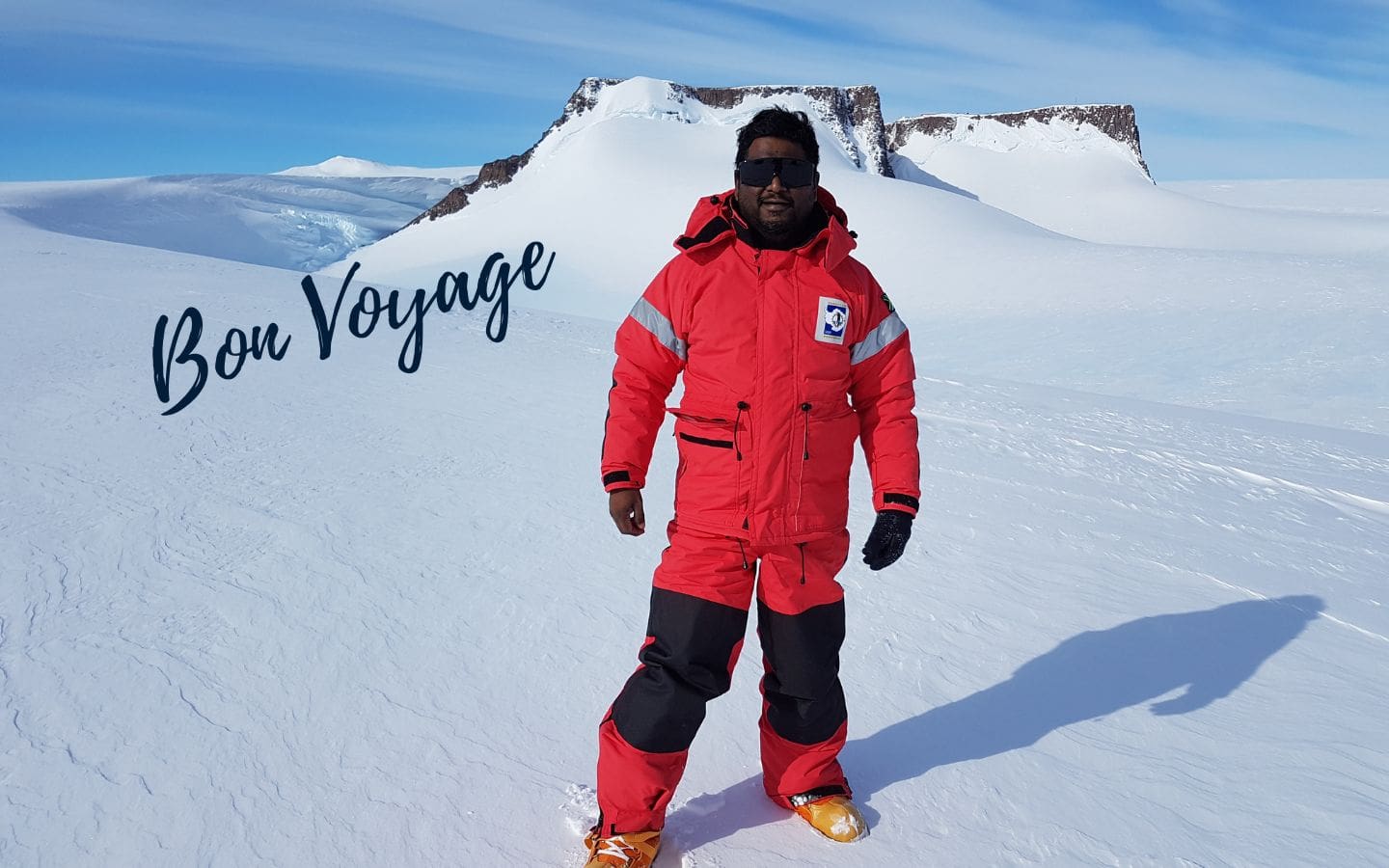
Feature Image: Nish Devanunthan at the South African National Antarctic Expedition Station, SANAE IV.
Anche Louw, South African Polar Research Infrastructure (SAPRI DPS Node), 04 May 2023
by Ria Olivier | May 2, 2023 | Current Event, Mammology, Marion Island, News, Research, SANAP, Science, Southern Ocean, sub-Antarctic
| TEAM | MIMMP |
| NRF-SANAP Funded Project Name | Marion Island Marine Mammals in Changing Environments: Individual Heterogeneity and Population Processes |
| Principal Investigator | Prof Nico de Bruyn |
| Affiliation | Mammal Research Institute, University of Pretoria |
| Takeover Sealer | Yinhla Shihlomule |
| M79 Sealer | Michael Ross |
| M79 Sealer | Banele Dosi |
| M79 Killer whaler | Monica Leitner |
| M80 Sealer | Zafar Monier |
| M80 Sealer | Dylan Seaton |
| M80 Killer whaler | Tammy Eggeling |
What are your plans for this takeover?
Into our 41st uninterrupted year of continuous monitoring! Takeover is mostly dedicated to training the new overwintering personnel, because most of the action (from a seal perspective) on the island take place outside takeover timeframes. Many long-term questions, aimed at understanding the ecology of the various species populations and their interactions with a changing environment, are pursued.
What are the main interest of the MIMMP in the sub-Antarctic region?
We are interested in how seal and killer whale populations change as the environment changes.
In more detail:
MIMMP does long-term ecological monitoring and research of four marine mammal species (Southern elephant seals, Antarctic – and Subantarctic fur seals, and Killer whales) at Marion Island. Focused primarily on population and foraging ecology, interactions between species and with their changing environments.
Check out the MIMMP Website!
Follow MIMMP on social media for the latest updates:
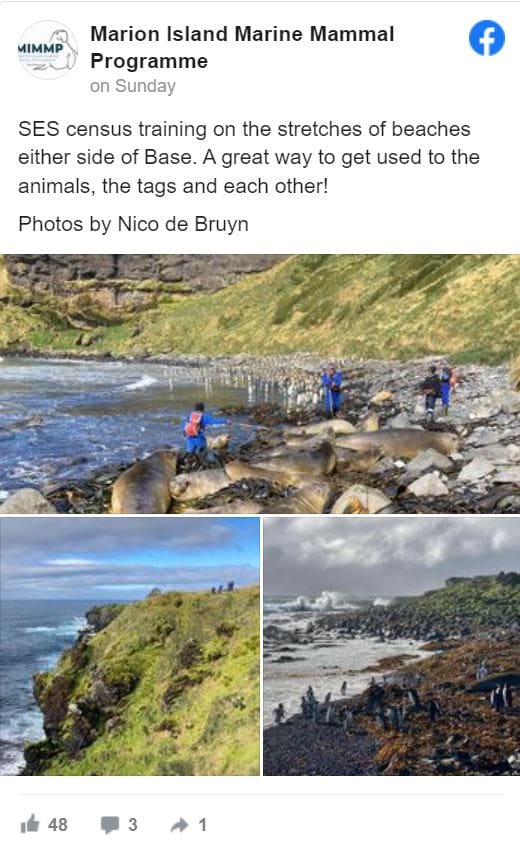
Most recent post on Facebook:
Text and images supplied by Prof Nico de Bruyn.
Featured image: The MIMMP takeover 2023 team. L-R: Dylan Seaton (M80 Sealer), Zafar Monier (M80 Sealer), Prof Nico de Bruyn (PI) and Tammy Eggeling (M80 Killer whaler). Photo taken in Cape Town, on board the S.A Agulhas II, before departure.
Anche Louw, South African Polar Research Infrastructure (SAPRI DPS Node), 02 May 2023