by Ria Olivier | Feb 5, 2024 | Research, SANAP, Uncategorised
 The 6th SANAP Research symposium was held at Houw Hoek Hotel in the Western Cape, from 27 November to 1 December 2023. A series of posts will be done on the SANAP website to give feedback on sessions and more will follow in the next few weeks.
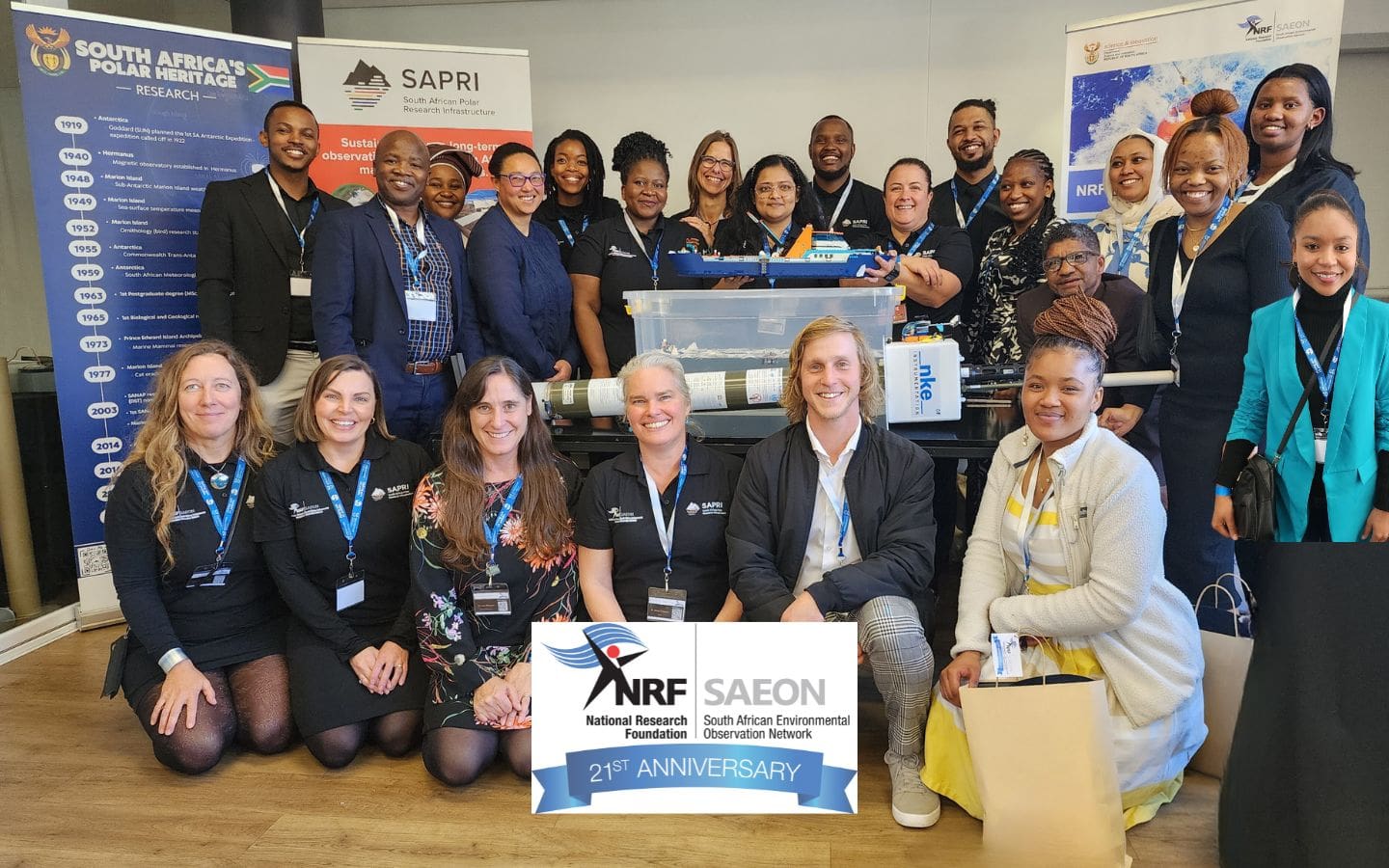
Delegates started arriving and most were settled in on Monday evening. Delegates from South Africa, Finland, and the United Kingdom spent the week networking with each other and with students, and listening to talks within the thematic themes identified under the South African National Antarctic Programme (SANAP). All delegates received a welcoming package to get them through the symposium.(Left: Photo Credit – Anché Louw, SAPRI)
The symposium started with a keynote lecture by Prof Jukka Tuhkuri of Aalto University, Finland on the expedition to find the shipwreck of the Endurance: “On March 5th, 2022 an international Endurance22 expedition located the wreck of Endurance, the lost vessel of Ernest Shackleton. The Endurance22 expedition was organized by the Falklands Maritime Heritage Trust and the expedition team was taken to the wreck site by S.A. Agulhas II, captain Knowledge Bengu and his crew. Jukka outlined and discussed the three goals of the expedition: to locate the wreck, to tell the story of Endurance to new generations, and to conduct scientific work. The science team onboard included scientists from Stellenbosch University and Aalto University. The Keynote lecture discusses, inter alia, who Shackleton was, how the Endurance was lost and found, and what was learned on the Weddell Sea Expedition” abstract supplied by Prof Tuhkuri. (Above: Photo Credit – Anché Louw, SAPRI)
A welcoming reception took place after the keynote lecture . This reception allowed members of the SANAP community (both old and new) to interact in an informal meet and greet for the first time since the last Symposium in 2018. The 2020 Symposium was cancelled due to the COVID-19 pandemic, and a decision was made to postpone the 2022 Symposium to allow the SANAP community to generate new data post-pandemic.
Afterwards a workshop was held by the Association for Polar Early Career Scientists of South Africa (APECSSA), and they reported back to the SANAP community n Day 3 of the symposium. (Right: Photo Credit: Anché Louw – SAPRI)
Prior to the commencement of the Symposium, a meeting of the members of the South African national committee for Scientific Committee on Antarctic Research (SCAR) took place chaired by Prof Bettine van Vuuren and was attend in person and online by members of the committee. Prof van Vuuren as chair of the national committee feedback on day 2 of the symposium.
More posts on sessions and presentations of the 6th SANAP research Symposium in the coming weeks.
by Ria Olivier | Dec 12, 2023 | International Days, Research, SA Polar Research Infrastructure, SANAP, SANAP Student, SAPRI, SCAR, Science, SEAmester
Over a period of 5 days 172 people participate in the 6th SANAP symposium. A lot has happened in the past 4 years since the last symposium in Hermanus in 2018 and feedback on research and other activities within SANAP featured on the program. The symposium was hosted by Stellenbosch University at Houw Hoek Hotel in the Grabouw valley where the participants built on a SANAP Research community for the future.
The Symposium kicked off with a hybrid meeting of the South African national committee for SCAR and the first evening a keynote lecture was presented by Prof Jukka Tukhuri (Aalto University, Finland) on the discovery of Shackleton’s Endurance on a voyage of the SA Agulhas II. During the symposium keynote lectures and plenary talks were given by Dr Peter Convey of British Antarctic Survey, Dr Sue Tonin of Mouse Free Marion and Prof Marcello Vichi on the Polar Lab part of the South African Polar Research Infrastructure (SAPRI).
The purpose of the symposium was to facilitate the free exchange of scientific information within SANAP research. In the Marine and Antarctic Research strategy it states that: “The need for coordinated, extensive and targeted research in the marine and oceanic domain has been underlined. Coordination has become important as there has been a shift in marine science from resources and process studies that could be carried out by small groups or individuals to very large-scale regional climate and ecosystem studies, where the success, nooses and benefits lie in the coordination.” One of the strategies outlined is: “creation of a society informed on the value of marine and Antarctic research initiatives.”
The following five thematic (vertical) areas were prioritised for research sessions and various principal investigators and researchers within SANAP chaired the sessions:
- Oceans and marine ecosystems under global change – Dr Rampai, Dr Fietz, Dr Thomalla, Dr Nicholson and Dr Lamont
- Earth systems observations – Prof Nel, Dr Lotz
- Ecosystems, biodiversity and biodiscovery – Prof Van Vuuren, Prof Cowan, Dr Greve, Prof Pistorius, Dr Wege,
- Innovation and development – Prof A Bekker
- Human Enterprise – Dr Lavery
Cross-cutting support interventions were discussed such as:
- Coordination and governance by Dr Gilbert Siko and Tracy Klarenbeek
- Human capital development and transformation chaired by Prof Ansorge
- Public awareness and engagement chaired by A Louw
- Research Infrastructure and platforms chaired by Dr T Morris
- Data management chaired by Dr Treasure
Feedback from SA National Committee for SCAR, APECSSA, SCALE expeditions and SEAmester were given and an evening session was held by the APECSSA committee where all the early career researchers that attended the symposium had great discussions. The newly established SAPRI was showcased to the SANAP community in cross discipline sessions on research infrastructure and platforms, data management and engagement, and a keynote lecture on the SAPRI Polar Lab that concluded all the research presentations
It was the first time that so many South African polar researchers were together on the 1st December on International Antarctic Day and a special Antarctic Breakfast took place to commemorate this International Day. A map of Antarctica, was signed and a cake was provided to celebrate the occasion.
The organising committee would like to thank all participants and attendees for making the 6th SANAP symposium a success and achieving its aim in building a SANAP research Community for the future. We are looking forward to the next Symposium in Kruger National Park in 2025 that will be hosted by a consortium of University of Johannesburg, Fort Hare University and the University of the Free State.
Comment by an ECR: “This was my very first SANAP symposium and it was absolutely incredible! Job well done to all those who assisted in organizing the event. Although it was a jam-packed week, the sessions were extremely interesting and well organized. The location was a perfect venue choice for this kind of event – especially for people to mingle, engage with one another and building strong relationships as well as for making connections for potential research collaborations. I am really impressed with the big focus that this symposium had on Early Career Researchers – I think it is a great way of getting the younger professionals more involved and to network! Congrats on pulling off a very successful SANAP Symposium!”
More will follow of the symposium and sessions that took place with a photos.
A huge thank you to the NRF for making the symposium possible and to all our suppliers and sponsors; Houw Hoek Hotel, Neelsie Travel Bureau, Adjuvo enterprises, Trilogy Audio Services, Crazylicous Cookies.
Featured Image: David Hedding
Image of signatures on Antarctica map : Anche Louw
by Ria Olivier | Nov 30, 2023 | Announcement, Legacy, Obituary, Oceanography, Research, SA Polar Research Infrastructure, SAPolarRI, SAPRI, SEAmester, Southern Ocean, Women in Science
It is with great sadness that we announce the untimely passing of Dr Precious Thembumuzi Mahlalela.
Dr Mahlalela, Research Coordinator of the South African Polar Research Infrastructure (SAPRI) LTO-Ocean Integrated Facility, passed away on 28 November 2023 after a short battle with cancer.
Dr Mahlalela joined NRF-SAEON (host of SAPRI) in May 2023 at the same time as successfully finishing off the corrections for her PhD in Ocean and Atmospheric Sciences thesis, entitled Variability and Trends in Rainy Season Characteristics of the Eastern Cape. She was due to graduate in December.
Upon joining the SAPRI team, she threw herself straight into the adventure, assisting with SEAmester and providing great support at sea. As soon as she was back on dry land she flew to China to learn about moorings. Although this was her first international trip, she approached it like the other challenges she has faced, with a calm and humble attitude, open to learning and new experiences. Upon her return, she insisted on accompanying the SEAON team on a science engagement roadshow in the Western Cape to inspire young minds. She continued to work with the same positive energy and gentle sense of humour that endeared her to everyone.
“In the short time she was with us at SAPRI she became part of our family. Taken from us far too soon, her light will continue to shine through the friendships she made, the individuals she worked with, and the souls she ignited with inspiration. Fair winds and following seas, shipmate. We have the watch now” Prof Juliet Hermes – SAPRI and SAEON Egagasini Manager.
Dear Precious
Your warmth and gentle spirit shone so brightly that any room you walked into lit up with a soft glow. You were an angel on this earth who combined both a bubbly and calming presence and we will miss you more than any words can convey. We were so honoured to have worked with you.
Go gently dearest Precious. With love, from the SAPRI team.
The SAPRI team and SAEON Egagasini team will miss you dearly.
Our deepest condolences to Precious’s family, friends and everyone who had the privilege of meeting her.
Obituary of Precious Mahlalela by Juliet Hermes, Tammy Morris, Anne Treasure, Errol Julies, Anche Louw, Abu Nguna, Rabia Mathakutha and Riesna R. Audh, 30 November 2023.
by Ria Olivier | Nov 27, 2023 | Announcement, Jobs, Marion Island, News, Overwintering Team, Prince Edward Islands, Research, SA Polar Research Infrastructure, SANAP, SAPolarRI, SAPRI, Science, Southern Ocean, Stations, sub-Antarctic
Applications open for:
- Overwintering Birder
- Overwintering Killer Whaler
- Overwintering Sealer (2x positions)
The National Research Foundation (NRF) supports and promotes research and human capital development through funding, the provision of National Research Facilities and science outreach platforms and programmes to the broader community in all fields of science and technology, including natural sciences, engineering, social sciences and humanities.
The South African Environmental Observation Network (SAEON) is a research platform funded by the Department of Science and Innovation (DSI) and managed by the National Research Foundation (NRF) since 2002. SAEON is mandated to observe and research ecosystems on land, in coastal regions and the oceans to understand how those systems function and might change over time and space when influenced by socio-economic driving forces including climate change. We deliver our data online and offer tools, services and advice for informed environmental policy-making.
SAEON Egagasini Node, based in Cape Town, Western Cape, requires the services of suitably qualified individuals to be responsible for collecting field data on birds and mammals, to be used for conservation and academic purposes as part of the South African Polar Research Infrastructure (SAPRI). The birder will be contributing to the project ‘On-island impacts of climate change on the Southern Ocean’s iconic seabirds’ run by the FitzPatrick Institute (University of Cape Town).
The Marion Island research station is managed and administered by the Department of Forestry, Fisheries and the Environment (DFFE).
Apply before: 07 December 2023
Click here!
Anche Louw, South African Polar Research Infrastructure, 27 November 2023
by Ria Olivier | Nov 9, 2023 | Gough Island, Meteorology, Overwintering Team, Research, South Atlantic
More about the South African Weather Service team on the recent Gough Island takeover expedition.
L-R: James Joubert Burns, Velelo Mazele, Samkelisiwe Thwala, Khuliso Collen Maphaha, Fulufhelo Brenda Khobo and Kelcey Maewashe.
The South African Weather Service (SAWS) has been part of the South African National Antarctic Programme (SANAP) from the beginning, when the first team was appointed to stay on Gough Island. The metkassies (meteorological overwintering team members) continue to contribute to a long history of data collection on Gough Island. This includes an automatic weather station that measures temperature, wind speed and direction, humidity, and pressure.
What can the new overwintering team on the island look forward to?
The metkassies when on shift do visual observations which includes cloud height and type, horizontal visibility, precipitation type, weather present and past and sea temperature. Formal observation is done every hour from 06:00GMT until 15:00GMT and then every 3 hours during night shift. This is done every day of the week.
| TEAM | South African Weather Service (SAWS) |
| Project Name | Atmospheric and Ocean interaction studies |
| Principal Investigator | Dr. Jonas Mphepya |
Takeover Team Leader
| Samkelisiwe Thwala |
| Takeover Technical Support Member | Velelo Mazele |
| Senior Meteorological Technician (Gough68) | Khuliso Collen Maphaha |
| Assistant Meteorological Technician (Gough68) | Mphumzi Brooklyn Zilindile |
| Assistant Meteorological Technician (Gough68) | Tshililo Kharivha |
| Senior Meteorological Technician (Gough69) | Kelcey Maewashe |
| Assistant Meteorological Technician (Gough69) | James Joubert Burns |
| Assistant Meteorological Technician (Gough69) | Fulufhelo Brenda Khobo |
Check out the SAWS Marine Portal
Follow SAWS on Facebook | Follow SAWS on X | Follow SAWS on Instagram
Project information supplied by SAWS. Images supplied by Mbulaheni Kelcey Maewashe and James Burns (G69 team members).
Anche Louw, South African Polar Research Infrastructure, 09 November 2023.
by Ria Olivier | Oct 30, 2023 | Environment, geochemistry, Gough Island, News, Oceanography, Research, SA Agulhas II, SA Polar Research Infrastructure, SANAP, SAPolarRI, SAPRI, Science, South Atlantic, Southern Ocean, sub-Antarctic, Tristan da Cunha
Research team on the recent Gough Island takeover expedition.
Phytoplankton are microscopic plants that live in the ocean, and just like plants on land they need to have enough food to grow and be happy. However, some places in the ocean don’t have enough food for them whereas some places do. The Southern Ocean Carbon & Climate Observatory (SOCCO) team based at CSIR, Trace Metals team based at Stellenbosch University (TracEx) and the Department of Forestry, Fisheries and the Environment: Oceans and Coasts team are trying to figure out where those places are (in the Southern Ocean).
During the Gough Island takeover expedition:
The Trace Metal Biogeochemistry research teams sampled upstream and downstream of Gough Island to look at how the Antarctic Circumpolar Current (ACC) interacts with the island to resuspend sediments from the seafloor. This resuspended sediments acts as a source of trace metals to the surface mixed layer in support of phytoplankton blooms. The team used a 12 bottle mini-CTD rosette system (see image below, right) to sample for dissolved trace metals, particulate trace metals and organic trace metal chemistry.
| TEAM | Trace Metal Biogeochemistry |
| Projects Name | Seasonal Iron speciation in the Southern Ocean, from open ocean environments to naturally fertilized sub-Antarctic Islands (Marion and Gough Island) |
| Principal Investigator | Dr Thomas Ryan-Keogh | Senior Researcher at the Southern Ocean Carbon-Climate Observatory (SOCCO), CSIR South Africa |
| Co-Principal Investigator (On board DFFE team leader) | Dr TN Mtshali | Department of Forestry, Fisheries and the Environment (DFFE) |
| Co-Principal Investigator | Prof AN Roychoudhury | Stellenbosch University (TracEx) |
| SOCCO/TracEx on board team leader | Olie Valk | TracEx |
On board team member (PhD Student)
| Thapelo Ramalepe | SOCCO-TracEx |
On board team member (MSc Student)
| Miranda Sitofile | SOCCO-TracEx |
| On board DFFE team member | Mutshutshu Tsanwani | DFFE |
| On board DFFE team member | Kanyisile Vena | DFFE |
| On board DFFE team member | Hassan Ismael | DFFE |
| On board DFFE team member | Mbulelo Makhetha | DFFE |
| On board team members | Including all ship-based scientists sampling for trace metals |
The project in more detail:
The Southern Ocean (SO) is one of the largest high-nutrient low-chlorophyll regions in the World’s Ocean, where primary productivity is limited by iron bioavailability, thereby impacting the strength and efficiency of biological carbon pump. There are, however, exceptions with large phytoplankton blooms persistently observed downstream of the sub-Antarctic Islands. While extensive research has focussed on iron-biogeochemistry around Kerguelen and Crozet islands, no such studies have been conducted at Marion and Gough islands.
Furthermore, whilst our previous studies have made substantial advances toward addressing the gaps in seasonal data coverage through the Southern oCean seAsonaL Experiment (SCALE) 2019 winter and spring expeditions, there is still a paucity of dissolved iron data in the SO, especially from autumn to late spring. This is severely hampering our understanding of the full seasonal biogeochemical iron cycle and its impact on primary production. This project aims to continue its focus on seasonality by expanding seasonal coverage of iron measurements to include autumn (Marion) and late-spring (Gough) expeditions for more comprehensive coverage of the SO seasonal cycle, with a particular focus on quantifying biogeochemical cycling of iron-pool around these understudied islands.
This project is funded by: The National Research Foundation, South African National Antarctic Programme funding (NRF-SANAP).
Current NRF-SANAP funded projects
Visit SOCCO here! Visit TracEx here!
Featured Image: L-R (Back): Kanyisile Vena (DFFE), Ole Valk (TracEx), Hassan Ismael (DFFE), Mbulelo Makhetha (DFFE); (front) Miranda Sitofile (SOCCO-TracEx), Thato Mtshali (DFFE), Thapelo Ramalepe (SOCCO- TracEx), Mutshutshu Tsanwani (DFFE).
Project information supplied by Dr Thomas Ryan-Keogh. Images supplied by Thapelo Ramalepe.
Anche Louw, South African Polar Research Infrastructure, 30 October 2023.

 The symposium started with a keynote lecture by Prof Jukka Tuhkuri of Aalto University, Finland on the expedition to find the shipwreck of the Endurance: “On March 5th, 2022 an international Endurance22 expedition located the wreck of Endurance, the lost vessel of Ernest Shackleton. The Endurance22 expedition was organized by the Falklands Maritime Heritage Trust and the expedition team was taken to the wreck site by S.A. Agulhas II, captain Knowledge Bengu and his crew. Jukka outlined and discussed the three goals of the expedition: to locate the wreck, to tell the story of Endurance to new generations, and to conduct scientific work. The science team onboard included scientists from Stellenbosch University and Aalto University. The Keynote lecture discusses, inter alia, who Shackleton was, how the Endurance was lost and found, and what was learned on the Weddell Sea Expedition” abstract supplied by Prof Tuhkuri. (Above: Photo Credit – Anché Louw, SAPRI)
 A welcoming reception took place after the keynote lecture . This reception allowed members of the SANAP community (both old and new) to interact in an informal meet and greet for the first time since the last Symposium in 2018. The 2020 Symposium was cancelled due to the COVID-19 pandemic, and a decision was made to postpone the 2022 Symposium to allow the SANAP community to generate new data post-pandemic.
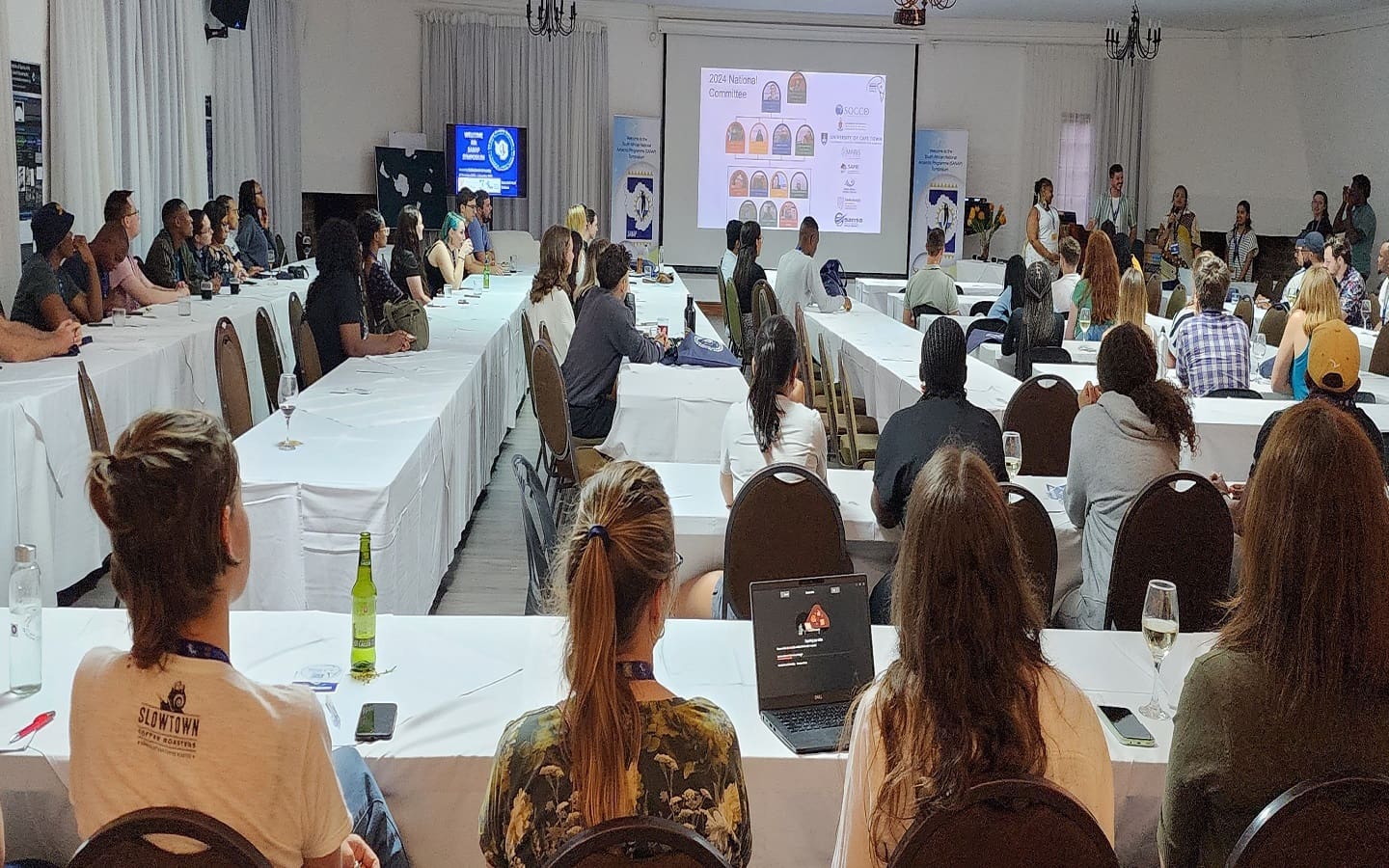 Afterwards a workshop was held by the Association for Polar Early Career Scientists of South Africa (APECSSA), and they reported back to the SANAP community n Day 3 of the symposium. (Right: Photo Credit: Anché Louw – SAPRI)
 Prior to the commencement of the Symposium, a meeting of the members of the South African national committee for Scientific Committee on Antarctic Research (SCAR) took place chaired by Prof Bettine van Vuuren and was attend in person and online by members of the committee. Prof van Vuuren as chair of the national committee feedback on day 2 of the symposium.
 Over a period of 5 days 172 people participate in the
  The purpose of the symposium was to facilitate the free exchange of scientific information within SANAP research. In the
 It was the first time that so many South African polar researchers were together on the 1st December on International Antarctic Day and a special Antarctic Breakfast took place to commemorate this International Day. A map of Antarctica, was signed and a cake was provided to celebrate the occasion.
 The organising committee would like to thank all participants and attendees for making the 6th SANAP symposium a success and achieving its aim in building a SANAP research Community for the future. We are looking forward to the next Symposium in Kruger National Park in 2025 that will be hosted by a consortium of University of Johannesburg, Fort Hare University and the University of the Free State.