by Ria Olivier | May 10, 2023 | Current Event, Marion Island, News, Overwintering Team, Prince Edward Islands, Research, SANAP, SAPRI, Science, Southern Ocean, Stations, sub-Antarctic, Team member

| TEAM | MAPRU | Affiliation |
| Project Name | Avian scavengers & seabirds |
| Principal Investigator | Dr Maëlle Connan | MAPRU, Nelson Mandela University |
| Co-Investigator | Prof Peter Ryan | Fitzpatrick Institute of African Ornithology, University of Cape Town |
| M79 Field Assistant | Lucy Smyth | MAPRU, Nelson Mandela University |
| M80 Field Assistant | Christopher Jones | MAPRU, Nelson Mandela University |
| M80 Field Assistant | Michelle Risi | MAPRU, Nelson Mandela University and the South African Polar Research Infrastructure (SAPRI) |
This team is studying seabirds at Marion Island and has two projects for the period 2021-2023:
1) Avian scavenger project focusing mostly on Black-faced Sheathbill, Kelp Gull and Brown Skua as well as some of their prey.
2) FitzPatrick long-term monitoring of Wandering Albatross, Grey-headed Albatross and Northern Giant Petrel.
More about the avian scavenger project:
This project started in 2021. It is tightly linked to the Mouse-Free Marion project.
Our aim is two fold: 1) we fill identified scientific gaps at the bird level that are crucial for best planning of the mouse eradication and development of appropriate mitigation measures. We are mostly focusing on three species of avian scavengers: Black-faced Sheathbill, Kelp Gull and Brown Skua and some of their prey. 2) we propose to use the three scavengers as indicators of recovery of the terrestrial ecosystem post-eradication by establishing baselines for the scavenger guild and their prey against which the impact of a successful mouse eradication can be measured in years to come.
More about the FitzPatrick long-term monitoring project:
The FitzPatrick long-term monitoring of Wandering and Grey-headed albatrosses and Northern Giant Petrel started in the early 1980s and has continued ever since. This individual-based monitoring of threatened species allows us to study the threats they face at sea (e.g. fisheries) and on land (e.g. mice) in order to act and decrease these threats and improve the conservation status. The species’ long-term monitoring is crucial as it allows us to decipher abnormal years from long-term trends.
More about the fieldwork:
The two projects above involve for example extensive counts of birds, lots of hiking, observations of bird behavior and record keeping of the activity of known individuals year after year.
What are your plans for this takeover:
During the takeover, we will be debriefing the year of Lucy Smyth who has worked on the island for our projects since April 2022. We will also train Chris and Michelle for the year ahead in all aspects, from field work to data entry and back-ups.
Follow MAPRU:
Follow PFIAO:
Text by Dr Maëlle Connan.
Images supplied by Christopher Jones.
Featured image: The MAPRU takeover 2023 team. L-R: Dr Maëlle Connan (PI), Lucy Smyth (M79 MAPRU Field Assistant), Michelle Risi (M80 MAPRU Field Assistant) and Christopher Jones (M80 MAPRU Field Assistant). Image taken on the Western side of the island.
Anche Louw, South African Polar Research Infrastructure (SAPRI DPS Node), 10 May 2023
by Ria Olivier | May 5, 2023 | Invasion Biology, Marion Island, Mice Eradication, News, Prince Edward Islands, Research, SA Agulhas II, SANAP, Southern Ocean, Stations, sub-Antarctic, Team member
| TEAM | Mouse-Free Marion |
| Project Name | Longitudinal monitoring of terrestrial diversity to assess the effects of the planned mouse eradication on Marion Island, and bait and mouse trials to inform further planning for the Mouse-Free Marion Project |
| Project Manager | Dr Anton Wolfaardt |
| Collaborator | Prof. Michelle Greve |
| M79 Field Assistant | Elsa van Ginkel |
| M80 Field Assistant | Camilla Smyth |
The Mouse-Free Marion Project is a partnership between the Department of Forestry Fisheries and the Environment (DFFE) and BirdLife South Africa, working towards an operation to eradicate invasive mice from Marion Island.
The mice, which were introduced accidentally some 200 years ago, have caused great harm to the ecology of Marion Island. They feed on indigenous invertebrates, damage vegetation, and have more recently started eating seabird chicks. As a result, the mice are considered to be a major pest to the island. If they are not removed, the ecosystem of the island will continue to deteriorate, and they will likely cause most of the seabirds on the island to become locally extinct. These seabirds will be lost to the island forever.
In order to monitor how the island recovers after the mice have been removed, we are collecting data on aspects of the island that we expect to improve once the mice are gone. These include the vegetation and invertebrates. Colleagues working on other projects are collecting similar data on seabirds.
The reason why it is important to collect this data before the eradication operation is so that we can compare and monitor how the island changes (improves) as a result of the eradication operation – comparing the island’s vegetation and invertebrate features before and after the operation.
More about your plans for this takeover?
The project will make use of data that have already been collected over many years, primarily through the various long-term monitoring projects that have been undertaken at Marion Island over many years. The focus of our work currently is to fill some pre-eradication (baseline) data on vegetation and invertebrates. This particular work was initiated during the 2022/23 period, and will continue in 2023/24. The takeover period will be used to provide training and orientation to the new Marion80 overwintering team member (Camilla Smyth) and for the current Marion79 Mouse-Free Marion overwintering team member (Elsa van Ginkel) to hand over the field-work responsibilities to Camilla.
The work includes standard invertebrate and vegetation survey techniques to establish a baseline that can be used to monitor how these ecological parameters change following the eradication of invasive mice. These surveys will repeat and build on historical surveys that have been undertaken on the island previously.
We will also be undertaking further bait trials and weather monitoring to help inform the planning of the baiting operation.
Latest takeover update from the island (on 26 April 2023)
Check out the Mouse-Free Marion Website!
Follow MFM on social media for the latest updates:
Text and images supplied by Dr Anton Wolfaardt.
Featured image: The MFM takeover 2023 team. L-R: Dr Anton Wolfaardt (MFM Project Manager), Camilla Smyth (M80 MFM Field Assistant) and Elsa van Ginkel (M79 MFM Field Assistant). Photo taken on Marion Island, April 2023.
Anche Louw, South African Polar Research Infrastructure (SAPRI DPS Node), 05 May 2023
by Ria Olivier | May 2, 2023 | Current Event, Mammology, Marion Island, News, Research, SANAP, Science, Southern Ocean, sub-Antarctic
| TEAM | MIMMP |
| NRF-SANAP Funded Project Name | Marion Island Marine Mammals in Changing Environments: Individual Heterogeneity and Population Processes |
| Principal Investigator | Prof Nico de Bruyn |
| Affiliation | Mammal Research Institute, University of Pretoria |
| Takeover Sealer | Yinhla Shihlomule |
| M79 Sealer | Michael Ross |
| M79 Sealer | Banele Dosi |
| M79 Killer whaler | Monica Leitner |
| M80 Sealer | Zafar Monier |
| M80 Sealer | Dylan Seaton |
| M80 Killer whaler | Tammy Eggeling |
What are your plans for this takeover?
Into our 41st uninterrupted year of continuous monitoring! Takeover is mostly dedicated to training the new overwintering personnel, because most of the action (from a seal perspective) on the island take place outside takeover timeframes. Many long-term questions, aimed at understanding the ecology of the various species populations and their interactions with a changing environment, are pursued.
What are the main interest of the MIMMP in the sub-Antarctic region?
We are interested in how seal and killer whale populations change as the environment changes.
In more detail:
MIMMP does long-term ecological monitoring and research of four marine mammal species (Southern elephant seals, Antarctic – and Subantarctic fur seals, and Killer whales) at Marion Island. Focused primarily on population and foraging ecology, interactions between species and with their changing environments.
Check out the MIMMP Website!
Follow MIMMP on social media for the latest updates:
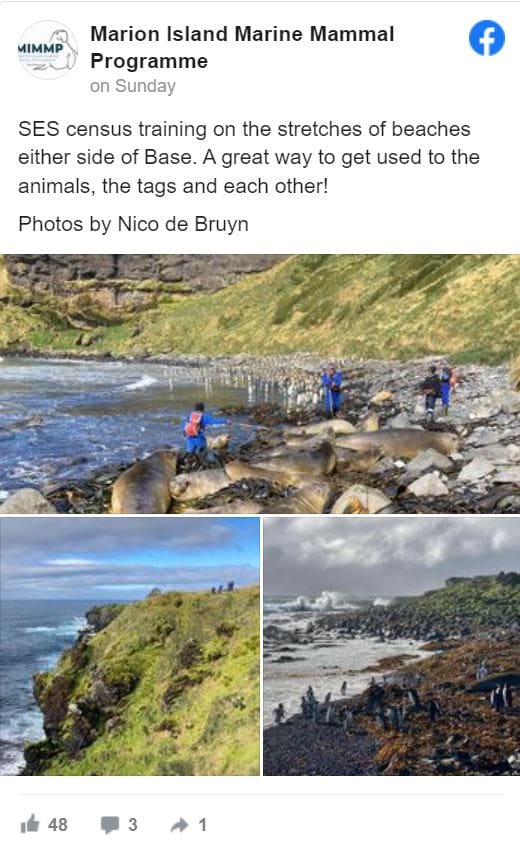
Most recent post on Facebook:
Text and images supplied by Prof Nico de Bruyn.
Featured image: The MIMMP takeover 2023 team. L-R: Dylan Seaton (M80 Sealer), Zafar Monier (M80 Sealer), Prof Nico de Bruyn (PI) and Tammy Eggeling (M80 Killer whaler). Photo taken in Cape Town, on board the S.A Agulhas II, before departure.
Anche Louw, South African Polar Research Infrastructure (SAPRI DPS Node), 02 May 2023
by Ria Olivier | Apr 20, 2023 | Announcement, Antarctica, Prince Edward Island, Research, SA Agulhas II, SANAE IV, Science, Southern Ocean, sub-Antarctic
The NRF-SANAP Funding call is now open!
Click on the link below to access the submission portal.
Have you registered on NRF Connect?
Submission deadline: 15 June 2023
Important Documents – as indicated on the NRF website
(Please click on the images below to open the various documents)
Anche Louw, South African Polar Research Infrastructure (SAPRI DPS Node), 20 April 2023
by Ria Olivier | Mar 23, 2023 | Commemorative Days, International Days, Marion Island, Meteorology, Overwintering Team, SANAP, Southern Ocean, sub-Antarctic
Message from the Metkassies (Meteorological Technicians) currently on Marion Island.
Happy World Meteorological Day from the Metkassies on the 79th Marion Island overwintering team.
The South African Weather Service (SAWS) has been running a Meteorological station at Marion Island since 1950s.
As meteorological technicians, we preform monthly conformance and verification of the Automatic Weather Station (AWS) instruments.
This is normally done on a monthly basis to verify, check and maintain the weather station to ensure that the required standards of the South African Weather Service (SAWS) are met. In South Africa, SAWS is the voice for weather and climate forecasting and also a member of the World Meteorological Organization (WMO).
Happy Meteorological Day from the Metkassies on the 79th Marion Island overwintering team.
Senior Metkassie: T. Sikhwari
Assistants Metkassies: T. Tshitavhe and S. Faltein
Read more about the Marion met station here
Text: Thendo Sikhwari, Senior Meteorological Technician, M79
Edited: Anche Louw, South African Polar Research Infrastructure (SAPRI), 23 March 2023
by Ria Olivier | Mar 8, 2023 | Commemorative Days, International Days, Marion Island, Meteorology, Overwintering Team, Southern Ocean, sub-Antarctic, Team member, Women in Science
In celebration of International Women’s Day, we came in contact with Tanganedzani “Tanga” Tshitavhe. She is an Assistant Meteorological Technician, for the South African Weather Service (SAWS), on the sub-Antarctic Marion Island.
This is a strong woman, with passion for her work and the sub-Antarctic environment. She also has a great sense of humour.
This is her message for all women out there:
“Today we celebrate the resilience, strength, grace, and beauty of women all around the world. On this day, let’s remember the importance of equity, work towards creating a more inclusive world, and honour the contributions and achievements of women”.
I mentioned she has a great sense of humour:
Today we are having a clear sky (sunshine) on Marion Island and as the Weather-Lady, here is a Sun pun.
Question:
Why is the Sun not very heavy to carry?
Answer:
Because it is very light
Wishing you all a happy International Women’s Day day filled with joy and laughter.
Text and photos supplied by: Tanganedzani Tshitavhe (Marion79)
Edited: Anche Louw, South African Polar Research Infrastructure (Data, Products and Society Node), 08 March 2023.