by Ria Olivier | Sep 13, 2023 | Announcement, Antarctica, Engineering, Gough Island, Marion Island, News, Prince Edward Islands, Research, SA Agulhas II, SA Polar Research Infrastructure, SANAP, SAPolarRI, SAPRI, Science, Southern Ocean, Stations

On the 1st of August, Errol Julies joined the South African Polar Research Infrastructure (SAPRI) as a Senior Electronics Technician, bringing with him a wealth of experience and a diverse skill set. His responsibilities at SAPRI encompass the maintenance of offshore marine infrastructure, asset management and supply chain management processes, providing technical support to researchers and students, ensuring compliance with the Occupational Health and Safety Act, and upgrading communication systems at the South African National Antarctic Programme (SANAP) research stations (bases), particularly the High Frequency (HF) systems at Marion Island between the base and field huts. Errol’s previous background and experiences make him an ideal fit for his role at SAPRI, where he continues to make significant contributions.
Meet Errol Julies: A Remarkable Journey of dedication and expertise
Errol Julies, hailing from the small town of De Doorns and having attended secondary school in Worcester, has embarked on an extraordinary path that has led him to become a highly accomplished professional in the scientific and research field.
Errol’s initial foray into the world of work began as an assistant train driver, but it was his introduction to the scientific realm at the Hermanus Magnetic Observatory (HMO), now known as the South African National Space Agency (SANSA), that truly ignited his passion. Starting as a general cleaner at HMO, Errol simultaneously pursued part-time studies and eventually obtained a BTech degree in Electrical Engineering.
For an impressive 17 years, Errol served as a Geomagnetic Observatory Technician at SANSA. In this role, he excelled in installing, maintaining, and monitoring geomagnetic and Magnetotelluric stations across Southern Africa. These stations adhered to the esteemed INTERMAGNET standards, a testament to Errol’s dedication in ensuring their construction and upkeep at the highest level. Additionally, Errol played a pivotal role in training aspiring geomagnetic observers from around the world during the biannual geomagnetic workshops hosted in different countries.
In 2015, Errol joined the Department of Forestry, Fisheries and the Environment (DFFE) as an Engineering Technician, specialising in telecommunications and instrumentation. His responsibilities encompassed managing the Very Small Aperture Terminal (VSAT) communications system from Cape Town to the SANAP bases, conducting calibration and testing of electronic equipment and instruments, and overseeing the maintenance and upgrade of electronic and HF equipment at all SANAP bases in accordance with specifications. Furthermore, Errol took on the role of Departmental Coordinating Officer (DCO), leading numerous voyages to the SANAP bases and successfully coordinating a voyage to Gough Island all by himself.
Driven by a thirst for knowledge and personal growth, Errol completed his BTech degree in Project Management in 2018, despite the challenges encountered during his voyage to Gough Island. In 2019 and 2020, he further demonstrated his resilience and expertise by overwintering on Gough Island as a Communication Engineer and team leader on the 65th Gough Island overwintering team. Currently, Errol is pursuing a Post Graduate Certificate in Education (PGCE), focusing on Mathematics and Mathematics Literacy for the Senior Phase and Technical Vocational Education and Training (TVET) colleges. This endeavor aims to support learners and students in his community through evening classes.
Errol Julies’ journey is a testament to his unwavering dedication, expertise, and commitment to excellence. His remarkable achievements and vast knowledge in the scientific and research field make him an invaluable asset to any organisation fortunate enough to have him on board.
Welcome to the SAPRI team, Errol!
Images supplied by Errol Julies.
Anche Louw, South African Polar Research Infrastructure, 13 September 2023
by Ria Olivier | Jul 27, 2022 | Antarctica, Current Event, Engineering, Research, SA Agulhas II, SANAP, Science, Southern Ocean, STEM
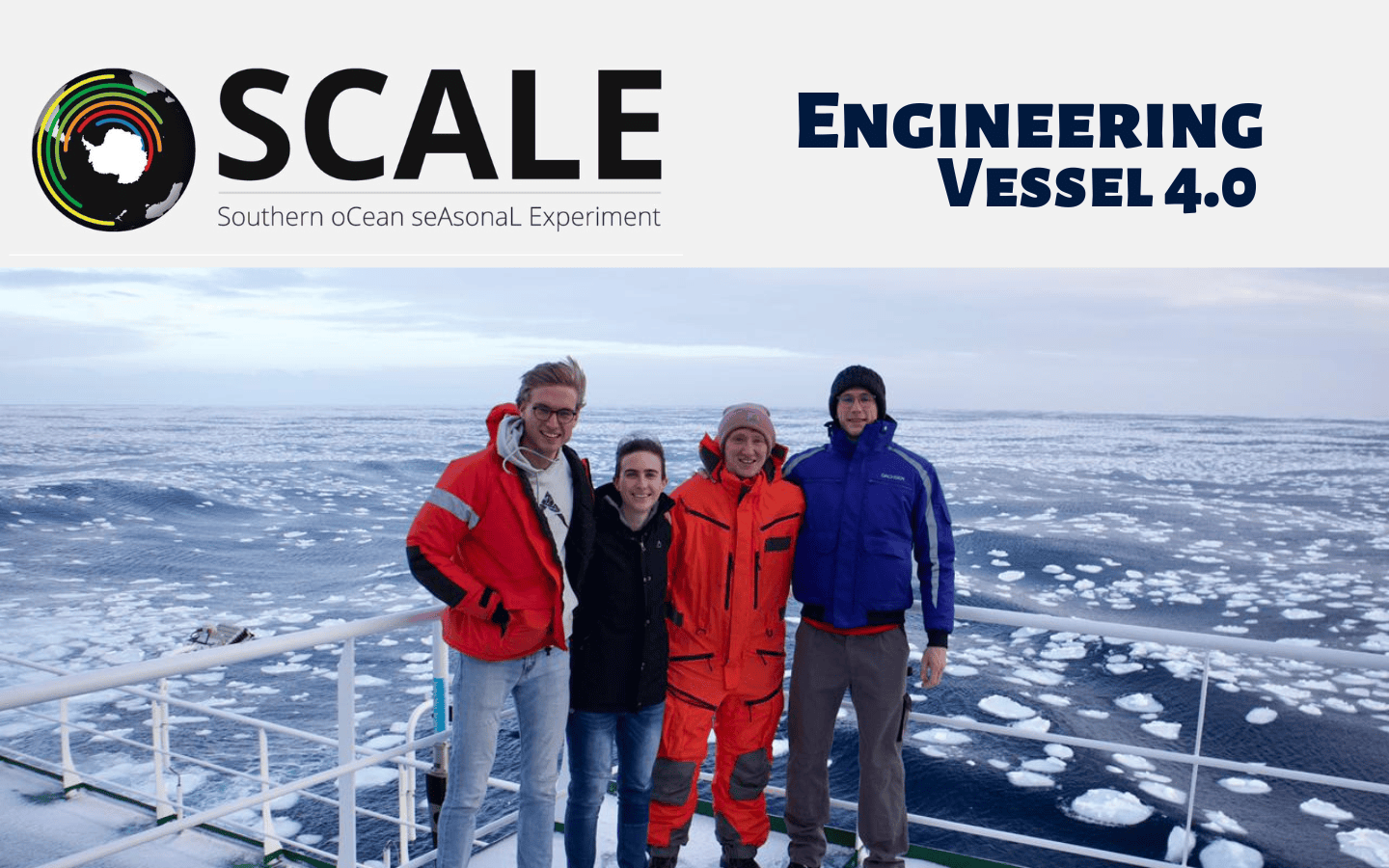
Vessel 4.0 team photo in marginal ice zone. In the photo (left to right): Christof van Zijl, Nicole Taylor, Marek Muchow and Markus Gilges.
| TEAM | VESSEL 4.0 |
| Project name | The Digital SA Agulhas II – Flagship for Vessel 4.0 |
| Principal Investigator | Annie Bekker | Stellenbosch University |
Onboard team members:
| Team Member | Role | Affiliation |
| Nicole Taylor | PhD
Onboard Team Leader | Stellenbosch University |
| Marek Muchow | PhD | Aalto University (Finland) |
| Christof van Zijl | PhD | Stellenbosch University |
| Markus Gilges | PhD | RWTH Aachen University (Germany) |
More about the team and the project:
Nicole and Christof of the Sound and Vibration Research Group of Stellenbosch University, in collaboration with Markus of the HealthProp consortium and Marek of Aalto University, comprise the Vessel 4.0 team. The aim of Team Vessel 4.0 is to investigate the responses of the S.A. Agulhas II as she travels through open water and sea ice during SCALE Winter Cruise 2022.
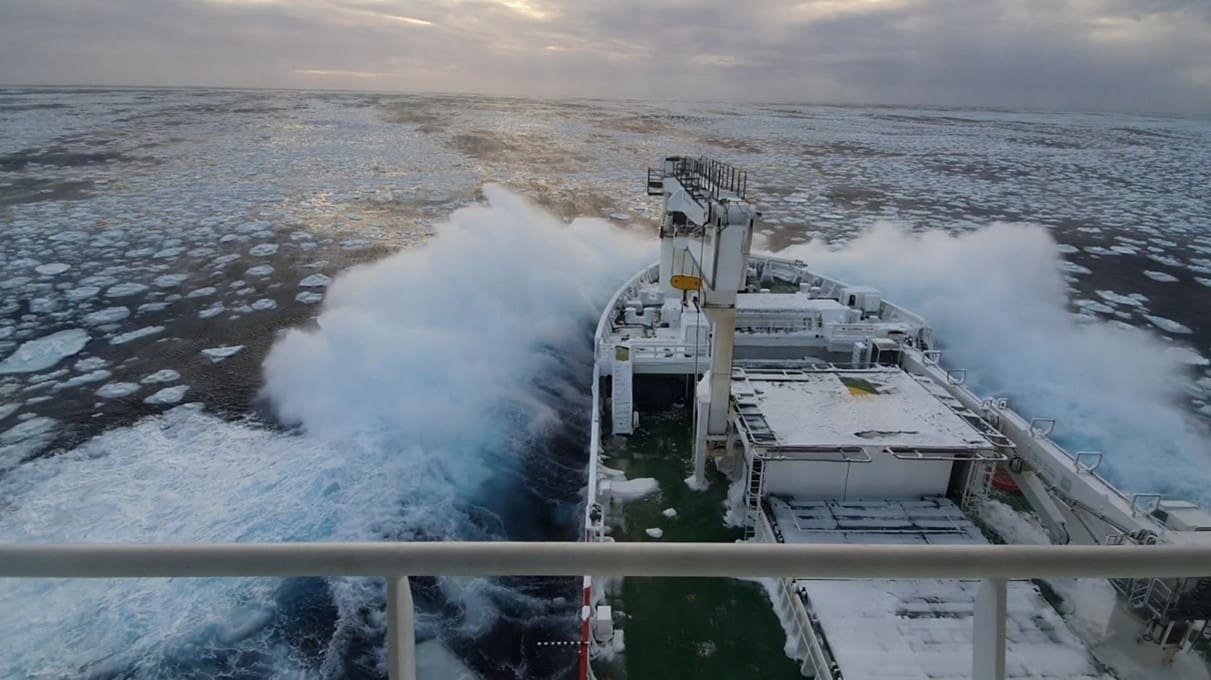
The S.A. Agulhas II is instrumented with a multitude of sensors, like accelerometers and strain gauges. These sensors function like an internal nervous system, enabling the Vessel 4.0 team to “sense” each vibration and motion of the ship as she breaks through waves and sea ice. So far, the S.A. Agulhas II has had to endure repeated “belly-flops” as she slams into incoming waves (see image below), as well as noteworthy rolling and pitching motions as she climbs and descends large swells on her journey through the Southern Ocean.
The S.A. Agulhas II in a bow slam while in the marginal ice zone (MIZ). Photo Credit: Nicole Taylor.
The team is particularly interested in studying the loads that the ice and waves cause to the hull and propulsion system of the ship. They perform engineering analyses of measurements from the hull and propulsion system to understand how intensively the Southern Ocean and its sea ice require the S.A. Agulhas II to work while navigating through winter conditions. In the image below (left), Markus is shown monitoring his measurement system located in the shaft line.
Additionally, the team is performing visual observations of the sea and ice state around the S.A. Agulhas II throughout the time of the cruise. It helps to record details about the environment that the ship encounters so that the team members have a clearer picture of what the installed nervous system is sensing. Team members spend hours being the “eyes” of the nervous system, writing down metrics like what the wave height and the direction of the main wave train is when in open water, or, when in ice, how thick the ice is and what type of ice the ship is breaking through. Christof is shown seated in the bridge while recording the sea ice conditions in the image above (right). The ice observations are done 24/7 while they are in the marginal ice zone with spotlights on during the night.
The team also uses other instruments, like cameras and lasers, to take measurements and snapshots of the ship’s environment. These really help when working through the measurements and visual observations back in the office after the cruise to understand what happened on board. In the image below Marek, Nicole and Christof are shown in the process of installing an ice thickness measurement system at the bow of the ship.
Ice thickness measurement system installation. In the photo (l-r): Nicole Taylor, Marek Muchow and Christof van Zijl. Photo credit: Kurt Martin.
Along with carefully studying the ship and the environment she interacts with, the team has recruited passengers to participate in their human response research to better understand how people experience living and working on board. During Winter Cruise, the team has distributed custom-developed human-centric software in conjunction with more traditional questionnaires. Through the Mariner 4.0 mobile application and daily diary booklets, participants are equipped to record their daily perception of vibration, noise and motion that may cause them discomfort or illness. The Mariner 4.0 application enables real-time data capturing and analysis on board that has a greater aim to support monitoring and managing of human activities. For example, this could be used to assist with planning research on board and navigation decisions to maximize the time during which researchers are estimated to be the least motion sick and able to work well.
Read more about the research that Team Vessel 4.0 team members are part of:
Text supplied by Team Vessel 4.0
Featured images supplied by Kurt Martin (SAPRI trainee)
Anche Louw, Antarctic Legacy of South Africa, 27 July 2022
by Ria Olivier | Jul 26, 2022 | Antarctica, Current Event, Engineering, Research, SA Agulhas II, SANAP
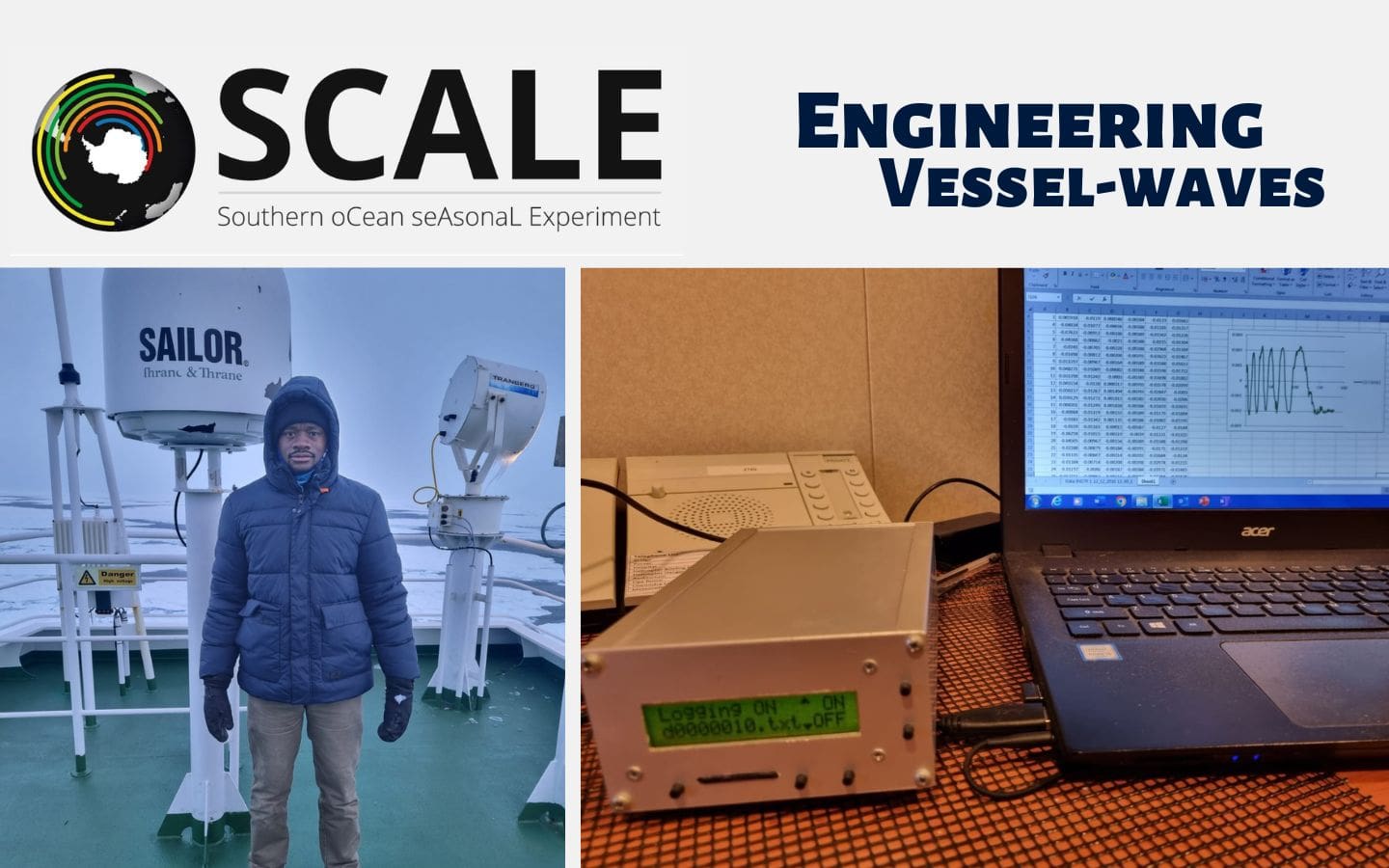
L-R: Paul Senda (onboard team member). Data recorded with the sensor in Room 7320 are being interpreted with mathematical modeling.
| TEAM | VESSEL-WAVE |
| Project name | Reconstruction of sea surface elevation from moving vessel |
| Principal Investigator | Butteur Ntamba Ntamba | Cape Peninsula University of Technology (CPUT) |
| Onboard team member/team leader | Paul Senda | CPUT |
More about the project:
Four IMU (Inertia Measurement Unit) sensors are installed on the S.A. Agulhas II – two sensors are near the center of gravity of the ship, one on the monkey deck and one on deck 7 (Room 7320 – for quick verification of the code). The sensor is a small, self-contained strap-on system and records the time series of roll, pitch and heave.
We know the ship’s response to waves, as described by Response Amplitude Operators (RAO). These must be computed numerically from the shape of the ship’s hull (the hull of the SAAII, which I obtained while she was on dry dock in 2019. We did a 3D scan of the vessel with Prof Bekker). We have developed software which relates the observed time series with the RAOs to the statistical characteristics of the sea state. Once it works, we can use a ship as a sensor for the sea state in which it travels.
Data recorded using the IMU are used to verify the algorithm or mathematical model and existing software predicting or giving the input to the ship’s motion on the sea which is waves. The understanding of sea waves will allow people or vessels for better seakeeping, seakeeping behavior and identify parts of the ship that affect good seakeeping.
Text and images supplied by Paul Senda.
Anche Louw, Antarctic Legacy of South Africa, 26 July 2022.
by Ria Olivier | Jun 1, 2022 | Announcement, Antarctica, Engineering, News, Newsletters>SANAE Newsletters, Overwintering Team, SANAE, SANAP, Stations, Team member
In this edition:
- Sunsets on Antarctica
- Birthday celebrations
- Get to know the team’s SANSA (South African National Space Agency) HF Radar/ VLF Engineer – Mfezeko Rataza, who celebrated his birthday on 16 April.
What do you find most challenging about being in Antarctica?
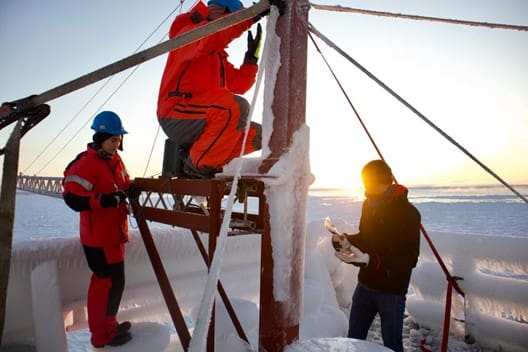
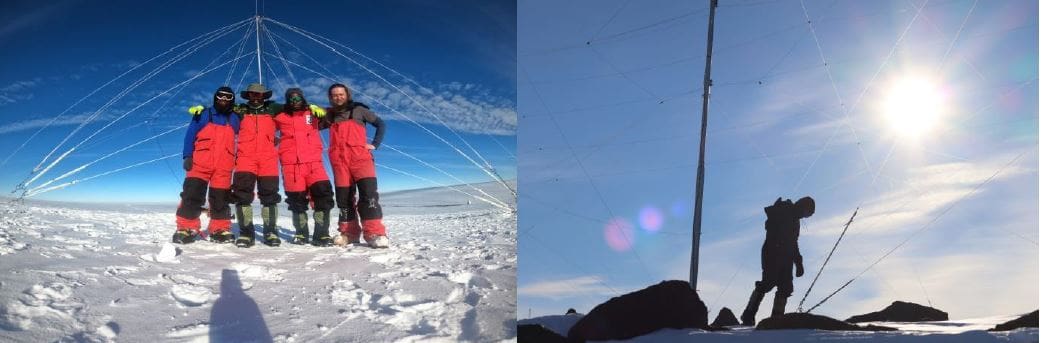
Mfezeko: “The job involve learning about climbing techniques and rope work, because we have to go up these 30 meters antenna to service them whenever there is a breakage sometimes in very cold conditions ( -15 degrees). Imagine trying to tighten a nut with your bear hands when frostbite start to occur after 2-3 minutes exposure”.
Want to read more? Click here to download the April 2022 issue.
Images from S61 April Newsletter. “Fez (Mfezeko) with his SANSA team by the Antennas”.
Birthday Card to Mfezeko Rataza (S61 SANSA Engineer) from Antarctic Legacy of South Africa – 16 April 2022.
Click here to view all the newsletters SANAE 61 has published to this date.
Anche Louw, Antarctic Legacy of South Africa, 01 June 2022
by Ria Olivier | May 11, 2022 | Announcement, Antarctica, Engineering, Environment, News, Research, SA Agulhas II, SANAP, Southern Ocean
Her lecture title is: What can we learn from the way a ship shudders on an icy wreck hunt.
For more info and a link to the LIVE event, click
here.
S.A. Agulhas II Image Credit: Ken Findlay.
Anche Louw, Antarctic Legacy of South Africa, 11 May 2022
by Ria Olivier | Mar 8, 2022 | Engineering, Genomics, International Days, News, Oceanography, Research, SA Agulhas II, Southern Ocean, STEM, sub-Antarctic, Women in Science
The theme for this year’s International Women’s Day is “Break the Bias”.
This year we are featuring three inspiring women within the South African National Antarctic Programme. They are leaders in their fields and represent South Africa on an international level.
Prof Annie Bekker – Stellenbosch University
Professor in Engineering, Director of the Sound & Vibration Research Group, and currently on the international Endurance 22 expedition (Antarctica).
“My job is about applying maths and science to technology… discovering and searching for new things. It is sometimes difficult, it takes long hours, breakthroughs can be incremental… and many times the belief, momentum, and enthusiasm for success have to come from within myself… Today, I love my job and the hard work to this point is absolutely worth it. I could not get here without encouragement, love, and mentorship in key moments. I cannot continue without the support of my family, the example of my colleagues, or the curiosity of my students – their excellence and hunger for their own new frontiers of discovery.
This is your life. Invest in your education. Believe in yourself, try, try again, never give up. Be hungry to learn. Sharpen your skills. Absorb all that is positive around you. Find mentors. Accept responsibility. Rebound from failure. Celebrate success. Be brave. Dream”.
Check out the Sound & Vibraton Research Group website: svrg.sun.ac.za.
Read more about Annie’s work and adventures here.
Prof Isabelle Ansorge – University of Cape Town
Head of the Oceanography Department at UCT and mastermind behind South Africa’s first class afloat – SEAmester.
Isabelle Ansorge is an observational oceanographer, Professor, and first female Head of the Oceanography Department at the University of Cape Town. Having built an observational oceanography career both nationally and internationally, Prof. Ansorge’s interests lie in Indian, Atlantic, and Southern Ocean dynamics that include Southern Ocean eddy transports of heat and salt, frontal dynamics, and variability in the Antarctic Circumpolar Current and its effects on Subantarctic Islands such as Marion Island. Another passion of Isabelle’s is the shipboard training of postgraduate students from all over South Africa and she is the mastermind behind the SEAmester Floating University programme. SEAmester provides an incredible teaching and research platform for South African early-career scientists and lecturers alike. Prof. Ansorge’s list of affiliations is a testament to her extensive experience in the field including being a committee member of the Scientific Committee on Antarctic Research (SCAR), as a member of the start-up committee for the Southern Ocean Observing System (SOOS), as an Executive Bureau Member of the International Union for Geodesy and Geophysics (IUGG) and formally the vice-president of the International Association for Physical Sciences of the Oceans (IAPSO).
Check out the SEAmester website: seamester.co.za.
Read more about Isabelle here.
Prof Bettine van Vuuren – University of Johannesburg
Professor of Zoology, Director of the Centre for Ecological Genomics and Wildlife Conservation, and Chair of the South African Committee for the Scientific Committee on Antarctic Research (SANC for SCAR).
“The first thing to say is that I believe there is nothing that any person can’t do if they apply their mind (and time) to it. We often set our own ceilings based on general beliefs that society or others impose on us, and it is crucial that we break through these (non-real) boundaries. STEM fields are a case in hand. This is especially true for women, who traditionally were seen as homemakers or child-carers. In STEM specifically, fields such as mathematics, physics, and engineering, and traditionally more field-based disciplines such as zoology, botany, or oceanography, are seen as more suited to men (either because women were not traditionally considered as analytically strong, capable to work in the field, or for that matter, be away from home for any period of time). It is critical that any person (both men and women) should carefully consider what they enjoy, what their specific strengths are (be that a STEM career for a woman, or as a childcarer/homemaker for a man), and then pursue that with all their strength and passion. Personally, I was initially directed into a field that I had no interest in (because I could not answer questions asked re where I would work if my husband lived in a small town), and from a personal perspective I strongly urge and support women that want to step out of the usual/ typical / what is expected from you by society and follow what they are passionate about”.
Follow Bettine on Twitter (Click here).
You can also visit her website: molzoolab.co.za.
Meet the SANC for SCAR committee here.
Read more about Bettine here.
Image of Prof Bekker supplied by: James-John Matthee.
Anche Louw, Antarctic Legacy of South Africa, 08 March 2022
 Read more about the research that Team Vessel 4.0 team members are part of:



 Prof Annie Bekker – Stellenbosch University
 Prof Isabelle Ansorge – University of Cape Town