by Ria Olivier | Sep 27, 2022 | Announcement, Antarctica, Legacy, Research, SANAP, SANAP Student, Science, STEM
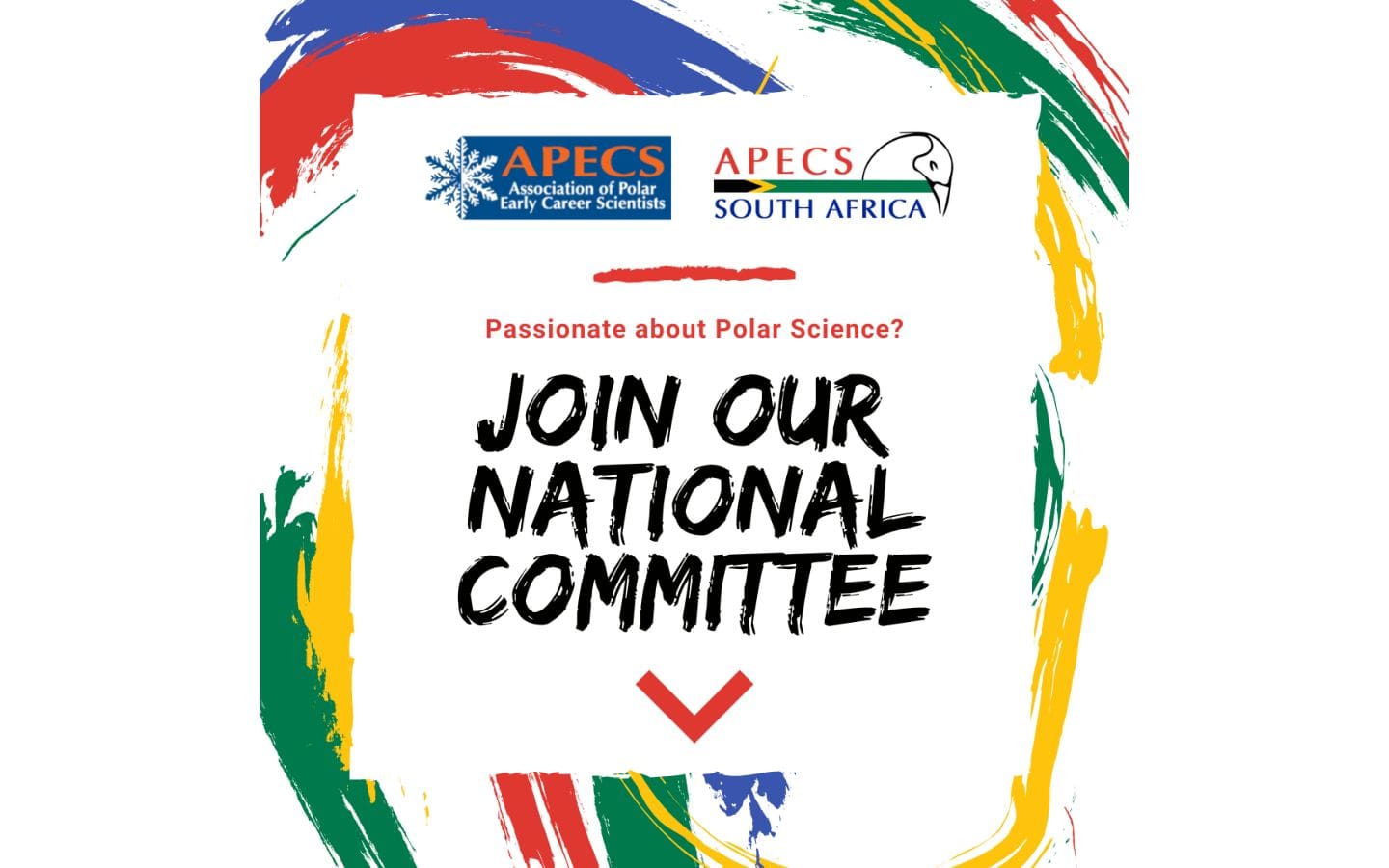 Applications are now open to join the national committee of APECS-SA, the South African National Committee of APECS (Association of Polar Early Career Scientists).
APECS-SA is looking for early career scientists, enthusiasts, naturalists, and good storytellers passionate about Polar Research, to join the team.
As polar researchers, we are responsible for communicating the value of polar research, and APECS-SA needs your help!
If you are not an APECS member yet, join APECS-SA today and apply to be on the National Committee.
Application deadline: 31 October 2022
Apply here!
The current National Committee
Read more about the NC members
Read more about APECS-SA
by Ria Olivier | Aug 17, 2022 | Antarctica, News, Research, SA Agulhas II, SANAP, SANAP Student, Science, Southern Ocean, sub-Antarctic
“SCAR’s mission is to advance Antarctic research, including observations from Antarctica, and to promote scientific knowledge, understanding and education on any aspect of the Antarctic region. To this end, SCAR is charged with the initiation and international co-ordination of Antarctic and Southern Ocean research beneficial to global society. One of the most effective ways to do this is to bring researchers together to share their latest results, discuss new ideas, and provide opportunities to develop new projects” – www.scar.org
SCAR expanded its biennial business meetings to include an Open Science Conference (OSC). This year’s open science conference was held from 1 – 10 August 2022, hosted by India. It made it possible for participants and attendees to discuss current results and develop future projects. The conference included plenary, parallel and satellite events, as well as workshops. Business meetings of the science groups were held before the open science conference.
South Africans participated and attended various sessions during the conference (see details below):
- Keynote speaker Katye Altieri: “Stable isotopes as a tracer of reactive nitrogen emissions and aerosol formation in the Southern Ocean”.(link)
- Bettine van Vuuren chaired a mini-symposium.
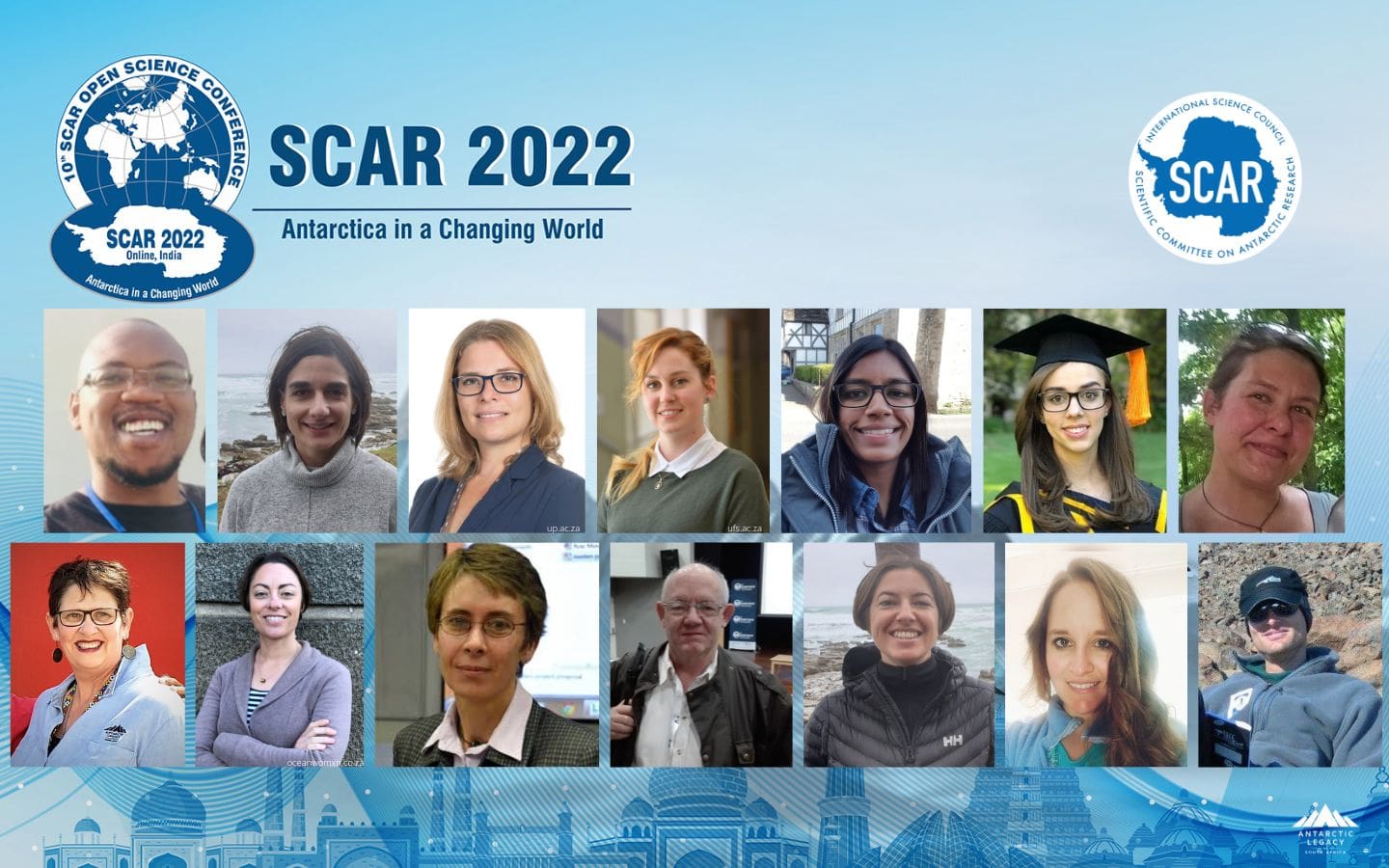
- Christel Hansen, Mia Wege, Geoff Grantham, and Charne Lavery were session convenors.
- The business meetings were attended by Bettine van Vuuren, Sarah Fawcett, Ria Olivier, Christel Hansen, Anche Louw, Charney Lavery, Geoff Grantham, Thulani Makhalanyane and Werner Nel.
Presentations delivered:
- Geoff Grantham: The Age And Chemistry Of Granitic Gneisses From The Western H.U.Sverdrupfjella, Maud Terrane, Western Dronning Maud Land, Antarctica. (link)
- Ria Olivier: Digging into the Past; An archive as a tool to compile and establish a timeline of human impact in our polar heritage (link); Collaboration of South African Researchers in an Extreme Cold Environment. (link)
- Marcel du Plessis: Insights from the SO-CHIC Expedition: what have we done and where are we now? (link)
- Morgan Raath-Krüger: Do Anisotropic Processes Influence Fine-Scale Spatial GeneticStructure Of A Keystone Sub-Antarctic Plant Species? (link)
- Charne Lavery: Antarctica, Africa and the Arts (link)
- Adrienne van Eeden Wharton: On Aftermaths and Afterlives, Afterimages and Aftersounds: Mourning-As-Witnessing Ecological Destruction in the SouthernOcean/S
- Daniela Monsanto: Landscape Genetics Of A Springtail Endemic To Marion Island (link)
- Sophie Kohler: Ice in the Southern Imagination (link)
- Pedro Lebre: Uncovering The Unexplored: The Microbial Ecology Of Sub-AntarcticIsland Soils (link)
E-Posters:
- Liezel Rudolph: A geospatial database for the sub-Antarctic Prince Edward Islands (link)
- Geoff Grantham: The Kuunga Accretionary Complex of Sverdrupfjella, western Dronning Maud Land, Antarctica (link)
- Shilpa Parbhu: Understanding how an invasive springtail adapted to cold sub-Antarctic Marion Island (link)
- Trevor McIntyre: The ontogeny of southern elephant seal foraging migration strategies: finding their way as they go (link)
Antarctic Legacy of South Africa communicated South Africa’s participation and conference-related announcements on Twitter (47 Tweets). A highlight was the session on the discovery of Shackleton’s Endurance, where South Africa was frequently mentioned during the talk.
What is to come:
- SCAR Delegates Meeting (5-7 September 2022)
- All the best to Bettine van Vuuren and Tracy Klarenbeek attending as SA representatives.
All posters and presentations can be found on the ALSA digital archive.
The conference virtual site is still available – if you have missed out on any sessions you can listen to the recordings, and all abstracts and posters can still be downloaded.
Ria Olivier, Antarctic Legacy of South Africa, 17 August 2022.
by Ria Olivier | Jul 12, 2022 | Current Event, News, Oceanography, Research, SA Agulhas II, SA Polar Research Infrastructure, SANAP, SANAP Student, SAPolarRI, Science, Southern Ocean, STEM
SCALE (Southern oCean seAsonaL Experiment) Winter 2022 Expedition (SCALE-WIN22) onboard the RV S.A. Agulhas II
This dedicated science cruise is funded by the Department of Science and Innovation (DSI) and the National Research Foundation (NRF) in support of the scientific community involved in Southern Ocean projects (South African National Antarctic Programme – SANAP and other fundings). The South African Polar Research Infrastructure (SAPRI) and the Department of Forestry, Fisheries and the Environment (DFFE) facilitated the coordination of logistics.
This is a continuation of the SCALE coordinated effort (Southern oCean seAsonaL Experiment) proposed by the South African scientific community as a bottom-up experiment.
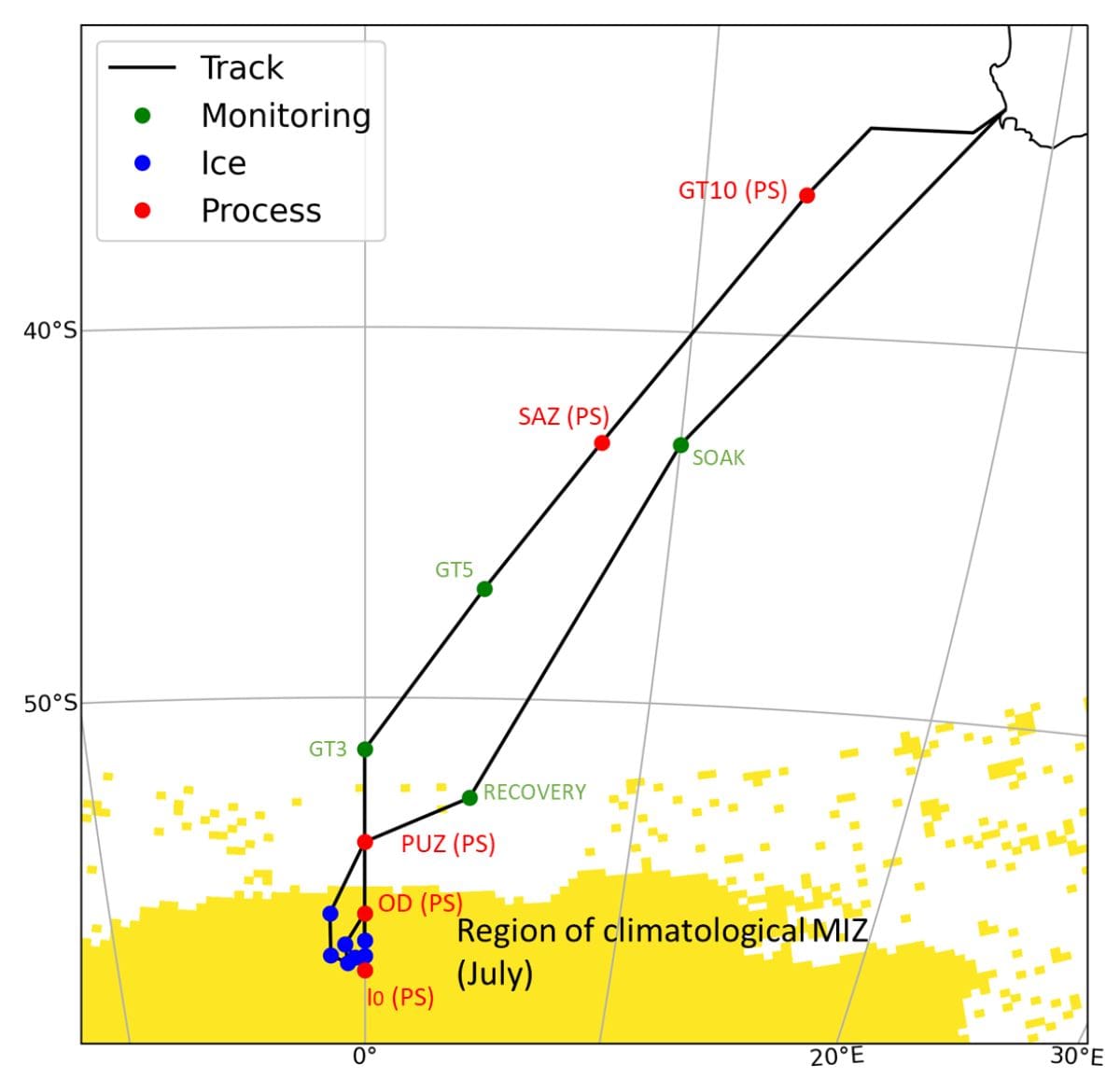
“SCALE-WIN22 will be a 21 days cruise of intensive sampling of the ocean-atmosphere- sea ice processes in the Antarctic polar zone. Multidisciplinary measurements of physical and biogeochemical properties of the ocean and sea ice will be performed in a set of process stations in the outer and inner MIZ”.
Departure: 11 July 2022
ETA back in Cape Town: 31 July 2022
Area of operation: The S.A. Agulhas II will operate from Cape Town to the Marginal Ice Zone (MIZ) along the Good Hope Line.
Provisional map of the track and stations.
Chief Scientists:
| Prof Marcello Vichi (UCT, on board) | Dr Sarah Fawcett (UCT, on land) |
| |
This cruise involves 13 national and 4 international research projects:
These projects will be introduced throughout the course of the cruise.
The number of passengers onboard:
84 passengers onboard the vessel. This number includes the 8 South African Polar Research Infrastructure (SAPRI) trainees.
National and international scientific institutions involved:
1. South African Polar Research Infrastructure (SAPRI) and South African Environmental Network (SAEON)
2. University of Cape Town (UCT)
3. Stellenbosch University (SU)
4. South African Weather Service (SAWS)
5. Cape Peninsula University of Technology (CPUT)
6. Council for Scientific and Industrial Research (Southern Ocean Carbon-Climate Observatory – SOCCO)
7. Department of Forestry, Fisheries and the Environment (DFFE)
8. University of Pretoria (UP)
9. Nelson Mandela University (NMU)
10. Representatives from the University of South Africa (UNISA), Rhodes University (RU), University of Kwa-Zulu Natal (UKZN), University of the Free State (UFS), Walter Sisulu University (WSU)
11. University of Gothenburg, Sweden
12. British Antarctic Survey, UK
13. University of Duisburg-Essen, Germany
14. The University of Melbourne, Australia
15. University of East Anglia, UK
16. Mediterranean Institute of Oceanography (MIO), France
17. CNR, Italy
18. University of Tasmania, Australian Antarctic Division, Australia
19. Aalto University, Finland
20. Finnish Meteorological Institute, Finland
21. SYKE, Finland
22. Alfred Wegener Institute, Germany
East Pier, Port of Cape Town. Cruise participants arriving from the quarantine facility. Only participants with negative Covid-19 test results will be allowed onboard.
The offical cruise hashtag to be followed: #SCALEwin2022
Anche Louw, Antarctic Legacy of South Africa, 12 July 2022
by Ria Olivier | Feb 11, 2022 | Marion Island, Meteorology, Not-Assigned, Oceanography, Research, SA Agulhas II, SANAP Student, Science, Southern Ocean, STEM, sub-Antarctic, Women in Science
In honour of every woman and girl entering the field of science within the Antarctic, sub-Antarctic and Southern Ocean.
Be inspired by the Women in Antarctic, sub-Antarctic and Southern Ocean Science.
Be inspired by the girls taking Marine Sciences as a subject in high school laying the path for their future in science.
Read more about the new SA subject – Marine Sciences: https://bit.ly/3gF9WN7
Anche Louw, Antarctic Legacy of South Africa, 11 February 2022
by Ria Olivier | Jan 7, 2022 | Antarctica, Mammology, News, Research, SANAP Student, Science, Southern Ocean, STEM, Women in Science
Congratulations Mia – from overwintering field assistant to lecturer at the University of Pretoria.
Dr Mia Wege was chosen as one of the “100 Women in Polar Science and Support” featured by Women in Polar Science. Mia is a true ‘go-getter’ and an inspiration to all young women in science!
Her connection with SANAP:
In 2009, her journey within the South African National Antarctic Programme started, where she joined the 66th Marion Island Overwintering Team as a “sealer” (Marion Island Marine Mammal Programme) field assistant (see overwintering team photo below). After this expedition, Mia started an MSc at the University of Pretoria, with her project titled: “Maternal foraging behaviour of Subantarctic fur seals from Marion Island”. During her time as MSc student, she applied to return to Marion Island for another year and returned as part of the 69th Marion Island Overwintering team from 2012 to 2013. In the same year of returning from her last overwinter expedition, she completed her MSc and started working on a PhD with her focus on “Population trend and foraging ecology of sympatric Antarctic and Subantarctic fur seals at Marion Island”. She has been on numerous other take-over expeditions to Marion Island, Gough Island, and Antarctica.
Mia completed her PhD, a 3-year Postdoctoral Research Fellow at the University of Pretoria, and another 1-year Postdoctoral Research Fellow at the University of Canterbury. She was recently employed as a lecturer at the University of Pretoria, Department of Zoology & Entomology.
We would like to congratulate Dr Mia Wege on all her qualifications obtained within the South African National Antarctic Programme and her new position as lecturer.
Her passion for the Antarctic is contagious and we encourage all ECR’s (Early Career Researchers) to work hard work and persevere.
Check out Mia’s website here.
Anche Louw, Antarctic Legacy of South Africa, 07 January 2022.
by Ria Olivier | Jun 16, 2021 | International Days, SANAP, SANAP Student
Today 16 June 2021 on South African Youth Day we congratulate the students within SANAP community that have graduated during the past year.
“The lack of a real graduation ceremony made it less sensational, and we risk to forget that we should celebrate our students’ achievements” – Marcello Vichi
Left: Liezel Rudolph received her PhD certificate (all the way from Fort Hare University) during takeover to Marion Island on the S.A. Agulhas II with supervisors Werner Nel and David Hedding. Right: Brendon Nickerson with his supervisor Annie Bekker at PhD graduation ceremony at Stellenbosch University wearing masks.
| Graduate | Degree | Institution | Supervisor |
| Elizabeth Rudolph | PhD | FH - Geography and Environmental Sciences | Werner Nel, David Hedding |
| Towards an improved understanding of the Southern Ocean’s biological pump: Phytoplankton group-specific contributions to nitrogen and carbon cycling across the Subantarctic Indian Ocean |
| Mapuka Nomsa | MSc | FH - Geography and Environmental Sciences | Werner Nel |
| The characteristics and trends of rainfall on sub-Antarctic Marion Island and associated air circulation patterns |
| Tegan Carpenter-Kling | PhD | NMU - Zoology (MAPRU) | Pierre Pistorius |
| Foraging in a dynamic environment: Movement and stable isotope ecology of marine top predators breeding at the Prince Edward Archipelago’ |
| Heather Forrer | MSc | UCT - Oceanography (Fawcett Lab) | Sarah Fawcett |
| Towards an improved understanding of the Southern Ocean’s biological pump: Phytoplankton group-specific contributions to nitrogen and carbon cycling across the Subantarctic Indian Ocean |
| Mark Hague | PhD | UCT - Oceanography (MARIS) | Marcello Vichi |
| The implications of ice - ocean - atmosphere interactions for phytoplankton phenology in the Southern Ocean |
| Ashleigh Womack | MSc | UCT - Oceanography (MARIS) | Marcello Vichi |
| Atmospheric drivers of ice drift in the Antarctic marginal ice zone |
| Jamie Jacobson | MSc | UCT - Oceanography (MARIS) | Marcello Vichi, A Mishra,R Verrinder |
| Development of Antarctic ice-tethered buoys |
| Ayanda Mpalweni | MSc | UCT - Oceanography (MARIS) | Marcello Vichi, Sarah Nicholson |
| Characterising the seasonal response of the mixed layer and the transitional layer to the passage of storms in the Sub-Antarctic Zone |
| Siobhan Johnson | MSc | UCT - Oceanography (MARIS) | Tokoloho Rampai, Marcello Vichi |
| Evaluation of the changes in the crystal structure of Antarctic sea ice from the marginal ice zone during winter and spring |
| Alexis Osborne | MSc | UCT - Zoology (Fitzpatrick Institute) | Peter Ryan |
| Understanding moult patterns in albatrosses and petrels breeding on Marion and Gough Islands |
| Mancha Mabaso | MSc | UP - Natural & Agricultural Sciences (GRI) | Thulane Makhalanyane |
| Elucidating the effects of physicochemical variables on the structure, composition and functionality of microbiomes in the Prince Edward Islands |
| Sunette Vos | MSc | UP - Natural & Agricultural Sciences (GRI) | Thulane Makhalanyane, Suzanne Fietz |
| Viral-host dynamics in marine environments |
| Liezl Pretorius | MSc | UP - Zoology and Entomology | Greg Hofmeyr, Marthán Bester, Maëlle Connan |
| Effect of sex and ontogeny on the trophic ecology of Southern Ocean fur seals |
| Kyle Lloyd | PhD | UP - Zoology (MIMMP) | Nico de Bruyn, Chris Oosthuizen |
| Individual variation in male southern elephant seal demography |
| Rowan Jordaan | PhD | UP - Zoology (MIMMP) | Nico de Bruyn, Chris Oosthuizen, Ryan Reisinger |
| Demographics of Marion Island killer whales |
| Nico L ü bcker | PhD | UP - Zoology (MIMMP) | Nico de Bruyn, RP Millar |
| Trophic influences, nutritional status, endocrine response on amino acid metabolism and reproduction of mammals |
| Yinhla Shilomule | MSc | UP - Zoology (MIMMP) | Nico de Bruyn, Ar Hoezel, Chris Oosthuizen |
| Hybridization and genetic variation of fur seals at Marion Island |
| Itai Mukutyu | MSc | UP - Zoology (MIMMP) | Nico de Bruyn, Mia Wege |
| Isotopic niche partitioning in sympatric fur seals from Marion Island |
| Caitlin van der Merwe | BSc Honns | UP - Zoology (MIMMP) | Nico de Bruyn, Cheryl Tosh |
| Oceanographic indicators of southern elephant foraging area avoidance |
| Leandri de Kock | BSc Honns | UP - Zoology (MIMMP) | Nico de Bruyn, Chris Oosthuizen |
| Phenology of southern elephant seal moult |
| Brendon Nickerson | PhD | US - Engineering (SVRG) | Annie Bekker |
| Inverse models for ice induced propeller moments on a polar vessel |
| Gerhard Durandt | M.Eng | US - Engineering (SVRG) | Annie Bekker |
| Data driven Regression Models for Voyage Cost Optimization Based on the Operating Conditions of the SA Agulhas II |
| Jesslyn Bossau | M.Eng | US - Engineering (SVRG) | Annie Bekker |
| The Detection and Quantification of Wave slamming from Full Scale Measurements on a Polar Vessel |
| Armand van Zuydam | M.Eng | US - Engineering (SVRG) | Annie Bekker |
| An investigation of the seakeeping behaviour of a polar vessel in waves |
| Nicole Taylor | M.Eng | US - Engineering (SVRG) | Annie Bekker |
| A Human Cyber Physical System Implementation for Seafarers. (Upgraded to PhD) |
| Martnique Engelbrecht | M.Eng | US - Engineering (SVRG) | Annie Bekker |
| Human response to wave induced motion, slamming and whipping. (Upgraded to PhD – awaiting faculty approval) |
| Jean Loock | PhD | US - Geology & Earth Sciences | Alakendra Roychoudhury |
| Austral Summer and Winter Trace Metal Distributions in the Southern Ocean and Antarctic Seasonal Sea Ice |
| Ryan Cloete | PhD | US - Geology & Earth Sciences | Alakendra Roychoudhury |
| The distribution and biogeochemical cycling of bioactive trace metals in the Southern Ocean |
| Tahlia Henry | MSc | Plymouth University - School of Biological and Marine Sciences | Alex Nimmo-Smith |
| Critical analysis of physical drivers of sediment movement at the mouth of the Erme Estuary. |







 Today 16 June 2021 on South African Youth Day we congratulate the students within SANAP community that have graduated during the past year.
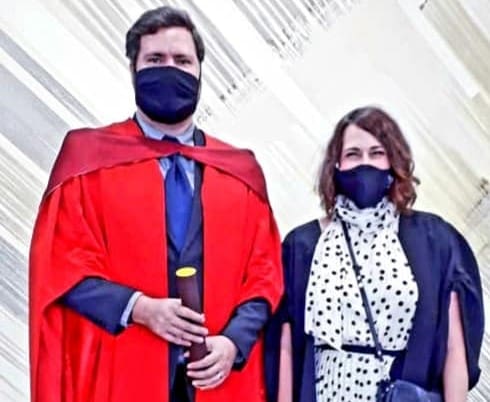 Left: Liezel Rudolph received her PhD certificate (all the way from Fort Hare University) during takeover to Marion Island on the S.A. Agulhas II with supervisors Werner Nel and David Hedding. Right: Brendon Nickerson with his supervisor Annie Bekker at PhD graduation ceremony at Stellenbosch University wearing masks.