by Ria Olivier | Apr 21, 2023 | International Days, News, Research, Science, Southern Ocean
Tomorrow, 22 April 2023, is Earth Day!
We support environmental protection. One way to encourage people to protect the environment is for environmental scientists to communicate scientific findings in a way that is digestible for your audience.

It is with great pleasure that we share that Dr Thomas Ryan-Keogh will be a speaker at TEDx Johannesburg Countdown to talk about the impacts of climate change on the Southern Ocean. “His talk will contribute towards the dialogue and action on climate change and will showcase how the CSIR is contributing towards global research efforts on the impact of climate change in Antarctica and the Southern Ocean”.
Book your seat today!
TEDx Johannesburg is a great platform where “remarkable people doing great work can amplify their ideas on the world wide web”.
“We believe that their ideas, delivered at our sought-after events, and distributed via video on the web, will change the world” – TEDx Johannesburg.
At this event, Tommy will have only 12 minutes to share his recent oceanographic research findings, “which showed that the natural carbon cycle in the Southern Ocean is being impacted and that it could be causing even more harmful climate impacts. These findings were recently published in the top-rated journal Science under the title: Multidecadal trend of increasing iron stress in Southern Ocean phytoplankton” – CSIR
Source: TEDxJohannesburg Countdown
Tommy is the Chair of the Association of Polar Early Career Scientists of South Africa. APECS-SA is a “National Committee of APECS international, a non-profit and voluntary organization which focuses on improving communication between young polar researchers on a local and international level.”
On Social Media:
Watch this video below and learn more about the current climate crisis and The Intergovernmental Panel on Climate Change (IPCC) climate report.
“This is an important message for the world to take in: make the economy, make the development clean and climate friendly” Hoesung Lee (Chair of the IPCC).
Find the IPCC report here.
Anche Louw, South African Polar Research Infrastructure (SAPRI DPS Node), 21 April 2023
by Ria Olivier | Mar 23, 2023 | Commemorative Days, International Days, Marion Island, Meteorology, Overwintering Team, SANAP, Southern Ocean, sub-Antarctic
Message from the Metkassies (Meteorological Technicians) currently on Marion Island.
Happy World Meteorological Day from the Metkassies on the 79th Marion Island overwintering team.
The South African Weather Service (SAWS) has been running a Meteorological station at Marion Island since 1950s.
As meteorological technicians, we preform monthly conformance and verification of the Automatic Weather Station (AWS) instruments.
This is normally done on a monthly basis to verify, check and maintain the weather station to ensure that the required standards of the South African Weather Service (SAWS) are met. In South Africa, SAWS is the voice for weather and climate forecasting and also a member of the World Meteorological Organization (WMO).
Happy Meteorological Day from the Metkassies on the 79th Marion Island overwintering team.
Senior Metkassie: T. Sikhwari
Assistants Metkassies: T. Tshitavhe and S. Faltein
Read more about the Marion met station here
Text: Thendo Sikhwari, Senior Meteorological Technician, M79
Edited: Anche Louw, South African Polar Research Infrastructure (SAPRI), 23 March 2023
by Ria Olivier | Mar 8, 2023 | Commemorative Days, International Days, Marion Island, Meteorology, Overwintering Team, Southern Ocean, sub-Antarctic, Team member, Women in Science
In celebration of International Women’s Day, we came in contact with Tanganedzani “Tanga” Tshitavhe. She is an Assistant Meteorological Technician, for the South African Weather Service (SAWS), on the sub-Antarctic Marion Island.
This is a strong woman, with passion for her work and the sub-Antarctic environment. She also has a great sense of humour.
This is her message for all women out there:
“Today we celebrate the resilience, strength, grace, and beauty of women all around the world. On this day, let’s remember the importance of equity, work towards creating a more inclusive world, and honour the contributions and achievements of women”.
I mentioned she has a great sense of humour:
Today we are having a clear sky (sunshine) on Marion Island and as the Weather-Lady, here is a Sun pun.
Question:
Why is the Sun not very heavy to carry?
Answer:
Because it is very light
Wishing you all a happy International Women’s Day day filled with joy and laughter.
Text and photos supplied by: Tanganedzani Tshitavhe (Marion79)
Edited: Anche Louw, South African Polar Research Infrastructure (Data, Products and Society Node), 08 March 2023.
by Ria Olivier | Feb 2, 2023 | Commemorative Days, Current Event, Environment, International Days, Marine Protected Area, Marion Island, Mice Eradication, News, Prince Edward Island, Prince Edward Islands, SANAP, Science, Southern Ocean, sub-Antarctic
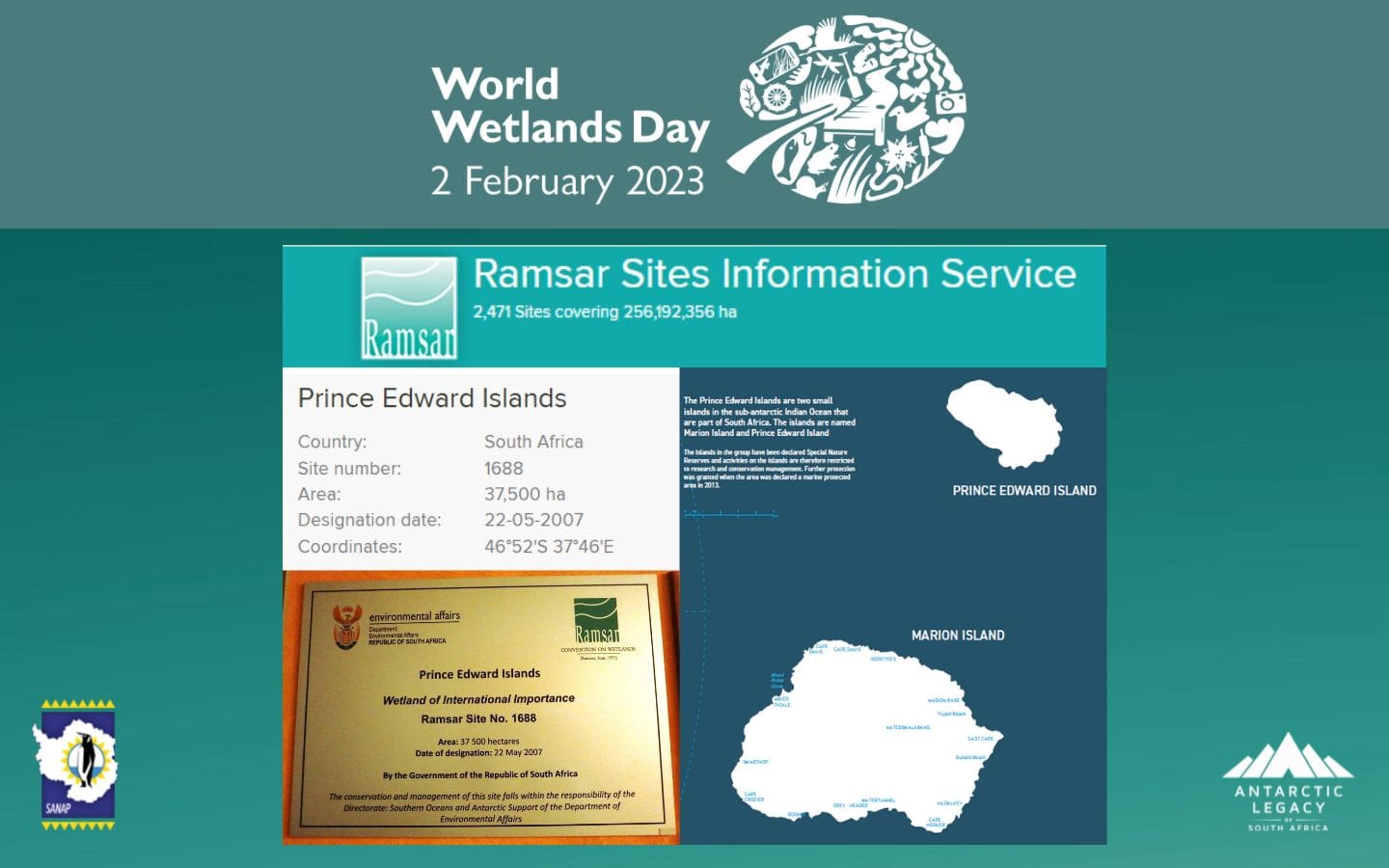
World Wetlands Day, is celebrated every year on 02 February. On this day, in 1971, the Convention on Wetlands of International Importance (Ramsar Convention) was signed in Ramsar, Iran.
World Wetlands Day is celebrated to to “raise awareness and understanding of what wetlands are and how we can contribute towards restoring them through making conscious choices, becoming persuasive voices and taking bold actions” (read more here).
What is a wetland?
A wetland is defined as the land which is transitional between terrestrial and aquatic systems where the water table is usually at or near the
surface, or the land is periodically covered with shallow water, and which land in normal circumstances supports or would support vegetation typically adapted to life in saturated soil (1).
Why is wetland restoration so important? Listed below are a few benefits of wetland restoration:
- Enhanced biodiversity
- Improve water supply
- Store carbon
- Reduced impacts from flooding
- Improve livelihoods
- Enhance well–being
- Protection of agricultural resources (1; 2)
Is your role in wetland restoration important?
Yes! Our individual and collective actions have an impact (1).
What can you as individual do to help protect and preserve wetlands?
- Participate in programs that help protect and restore wetlands.
- Report illegal actions such as unauthorized wetland fill or dredging activities to government authorities
- Pick up litter and dispose in appropriate trash containers. Keep surface areas that wash into storm drains clean from pet waste, toxic chemicals, fertilizers and motor oil, which can eventually reach and impair our wetlands.
- Use native species when planting trees, shrubs and flowers to preserve the ecological balance of local wetlands.
- Avoid wetland when you are expanding your house.
- Use phosphate-free laundry and dishwasher detergents. Phosphates encourage algae growth, which can suffocate aquatic life.
- Use non-toxic products for household cleaning and lawn and garden care. Never spray lawn and garden chemicals outside on a windy day or on a day that it might rain and wash the chemicals into waterways.
- Enjoy the scenic and recreational opportunities wetlands offer, while preserving their integrity for future generations by minimizing the use of heavy equipment and staying in designated visitor areas where available (3).
Did you know that the South African Prince Edward Islands (Prince Edward Island and Marion Island) is declared as Wetland of International Importance?
The Prince Edward Islands was declared Wetland of International Importance: Ramsar Site No.1688, on 22 May 2007. The conservation and management of this site falls within the responsibility of the Directorate: Southern Oceans and Antarctic Support of the Department of Forestry, Fisheries and the Environment.
Want to know about wetlands in South Africa?
Click on the posters to enlarge.
What’s been happening on Social Media
Sources:
1- https://www.worldwetlandsday.org/
2- https://www.dffe.gov.za/event/international/wetlandsday2013
3- https://www.epa.gov/wetlands/what-you-can-do-protect-coastal-wetlands
4- https://rsis.ramsar.org/ris/1688
5- https://alp.lib.sun.ac.za/handle/123456789/15327
6- https://blogs.sun.ac.za/antarcticlegacy/event/world-wetlands-day/
Anche Louw, South African Polar Research Infrastructure, 02 February 2023.
by Ria Olivier | Dec 1, 2022 | Announcement, Antarctica, Environment, International Days
Antarctica Day is celebrated by the international polar community on the 1st of December to commemorate the signing of the Antarctic Treaty, by 12 countries (including South Africa) in 1959.
On 01 December 1959, Antarctica was set aside for peaceful and scientific purposes. Read more about the Antarctic Treaty here.
I would like to quote Dr Renuka Badhe – Executive Secretary of the European Polar Board.
“The polar regions are extremely important and connected to the rest of the planet. The polar regions are essential for the health and future of the fantastic planet earth”.
We need to protect the frozen continent, check out the video below!
Antarctic Legacy of South Africa, 01 December 2022
by Ria Olivier | Nov 10, 2022 | Antarctica, Environment, Gough Island, International Days, Marion Island, News, Research, SA Agulhas II, Science, Southern Ocean, sub-Antarctic
World Science Day for Peace and Development is coordinated each year by UNESCO on 10 November.
The theme of World Science Day for Peace and Development is Basic Sciences for Sustainable Development. This day is being celebrated within the International Year of Basic Sciences for Sustainable Development, which kicked off on 8 July 2022 (UNESCO).
World Science Day for Peace and Development aims to build a bridge between science and society. This should be an encouragement to all scientific programmes to create an open line for communication between scientists and the public. The public needs to be informed about polar research as “the polar regions are extremely important and connected to the rest of the planet. The polar regions are essential for the health and future of the fantastic planet earth” (European Polar Board Executive Secretary, Dr Renuka Badhe).
Keep an eye out for more information on the Antarctic Season Launch 2022 – providing a platform for discussions between the SANAP scientific community and the public.
Scientific projects within the South African National Antarctic Programme (SANAP) are based on basic sciences (Mathematics, Physics, Chemistry, and Biology). Below we point out some of these scientific projects funded by the National Research Foundation (SANAP-Funding).
See below a list of all the research projects funded by the NRF-SANAP. These projects will be funded until the end of 2023.
Researchers previously involved in SANAP and those new to Antarctic research from universities not previously involved in SANAP are encouraged to put in a project proposal once the new cycle for applications opened.
View the current NRF-SANAP projects and previous NRF-SANAP projects here.
Anche Louw, Antarctic Legacy of South Africa, 10 November 2022.



 The Prince Edward Islands was declared