by Ria Olivier | Feb 2, 2023 | Commemorative Days, Current Event, Environment, International Days, Marine Protected Area, Marion Island, Mice Eradication, News, Prince Edward Island, Prince Edward Islands, SANAP, Science, Southern Ocean, sub-Antarctic
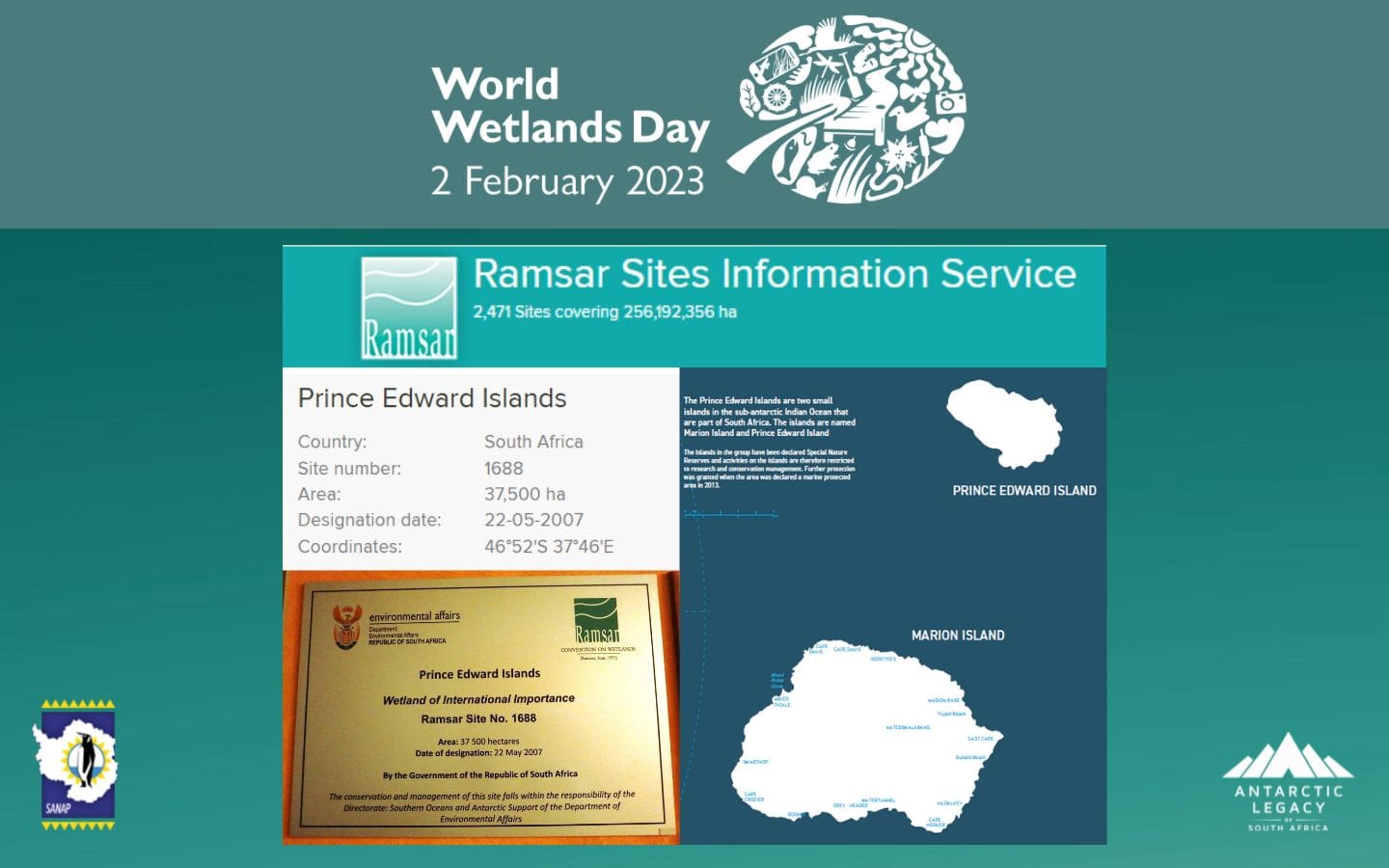 World Wetlands Day, is celebrated every year on 02 February. On this day, in 1971, the Convention on Wetlands of International Importance (Ramsar Convention) was signed in Ramsar, Iran.
World Wetlands Day is celebrated to to “raise awareness and understanding of what wetlands are and how we can contribute towards restoring them through making conscious choices, becoming persuasive voices and taking bold actions” (read more here).
What is a wetland?
A wetland is defined as the land which is transitional between terrestrial and aquatic systems where the water table is usually at or near the
surface, or the land is periodically covered with shallow water, and which land in normal circumstances supports or would support vegetation typically adapted to life in saturated soil (1).
Why is wetland restoration so important? Listed below are a few benefits of wetland restoration:
- Enhanced biodiversity
- Improve water supply
- Store carbon
- Reduced impacts from flooding
- Improve livelihoods
- Enhance well–being
- Protection of agricultural resources (1; 2)
Is your role in wetland restoration important?
Yes! Our individual and collective actions have an impact (1).
What can you as individual do to help protect and preserve wetlands?
- Participate in programs that help protect and restore wetlands.
- Report illegal actions such as unauthorized wetland fill or dredging activities to government authorities
- Pick up litter and dispose in appropriate trash containers. Keep surface areas that wash into storm drains clean from pet waste, toxic chemicals, fertilizers and motor oil, which can eventually reach and impair our wetlands.
- Use native species when planting trees, shrubs and flowers to preserve the ecological balance of local wetlands.
- Avoid wetland when you are expanding your house.
- Use phosphate-free laundry and dishwasher detergents. Phosphates encourage algae growth, which can suffocate aquatic life.
- Use non-toxic products for household cleaning and lawn and garden care. Never spray lawn and garden chemicals outside on a windy day or on a day that it might rain and wash the chemicals into waterways.
- Enjoy the scenic and recreational opportunities wetlands offer, while preserving their integrity for future generations by minimizing the use of heavy equipment and staying in designated visitor areas where available (3).
Did you know that the South African Prince Edward Islands (Prince Edward Island and Marion Island) is declared as Wetland of International Importance?
The Prince Edward Islands was declared Wetland of International Importance: Ramsar Site No.1688, on 22 May 2007. The conservation and management of this site falls within the responsibility of the Directorate: Southern Oceans and Antarctic Support of the Department of Forestry, Fisheries and the Environment.
Want to know about wetlands in South Africa?
Click on the posters to enlarge.
What’s been happening on Social Media
Sources:
1- https://www.worldwetlandsday.org/
2- https://www.dffe.gov.za/event/international/wetlandsday2013
3- https://www.epa.gov/wetlands/what-you-can-do-protect-coastal-wetlands
4- https://rsis.ramsar.org/ris/1688
5- https://alp.lib.sun.ac.za/handle/123456789/15327
6- https://blogs.sun.ac.za/antarcticlegacy/event/world-wetlands-day/
Anche Louw, South African Polar Research Infrastructure, 02 February 2023.
by Ria Olivier | Jan 10, 2023 | Announcement, Antarctica, Current Event, Environment, News, SA Agulhas II, SANAE, SANAE IV, SANAP, Science, Stations
Media Release by the Department of Forestry Fisheries and the Environment
Minister Barbara Creecy visits Antarctica, 9 to 12 Jan
Forestry, Fisheries and the Environment Minister, Ms Barbara Creecy, will on Monday (9 January 2023) visit the Princess Elisabeth Antarctic Research Station as a guest of the Government of Belgium for four days.
The Ministerial visit to the research station is being hosted by the Government of Belgium and the International Polar Foundation, as the operator of the Princess Elisabeth Antarctica under mandate from the Belgian Polar Secretariat.
While at the base the Minister will have an opportunity to learn more about the first zero emissions research station in Antarctica, which has become a showcase for best practice in the use of renewable energies to reduce the environmental impact of operations on Antarctica. The Belgians have expressed their desire to sharing Best Practice to improve the environmental performance of the South African Research Infrastructure in Antarctica.
The Belgian Antarctic Research Expedition (BELARE) uses Cape Town as its gateway.
On Tuesday, 10 January 2023, Minister Creecy will travel from the Belgian base to the South African Antarctic Programme’s Research Station, known as SANAE IV, in Queen Maud Land. At the base, which is managed and administered by the Department of Forestry, Fisheries and the Environment, Minister Creecy will interact with station crew and also inspect the facilities used by the South African scientists. During the visit to the biodiversity hotspot, the Minister will learn about the threats of pollution and research into the human impact on ocean and marine ecosystems threatened by global climate change and earth systems observations.
The S.A. Agulhas II departed Cape Town in December with the team for 2023, also delivering equipment, supplies and fuel.
The department has maintained South Africa’s research presence in Antarctica and the Prince Edward Islands. The scientific data that is collected during voyages is critical to the understanding of amongst other things, the impacts of climate change and weather information associated with extreme events.
The first South African built Antarctic base, a wooden structure, SANAE I, was a Meteorological research station constructed in 1961/62. South Africa has not only maintained an uninterrupted presence in the Antarctic since 1960 but played an active role in the management and conservation of the vast continent and contributed to the pool of scientific knowledge.
MEDIA RELEASE
For media inquiries contact:
Albi Modise
Cell: 083 6490 2871
Ria Olivier, Antarctic Legacy of South Africa, 10 January 2023
by Ria Olivier | Nov 10, 2022 | Antarctica, Environment, Gough Island, International Days, Marion Island, News, Research, SA Agulhas II, Science, Southern Ocean, sub-Antarctic
World Science Day for Peace and Development is coordinated each year by UNESCO on 10 November.
The theme of World Science Day for Peace and Development is Basic Sciences for Sustainable Development. This day is being celebrated within the International Year of Basic Sciences for Sustainable Development, which kicked off on 8 July 2022 (UNESCO).
World Science Day for Peace and Development aims to build a bridge between science and society. This should be an encouragement to all scientific programmes to create an open line for communication between scientists and the public. The public needs to be informed about polar research as “the polar regions are extremely important and connected to the rest of the planet. The polar regions are essential for the health and future of the fantastic planet earth” (European Polar Board Executive Secretary, Dr Renuka Badhe).
Keep an eye out for more information on the Antarctic Season Launch 2022 – providing a platform for discussions between the SANAP scientific community and the public.
Scientific projects within the South African National Antarctic Programme (SANAP) are based on basic sciences (Mathematics, Physics, Chemistry, and Biology). Below we point out some of these scientific projects funded by the National Research Foundation (SANAP-Funding).
See below a list of all the research projects funded by the NRF-SANAP. These projects will be funded until the end of 2023.
Researchers previously involved in SANAP and those new to Antarctic research from universities not previously involved in SANAP are encouraged to put in a project proposal once the new cycle for applications opened.
View the current NRF-SANAP projects and previous NRF-SANAP projects here.
Anche Louw, Antarctic Legacy of South Africa, 10 November 2022.
by Ria Olivier | Nov 2, 2022 | Announcement, Antarctica, Gough Island, Jobs, Marion Island, Prince Edward Island, Prince Edward Islands, SA Agulhas II, SA Polar Research Infrastructure, SANAE, SANAP, SAPolarRI, SAPRI, Science, Southern Ocean, sub-Antarctic
As per job advertisement:
The South African Environmental Observation Network (SAEON) is a research platform funded by the Department of Science and Innovation (DSI) and managed by the National Research Foundation (NRF).
SAEON is mandated to establish and manage long-term environmental observatories; maintain reliable long-term environmental data sets; promote access to data for research and/or informed decision making; and contribute to capacity building.
This position is supported by the Department of Science and Innovation’s South African Polar Research Infrastructure (SAPRI) programme and will be based in Cape Town.
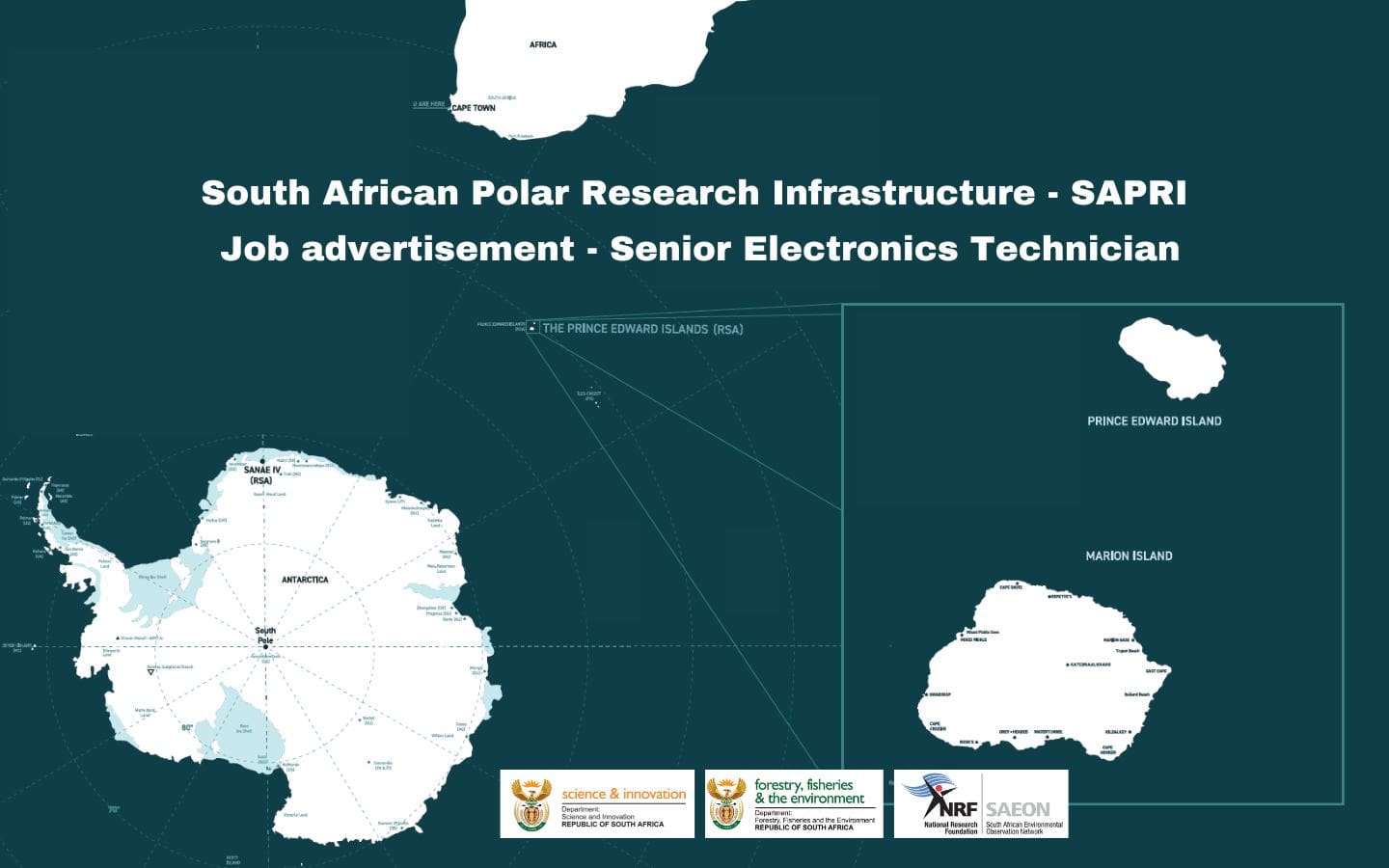
A Senior Electronics Technician to provide technical and logistic support for the SAPRI programme’s various research and long-term monitoring activities in the offshore marine and Southern Ocean, sub-Antarctic Islands and Antarctica, conducted onboard South African and international research vessels.
Application Closing Date: 16 November 2022
Click here to view the position advert.
Read more about SAPRI:
South African Polar Research Infrastructure (SAPRI): Feedback and start of the Preparatory Phase
Anche Louw, Antarctic Legacy of South Africa
by Ria Olivier | Oct 31, 2022 | Announcement, Jobs, Marion Island, News, Overwintering Team, Research, SANAP, Science, Southern Ocean, Stations, sub-Antarctic, Team member
The following positions are available on the sub-Antarctic, Marion Island for the overwintering period (April 2023 to May 2024)
Applications close between 7 November and 14 November 2022.
Click here: View the positions
Anche Louw, Antarctic Legacy of South Africa, 31 October 2022.
by Ria Olivier | Oct 18, 2022 | Announcement, Antarctica, Important Dates, Meetings, News, Research, SANAP, SCAR, Science, Southern Ocean
This is the first announcement for the Scientific Committee on Antarctic Research (SCAR) Biology Symposium 2023 in New Zealand.
Conference Website
Will you be attending/presenting a paper? Let ALSA know!

 The Prince Edward Islands was declared Wetland of International Importance: Ramsar Site No.1688, on 22 May 2007. The conservation and management of this site falls within the responsibility of the Directorate: Southern Oceans and Antarctic Support of the Department of Forestry, Fisheries and the Environment.