by Ria Olivier | Nov 2, 2022 | Announcement, Antarctica, Gough Island, Jobs, Marion Island, Prince Edward Island, Prince Edward Islands, SA Agulhas II, SA Polar Research Infrastructure, SANAE, SANAP, SAPolarRI, SAPRI, Science, Southern Ocean, sub-Antarctic
As per job advertisement:
The South African Environmental Observation Network (SAEON) is a research platform funded by the Department of Science and Innovation (DSI) and managed by the National Research Foundation (NRF).
SAEON is mandated to establish and manage long-term environmental observatories; maintain reliable long-term environmental data sets; promote access to data for research and/or informed decision making; and contribute to capacity building.
This position is supported by the Department of Science and Innovation’s South African Polar Research Infrastructure (SAPRI) programme and will be based in Cape Town.
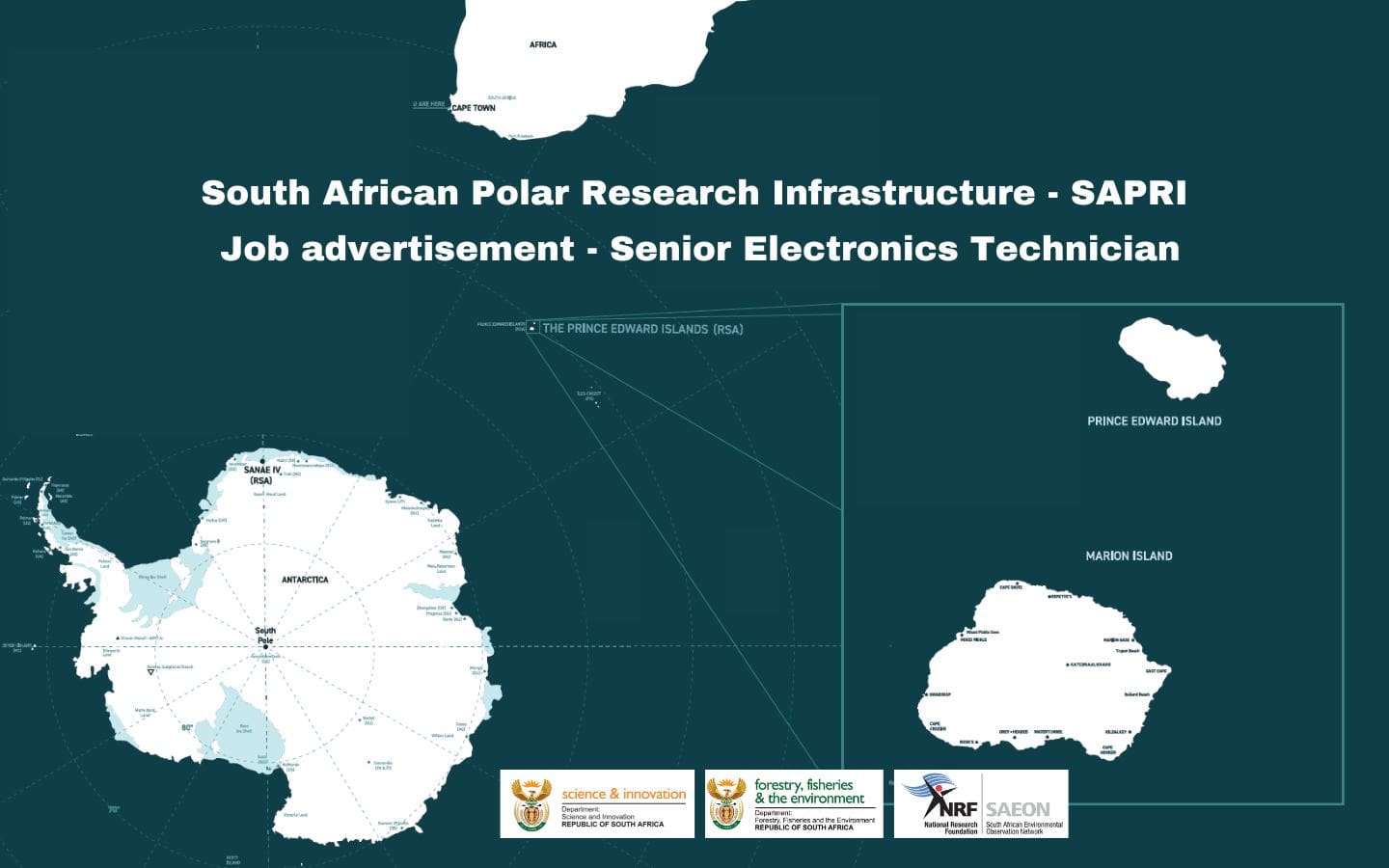
A Senior Electronics Technician to provide technical and logistic support for the SAPRI programme’s various research and long-term monitoring activities in the offshore marine and Southern Ocean, sub-Antarctic Islands and Antarctica, conducted onboard South African and international research vessels.
Application Closing Date: 16 November 2022
Click here to view the position advert.
Read more about SAPRI:
South African Polar Research Infrastructure (SAPRI): Feedback and start of the Preparatory Phase
Anche Louw, Antarctic Legacy of South Africa
by Ria Olivier | Oct 6, 2022 | Announcement, Geomorphology, Marion Island, News, Prince Edward Island, Prince Edward Islands, Research, SANAP, Science, sub-Antarctic
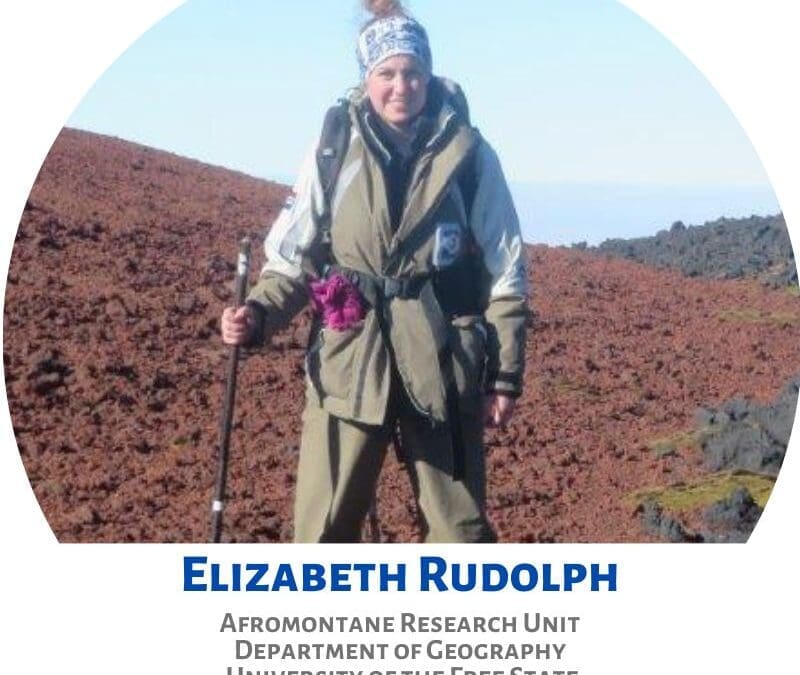
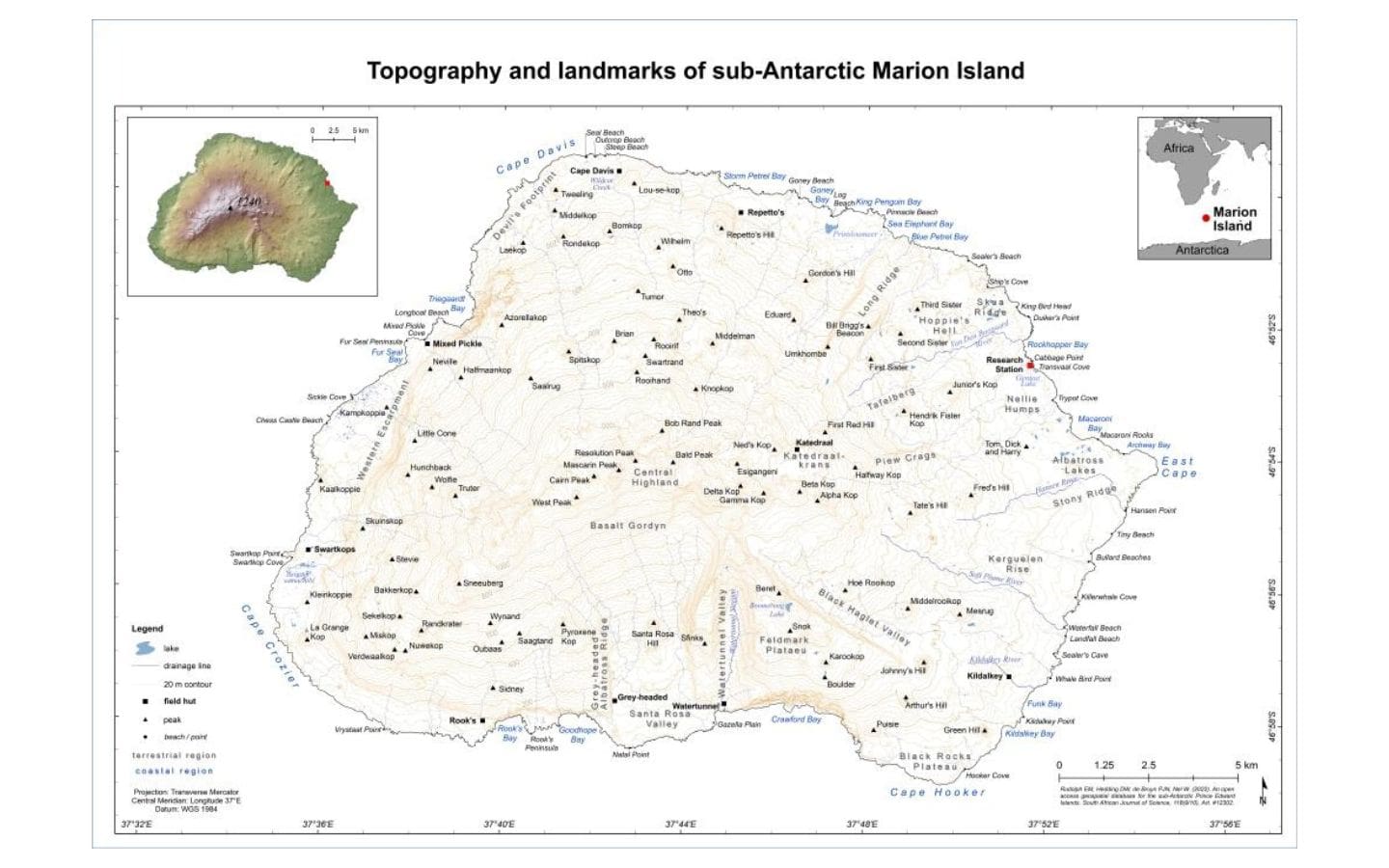
In a new publication, An open access geospatial database for the sub-Antarctic Prince Edward Islands, by Elizabeth Rudolph, David William Hedding, Nico de Bruyn, and Werner Nel, open access is given to a geospatial database for both Marion Island and Prince Edward Island.
Click here to view the full suite of data: Prince Edward Islands Geospatial Database
This paper was presented at the Scientific Committee on Antarctic Research Open Science Conference 2022, in a poster format. Click here to view the poster.
Authors:
Anche Louw, Antarctic Legacy of South Africa, 06 October 2022
by Ria Olivier | Jun 21, 2022 | Antarctica, Current Event, International Days, Marion Island, News, Overwintering Team, Prince Edward Islands, SANAE, SANAP, Southern Ocean, Stations
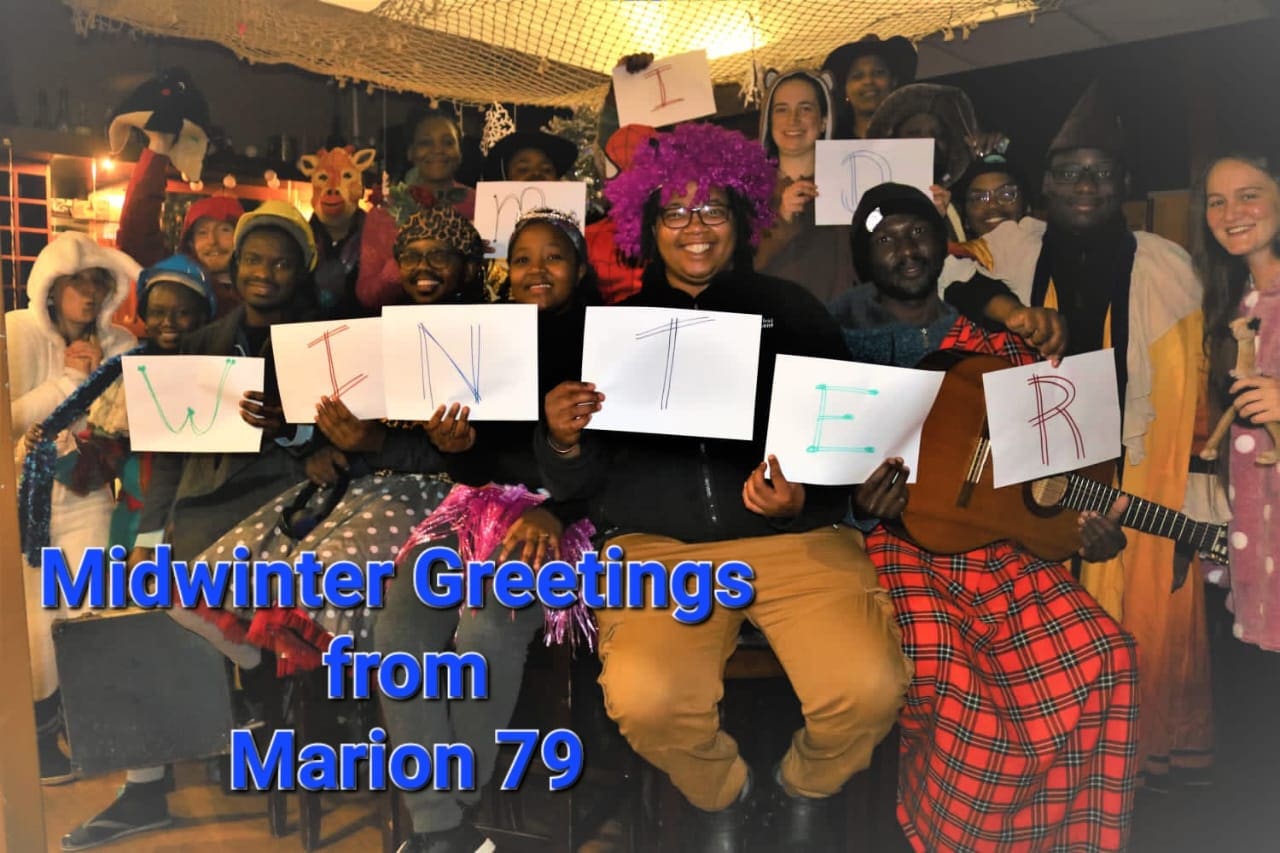
Midwinter’s Day (21 June) is celebrated by the South African National Antarctic Programme (SANAP) overwintering teams on Antarctica (SANAE 61), Marion Island (Marion 79), and Gough Island (Gough 67).
Midwinter is the shortest day, and for those on Antarctica, the darkest day, of the year.
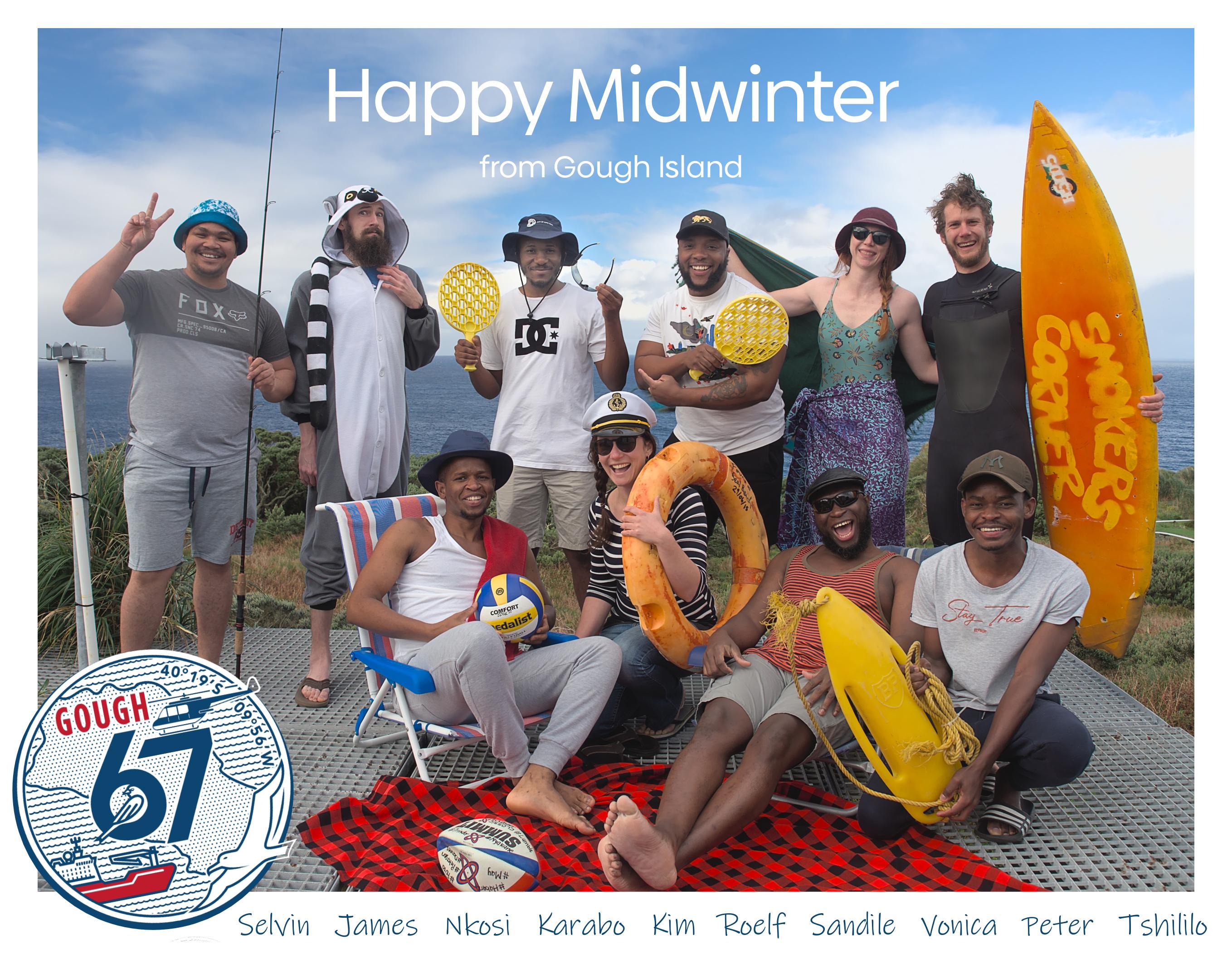
Overwintering teams from all over the world send greeting cards to each other, to family and friends, and to their national Antarctic program communities. We received greeting cards from the three SANAP overwintering teams, wishing all of you a happy midwinter!
Midwinter greetings from the 79th overwintering team on South Africa’s sub-Antarctic Marion Island.
On Antarctica, Midwinter is the midpoint of a time of darkness and extreme isolation and the SANAE team will also celebrate this today!
Midwinter greetings from the 61st SANAE Overwintering Team, on Antarctica.
Midwinter greeting from the 67th Gough Island Overwintering team!
We asked the teams what their plans are for today:
Marion Island: “We are having a nice braai and midwinter games”.
Gough Island: “We have actually already started our own midwinter tournament knockouts (with our semifinals and finals today)! We have a number of events including pool, table tennis, darts, fuzzball, checkers, chess and Mario Cart (TV game).
Quite an exciting lineup”.
SANAE IV: “We will celebrate with some midwinter games”.
Do you want to know more about the teams?
Click here to meet Marion 79!
Click here to meet Gough 67!
Click here to meet SANAE 61!
Thank you for the greeting cards SANAP teams, have a great day!
Anche Louw, Antarctic Legacy of South Africa, 21 June 2022.
by Ria Olivier | Jun 19, 2022 | Announcement, Environment, Important Dates, International Days, Marion Island, Prince Edward Islands, Southern Ocean, sub-Antarctic
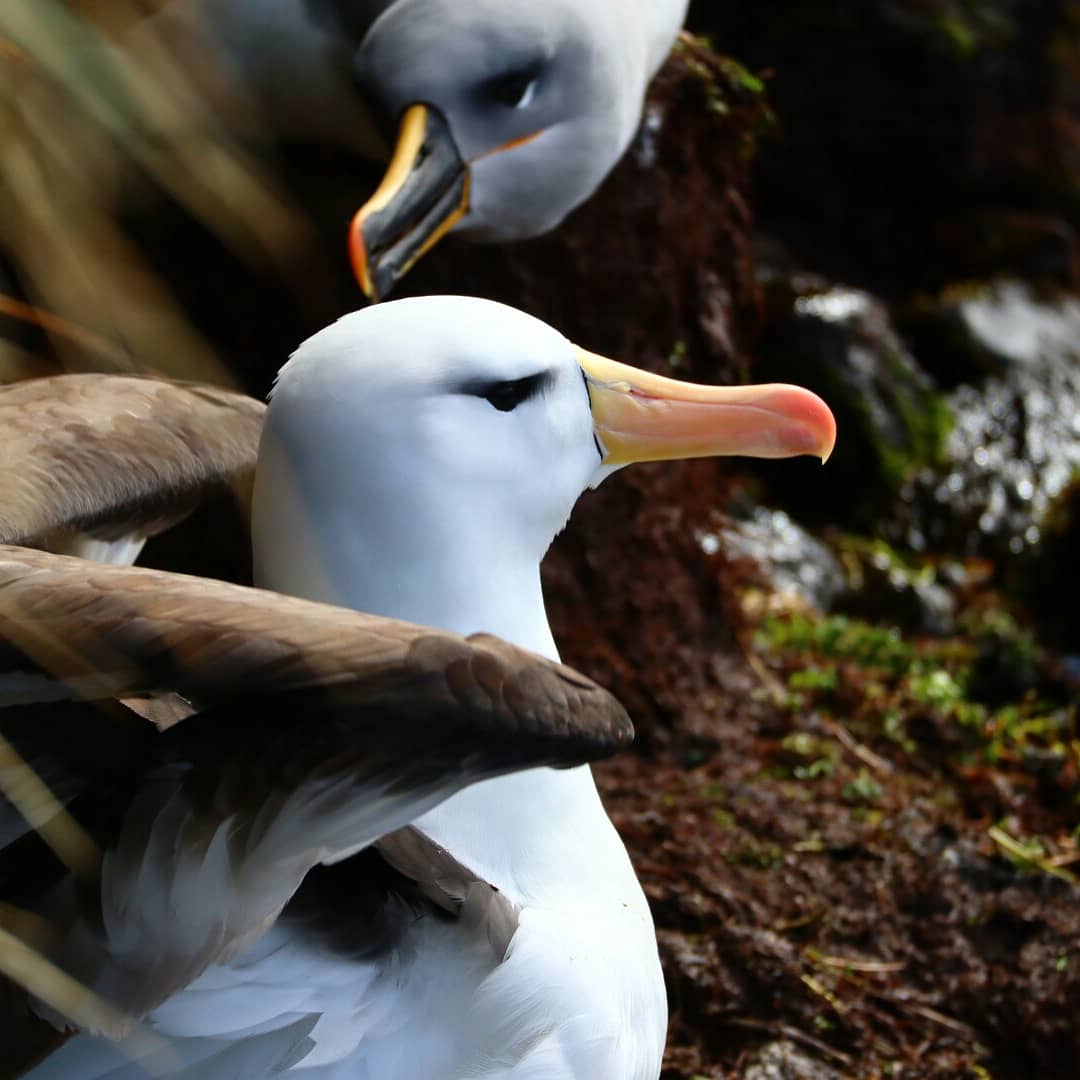
World Albatross Day was inaugurated by the Agreement on the Conservation of Albatrosses and Petrels (ACAP) in 2020 and is now celebrated annually on 19 June.
I have spent the past eight years in close contact with albatrosses, but have realised that many don’t really know of their existence and/or importance. World Albatross Day is a very important initiative to highlight the wonders of these special birds, as well as the threats they face on a daily basis.
Stefan Schoombie, a PhD in Biological Sciences at the University of Cape Town. His research focus is on the behaviour of seabird species.
How did you end up working on seabirds in the sub-Antarctic?
After finishing a BSc (Hons) at the University of KwaZulu-Natal in 2012, I had the opportunity to overwinter on Marion Island as part of the 70th overwintering expedition. During this expedition (2013-2014) I worked as a field assistant (for Fitzpatrick Institute of African Ornithology), monitoring seabird colonies, and gathering data for my Master’s degree.
I was fortunate enough to join several more expeditions to Marion Island between 2015 and 2019, this time gathering data towards my PhD degree, while performing other research activities with the ultimate goal of seabird conservation.
Read more about Stefan’s research and publications here!
How would you describe your first encounter with an albatross?
The first albatross I encountered was a Wandering Albatross, sitting on a nest on Marion Island. The sheer size of the bird was unbelievable, but the fact that they are so calm in our presence was incredible. Adult albatrosses breeding on sub-Antarctic Islands have no natural predators while on land, and thus they are not as scared of us as most land birds that we are used to. However, the most amazing thing about a Wandering Albatross is when they open their wings and reveal a three-meter wingspan.
Swartkops hut (on the Western side of Marion Island) and hundreds of Wandering Albatross nests.
The different Albatross species on Marion Island are each unique in their own way. How would you describe the uniqueness of each species?
WANDERING ALBATROSS
By far the most impressive of the albatrosses when you are up close. I tracked the fine-scale movements of these birds for my PhD degree, resulting in a lot of close encounters with them. We also monitored hundreds of breeding birds, as part of a long-term monitoring program. I was fortunate enough to spend enough time on Marion Island to see albatross chicks grow up from tiny chicks up to the point where they were large and strong enough to fly off into the vast Southern Ocean skies. Part of my research included the use of bird-borne cameras, where we were able to see what the birds experienced from their point of view, giving me a new-found respect for the incredible flying capabilities of these birds.
SOOTY (OR DARK-MANTLED SOOTY) ALBATROSS
These were the first albatross species I worked with, while gathering data for my MSc. Part of my research included setting up a long-term monitoring colony of Sooty Albatrosses. This included marking a large number of birds with unique numbered rings, for identification, which is particularly challenging seeing that these are cliff-nesting birds. One of the most memorable things about Sooty Albatrosses is their calls, which echo along the cliffs as they call to their partners. They also perform a synchronised flight as part of their courtship which is something to behold.
LIGHT-MANTLED (OR LIGHT-MANTLED SOOTY) ALBATROSS
These birds are very similar to the Sooty Albatross and I conducted the same research as with the Sooty Albatrosses. Light-mantled Albatrosses are more common in the southern parts of the Southern Ocean, with Marion Island being their northernmost breeding ground. Thus, their population size is quite small on Marion and the birds are a bit more skittish than other species.
GREY-HEADED ALBATROSS
These are incredibly beautiful birds that are very photogenic, but their cliff-nesting behaviour makes them difficult to get close to. Apart from a small monitoring colony, we normally don’t come close to these birds and only perform annual counts with binoculars. However, in 2015 increases in attacks from invasive house mice resulted in us monitoring them much closer. Grey-headed Albatrosses breed in dense colonies which is like a very noisy, busy airport terminal, with birds landing and taking off all around you.
BLACK-BROWED ALBATROSS
Marion Island is not a breeding ground for Black-browed Albatrosses, but there is one vagrant individual that breeds with Grey-headed Albatrosses from time to time, resulting in hybrid offspring.
Seabirds of the sub-Antarctic are under threat due to unsustainable fishing practices, climate change, and invasive species. Currently, on Marion Island, the invasive house mice are threatening the albatross species living and breeding on this sub-Antarctic island. The Mouse-Free Marion Project (partnering with BirdLife South Africa and the South African Department of Forestry, Fisheries and the Environment) aims to remove the mice from Marion Island in 2024.
YOU CAN HELP SAVE MARION ISLAND’S SEABIRDS
View the ACAP Media Release for this Year’s Albatross Day
Anche Louw, Antarctic Legacy of South Africa, 19 June 2022.
Images: Stefan Schoombie.
by Ria Olivier | May 18, 2022 | Announcement, Discover, Gateway cities, International Days, Prince Edward Island, Prince Edward Islands, Research, SA Agulhas II, SANAE, SANAP, Science, Southern Ocean, Stations, sub-Antarctic
Free entrance to Iziko Museums of South Africa today, 18 May 2022.
Visit the Sentinels of the South Exhibition at Iziko Museum of South Africa, Cape Town.
This exhibition will give you insight into the history, discoveries, and current role of South Africa’s Antarctic and Southern Ocean exploration. Read more here.
Anche Louw, Antarctic Legacy of South Africa, 18 May 2022
by Ria Olivier | Apr 21, 2022 | Current Event, Marion Island, News, Overwintering Team, Prince Edward Islands, Research, SA Agulhas II, SANAP, Science, Southern Ocean, Stations, sub-Antarctic, Take-Over Operations
The S.A. Agulhas II departed from East Pier, V&A Waterfront on her annual Marion Island relief voyage, Sunday 17 April 2022. The expected time of arrival at the island is today, 21 April 2022.
The first leg of the voyage, Oceanographic Leg 1, from Cape Town to Marion Island, was dedicated to underway sampling (the vessel did not stop for sampling to take place).
Once at the island, take-over operations will commence immediately (weather permitting) – all land-based scientists, National Department of Public Works (NDPW) personnel, and take-over personnel (DFFE) will disembark. Cargo will be slung with helicopters to the island and fuel will be pumped to the island. Hereafter, the vessel will depart from Marion Island on the 2nd Oceanographic leg (annual Research and Monitoring programme around the Prince Edward Islands). The 3rd Oceanographic leg will commence after take-over, on the way back to Cape Town.
What is planned for the 2022 take-over on Marion Island (land-based)
- base and hut maintenance (NDPW)
- base and hut restock
- take-over function
- 79th Marion Island overwintering team (meet the team in next article) to take over from 78th Marion Island overwintering team (M78 – click here).
- take-over projects – scientific fieldwork (see table below)
University of Fort Hare, Department of Geography
Landscape and climate Interactions In a changing sub-Antarctic Environment🔗 |
| Group Leader | Prof Werner Nel |
DFFE: Oceans and Coasts
Southern Ocean and Island Research Programme
|
| Group Leader | Dr Azwianewi Makhado |
BirdLife South Africa & University of Pretoria
Department of Plant and Soil Sciences🔗
Longitudinal monitoring of terrestrial diversity to assess the effects of mouse eradiction on Marion Island, and bait and mouse trials to inform further planning for the project |
| Group Leader | Mr Luis Alberto Rodriguez-Pertierra |
BirdLife South Africa, DFFE
Mouse-Free Marion (Project to Eradicate House Mica from Marlon Island)🔗 |
| Group Leader | Dr Anton Wolfaardt |
South African National Space Agency (SANSA)
Polar Space Weather Studies🔗 |
| Group Leader | Mr Matthew Spoor |
South African Weather Service (SAWS)
Atmosphere and Ocean Surface Research🔗 |
| Group Leader | Mr Vuyo Xelithole |
University of KwaZulu-Natal, School of Mathematics, Statistics and Computer Science
Observing Dawn In the Cosmos🔗 |
| Group Leader | Mr Ronny Joseph |
University of Pretoria, Mammal Research Unit, Department of Zoology & Entomology
Marion Island Marine Mammal Programme (MIMMP)🔗
Marion Island Marine Mammals in Changing Environments: lndividual Heterogeneity and Population Processes |
| Group Leader | Prof Nico de Bruyn
|
Nelson Mandela University, Department of Zoology
Marine Apex Predator Research Unit (MAPRU)🔗
Avian scavengers as indicators of recovery of an island biota |
| Group Leader | Dr Maëlle Connan |
What is planned for the take-over onboard the S.A. Agulhas II (ship-based)
DFFE: Ocean & Coasts Research
DFFE Ship-based Southern Ocean and Islands Research Programme |
| Ocean Physics: Group Leader | Mr Gavin Tutt |
| Ocean Chemistry: Group Leader | Dr Thato Mtshali |
| Ocean Biological: Group Leader | Mr Henry Kakora |
DFFE:Ocean & Coasts, University of Cape Town, Bayworld Centre for Research & Education
SAMOC-SA |
| Group Leader | Mr. Grant van der Heever |
University of Pretoria
Enhanced insights regarding the ecology, evolution, and function of marine microbiomes |
| Group Leader | Mr Choaro Dithugoe |
Land-based DFFE and other take-over personnel
Department of Forestry Fisheries and the Environment (DFFE)
Directorate: Southern Oceans & Antarctic Support
Management, logistics and support for this voyage |
| Departmental Co-ordinator (DCO) | Mr Errol Julies |
| Assistant DCO | Mr Mfundo Tima |
| Admin Officer | Ms Pozisa Matshoba |
| General/Waste Technician | Mr Sabata Setona |
| General/Waste Technician | Mr Mazizi Salmani |
DFFE
Directorate: Oceans, Coasts & Biosecurity Compliance |
| Environmental Control Officer | Mr Thomas Mufanadzo |
DFFE
Directorate: Earth Systems Strategies
Prince Edward Islands Management Authority (Oversight Management Functions) |
| Group Leader | Ms Ntombovuyo Madlokazi |
| Chief Scientists |
| Land-based | Prof Werner Nel |
| Ship-based | Mr Marcel van den Berg |
National Department of Public Works (NDPW)
Maintenance Support |
| Group Leader | Mr Takalani Mudau |
Featured Image: S.A. Agulhas II at Marion Island, May 2014 (Credit: Anche Louw).
Anche Louw, Antarctic Legacy of South Africa, 21 April 2022